
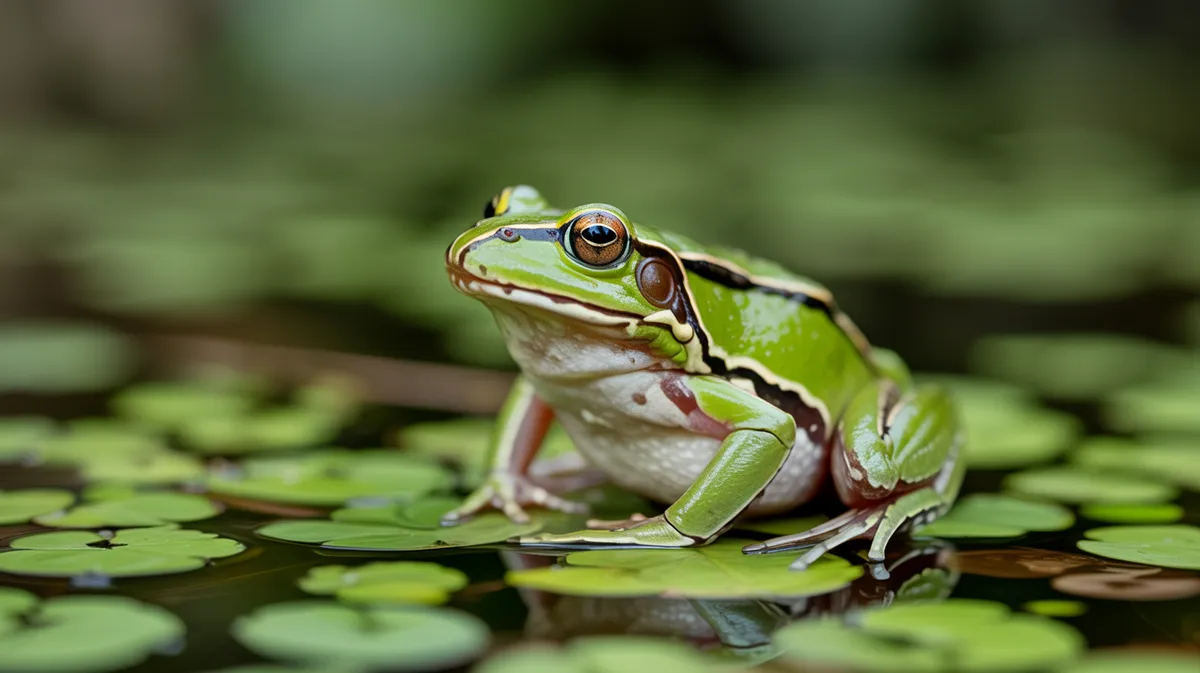
About the Barking Tree Frog
The Barking Tree Frog is the largest native tree frog in the southeastern United States, known for its distinctive, loud, dog-like barking call. This robust amphibian exhibits a plump, green or brown body covered with dark spots and granular skin, often changing color based on temperature and environment. It is most active at night, spending time high in trees or shrubs but descending to breed in fishless ponds and wetlands. Its powerful limbs and enlarged toe pads allow it to climb with ease, making it well-adapted for its arboreal lifestyle.
Fascinating facts
Loud Calls
The Barking Tree Frog’s call resembles a dog’s bark and is one of the loudest among North American frogs.
Arboreal Adaptations
With its enlarged toe pads, this frog excels at climbing, spending much of its life in trees and shrubs.
Color Changers
It can quickly change its skin color to blend with surroundings, aiding in camouflage and temperature regulation.
Detailed description
The Barking Tree Frog (Hyla gratiosa) is a robust, medium-to-large hylid, reaching adult snout-vent lengths of 5.0–7.0 cm (2.0–2.8 in), making it the largest native tree frog in the southeastern United States. Its body is notably plump with granular, warty skin, and it displays a variable coloration—ranging from bright green to brown or gray—often with irregular dark spots or blotches across the dorsum. This species is capable of rapid color change in response to temperature, humidity, and background, a trait mediated by specialized chromatophores in the skin. The head is broad with a rounded snout and large, prominent golden eyes. Its limbs are strong and muscular, with enlarged, adhesive toe pads that facilitate expert climbing in arboreal habitats. The ventral surface is pale and granular. Barking Tree Frogs are primarily nocturnal and spend much of their time high in vegetation, descending only to breed or during periods of high humidity. Their distinctive call, a loud, resonant 'bark,' is produced by males during the breeding season and can be heard over considerable distances. Unlike many tree frogs, Hyla gratiosa is relatively solitary outside of the breeding season, with individuals occupying overlapping but loosely defined territories.
Did you know?
Despite their name, Barking Tree Frogs often spend more time burrowed underground than in trees, especially during dry periods.
Research & sources
Behaviour & social structure
Barking Tree Frogs are largely solitary and exhibit territorial behavior, especially during the breeding season when males call from floating vegetation or emergent plants in shallow, fishless ponds. Their calls serve both to attract females and to establish calling territories among rival males. Outside the breeding season, they are arboreal, spending daylight hours concealed in tree hollows, under bark, or within dense foliage to avoid desiccation and predation. At night, they become active, foraging for a variety of invertebrates such as insects, spiders, and other small arthropods. They employ a sit-and-wait hunting strategy, relying on their cryptic coloration and stillness to ambush prey. Barking Tree Frogs are sensitive to environmental humidity and are most active during or after rains. They are known to bask in the sun during cooler periods, a behavior rare among tree frogs, to regulate body temperature.
Reproduction & life cycle
Breeding occurs from late spring through summer (typically April to August), triggered by warm temperatures and heavy rainfall. Males congregate at ephemeral, fishless wetlands and produce their characteristic barking calls to attract females. Amplexus is axillary, with the male grasping the female behind her forelimbs. Females lay clutches of 1,500–4,000 eggs, deposited in small, floating clusters or loose sheets attached to submerged vegetation. Eggs hatch within 1–2 days, depending on water temperature. The larval (tadpole) stage lasts 45–60 days, with metamorphosis occurring in late summer. Tadpoles are large, reaching up to 5 cm (2 in) in length, and are characterized by a dark body with a pale belly and a distinctive tail fin. There is no parental care post-oviposition, and survival is highly dependent on the absence of aquatic predators and the persistence of breeding ponds.
Adaptations & survival
Hyla gratiosa exhibits several adaptations for arboreal and aquatic life. Enlarged toe pads with specialized epithelial cells provide strong adhesion to smooth and rough surfaces, facilitating climbing and movement through vegetation. Their granular skin helps reduce water loss and offers camouflage against bark and leaves. The ability to rapidly change color aids in thermoregulation and predator avoidance. During drought or extreme heat, they can burrow into moist substrate or retreat into tree hollows to conserve moisture. Their loud, low-frequency calls are adapted to travel long distances across open wetlands, increasing breeding success. Tadpoles possess keratinized mouthparts for scraping algae and detritus, and their rapid development is an adaptation to the ephemeral nature of breeding ponds.
Cultural significance
The Barking Tree Frog is a well-known species in the southeastern United States, often recognized by its distinctive call, which is sometimes mistaken for a barking dog. It is the state amphibian of North Carolina, reflecting its ecological importance and public appreciation. The species features in regional folklore and is occasionally referenced in educational programs to highlight wetland conservation. There are no known traditional medicinal or utilitarian uses, but its presence is considered an indicator of healthy wetland ecosystems.
Recent research
Recent research has focused on the genetic diversity and population structure of Hyla gratiosa, revealing significant genetic differentiation among populations, likely due to habitat fragmentation. Studies on their vocalization patterns have provided insights into sexual selection and species recognition within the Hyla genus. Ongoing research is examining the effects of environmental contaminants, particularly endocrine-disrupting chemicals, on larval development and metamorphosis. Climate change models are being used to predict future shifts in distribution and breeding phenology. The species is also being studied as a bioindicator for wetland health due to its sensitivity to changes in hydrology and water quality.
Videos
Habitat
Forested wetlands, pine woodlands, and cypress swamps


Conservation
The Barking Tree Frog is currently classified as Least Concern on the IUCN Red List.
Threats & challenges
Although currently listed as Least Concern, Barking Tree Frogs face several localized threats. Habitat loss and fragmentation due to urbanization, agriculture, and silviculture reduce the availability of suitable breeding sites and upland refugia. Drainage of wetlands and the introduction of predatory fish to breeding ponds significantly impact larval survival. Pesticide runoff and pollution can disrupt development and reduce reproductive success. Climate change poses additional risks by altering precipitation patterns and hydroperiods of breeding sites. Despite these challenges, populations remain stable in large, contiguous tracts of suitable habitat, but declines have been noted at the periphery of their range.
Taxonomy
Scientific name
Hyla gratiosa
- Kingdom
- Animalia
- Phylum
- Chordata
- Class
- Amphibia
- Order
- Anura
- Family
- Hylidae
- Genus
- Hyla
- Species
- gratiosa
Where to see a barking tree frog
1 zoo and aquarium in 1 country are recorded as keeping this species.

Community notes
Share your observations about the Barking Tree Frog.
No community notes yet. Be the first!
Discover more wildlife
More fascinating animals from the encyclopedia.