
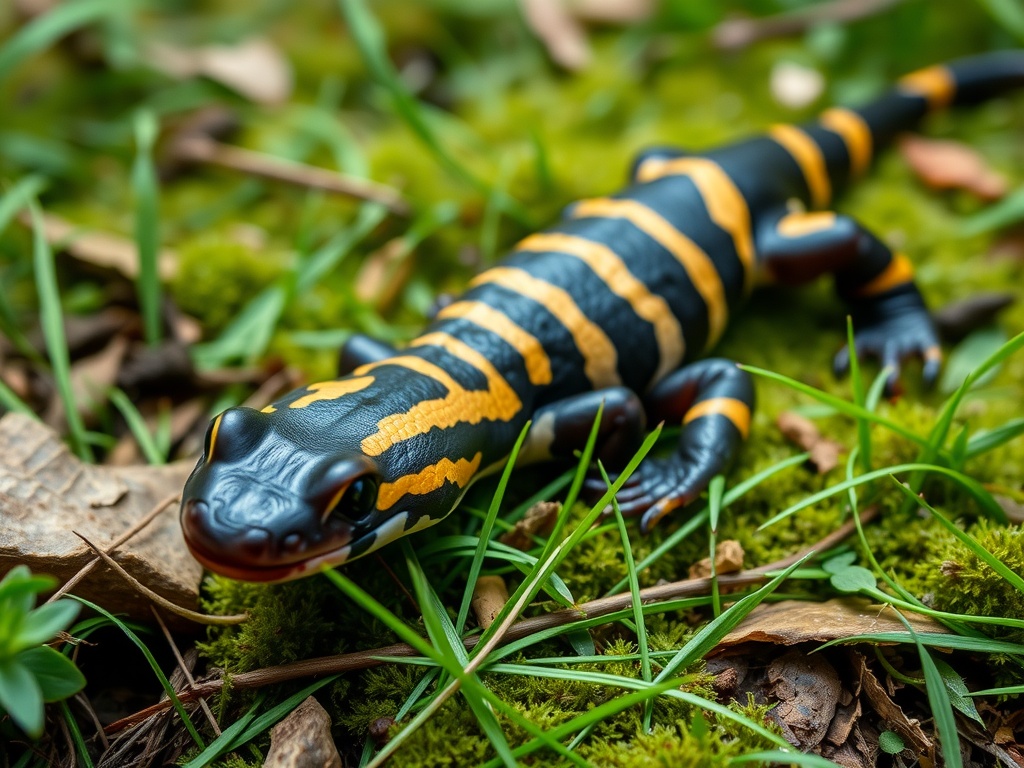
About the Barred Tiger Salamander
The tiger salamander is the largest land salamander in North America, and its most remarkable trick is that it does not always bother becoming one. Given a permanent, stable pond and a poor terrestrial environment, the larvae may simply never metamorphose: they keep their feathery external gills and their aquatic bodies, grow to full size, and breed as though they were adults. This is neoteny, the same arrested development that makes an axolotl what it is — except that the tiger salamander can go either way depending on where it finds itself, which makes it a natural experiment in how flexible a life cycle can be. It has a second, stranger option. When larvae are crowded and food is scarce, some develop into a distinct cannibal morph, with a broader head and enlarged teeth, and eat the other larvae in the pond — and they appear to avoid eating close relatives, preferring unrelated pond-mates. Adults spend most of the year underground in burrows, emerging in numbers on rainy nights to migrate to the breeding ponds.
Fascinating facts
Rain-Triggered Activity
The Barred Tiger Salamander is primarily nocturnal and emerges from its burrow mostly after heavy rains or during breeding season.
Impressive Size
This species can reach lengths of up to 33 centimeters (13 inches), making it one of the largest terrestrial salamanders in North America.
Burrowing Expert
Barred Tiger Salamanders dig their own burrows or use those created by other animals to avoid dry conditions and predators.
Detailed description
The Barred Tiger Salamander (Ambystoma mavortium) is a robust, large-bodied amphibian, with adults typically measuring between 15 and 25 cm in total length, though neotenic individuals can reach up to 35 cm. Its broad, flattened head is equipped with small, lidless eyes adapted for nocturnal activity. The skin is smooth and moist, aiding in cutaneous respiration, and is marked by distinctive yellow, olive, or cream-colored bars and spots on a dark brown or black background, a pattern that provides camouflage among leaf litter and soil. Limbs are well-developed, with four toes on the forelimbs and five on the hindlimbs, facilitating efficient burrowing. The tail is laterally compressed, especially in aquatic neotenes, aiding in swimming. Barred Tiger Salamanders are primarily fossorial, spending much of their lives in self-dug or rodent burrows, emerging mainly at night or during wet weather. Their lungs are functional, but they also rely on moist skin for gas exchange. This species exhibits both metamorphic and neotenic life histories, with some populations retaining larval features and remaining aquatic throughout life. Their diet is broad, consisting of invertebrates and small vertebrates, and their secretive nature makes them a keystone predator in many ecosystems.
Did you know?
Barred Tiger Salamanders can produce a sticky, toxic secretion from their skin to deter predators.
Research & sources
Wikipedia summary
The barred tiger salamander or western tiger salamander is a species of mole salamander that lives in lower western Canada, the western United States and northern Mexico.
Behaviour & social structure
Barred Tiger Salamanders are solitary and primarily nocturnal, emerging from their burrows at dusk or after rainfall to forage. They are opportunistic ambush predators, feeding on earthworms, insects, spiders, slugs, and occasionally small vertebrates such as frogs or other salamanders. Hunting is typically conducted by slowly stalking prey and using a rapid strike with a sticky tongue. During dry or hot periods, they remain underground in moist burrows to avoid desiccation. Social interactions are minimal outside of the breeding season, though multiple individuals may share large burrows or congregate at breeding ponds. They exhibit site fidelity, often returning to the same breeding pools annually. Territoriality is not pronounced, but aggressive encounters may occur if resources are limited.
Reproduction & life cycle
Breeding occurs in late winter to early spring, triggered by rainfall and rising temperatures. Adults migrate en masse to temporary or permanent ponds, sometimes traveling over a kilometer from their burrows. Courtship involves a series of tactile and chemical cues, with males depositing spermatophores on the substrate, which females then pick up with their cloaca. Females lay between 100 and 1,000 eggs, attaching them singly or in small clusters to submerged vegetation or debris. Embryonic development lasts 2–4 weeks, depending on water temperature. Larvae are fully aquatic, possessing external gills and a finned tail, and undergo metamorphosis into terrestrial juveniles after 2–5 months, though some populations exhibit neoteny, remaining aquatic and reproductively mature. There is no parental care post-oviposition.
Adaptations & survival
Ambystoma mavortium exhibits several adaptations for survival in variable environments. Its fossorial lifestyle reduces predation risk and water loss, while its permeable skin allows for cutaneous respiration in hypoxic underground conditions. The ability to exploit both aquatic and terrestrial habitats, and to exhibit neoteny in permanent water bodies, provides flexibility in response to environmental unpredictability. Their cryptic coloration aids in camouflage, and they can secrete noxious, mildly toxic substances from skin glands as a defense against predators. Rapid larval development enables them to exploit ephemeral breeding pools before they dry. Additionally, their broad diet allows them to thrive in diverse habitats.
Cultural significance
Barred Tiger Salamanders have appeared in Native American folklore, often symbolizing rain or fertility due to their emergence during wet weather. In some regions, they have been used as bait in fishing, though this practice is now discouraged due to conservation concerns. They are occasionally kept as pets and used in educational settings to demonstrate amphibian life cycles and metamorphosis. Their striking appearance and ecological role have made them a subject of interest in environmental education and outreach.
Recent research
Recent research has focused on the genetic differentiation between Ambystoma mavortium and related tiger salamander species, with molecular studies revealing complex hybrid zones and cryptic diversity. Studies on neoteny have provided insights into the hormonal and environmental controls of amphibian metamorphosis. Ongoing monitoring of disease prevalence, particularly chytrid fungus and ranavirus, is critical for understanding population health. Ecological research has highlighted their role in controlling invertebrate populations and their sensitivity to environmental contaminants, making them valuable bioindicators. Conservation genetics and landscape ecology studies are informing habitat connectivity and management strategies.
Videos
Habitat
Grasslands, woodlands, and areas near freshwater bodies
 Various Continental Regions
Grassland
Open areas dominated by grasses rather than trees, supporting numerous herbivores and their predators.
 Global
Forest
Wooded areas with significant tree cover and diverse plant and animal communities.
 Global
Freshwater
Lakes, rivers, and wetlands with diverse aquatic ecosystems.
Conservation
The Barred Tiger Salamander is currently classified as Least Concern on the IUCN Red List.
Threats & challenges
While currently listed as Least Concern by the IUCN, Barred Tiger Salamanders face localized threats including habitat loss from agriculture and urbanization, road mortality during breeding migrations, introduction of predatory fish to breeding ponds, and diseases such as chytridiomycosis and ranavirus. Pesticide and fertilizer runoff can degrade breeding habitats and impact larval survival. Climate change poses a long-term risk by altering precipitation patterns and reducing the availability of suitable breeding sites. Population trends are stable overall, but some peripheral or isolated populations are declining.
Taxonomy
Scientific name
Ambystoma mavortium
- Kingdom
- Animalia
- Phylum
- Chordata
- Class
- Amphibia
- Order
- Urodela
- Family
- Ambystomatidae
- Genus
- Ambystoma
- Species
- mavortium
Community notes
Share your observations about the Barred Tiger Salamander.
No community notes yet. Be the first!
Discover more wildlife
More fascinating animals from the encyclopedia.