
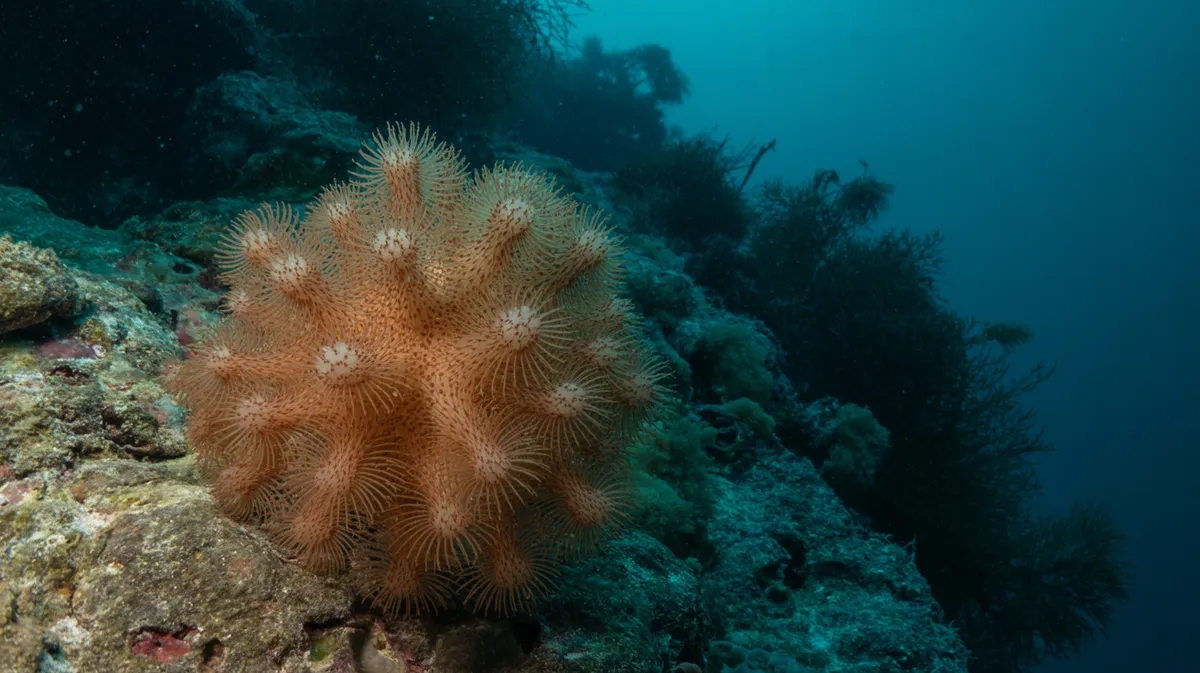
About the Basket Star
The basket star is a unique echinoderm known for its intricate, highly branched arms that resemble a tangled basket. Found primarily in cold and deep ocean waters, it uses its delicate arms to capture plankton and small organisms drifting in the current. Basket stars are nocturnal, often hiding in crevices during the day and extending their arms to feed at night. Their remarkable arm structure allows for both flexibility and efficiency in filter feeding, making them fascinating members of the deep-sea community.
Fascinating facts
Deep Sea Dweller
Basket stars are commonly found at depths reaching over 2,000 meters, where sunlight does not penetrate and temperatures are near freezing.
Master Filter Feeder
They extend their branched arms into the current to ensnare plankton, small crustaceans, and other drifting organisms with their tiny hooks.
Regenerative Powers
Like many echinoderms, basket stars can regenerate lost arms, aiding in survival after predatory attacks or accidental breakage.
Detailed description
Gorgonocephalus eucnemis, commonly known as the basket star, is a large echinoderm belonging to the order Euryalida within the class Ophiuroidea. Adult basket stars can reach a disc diameter of up to 14 cm, with total arm spans extending over 70 cm when fully outstretched. Their most distinctive feature is their five primary arms, each repeatedly branching into finer tendrils, forming a complex, basket-like structure that maximizes surface area for feeding. The arms are covered in tiny hooks and spines, aiding in the capture and retention of planktonic prey. The central disc contains the mouth and internal organs, as basket stars lack an anus, expelling waste through the mouth. They exhibit remarkable flexibility, curling their arms tightly during the day to avoid predation and desiccation, and unfurling them at night to feed. Basket stars are primarily nocturnal, emerging from crevices or under rocks after dusk. Their coloration ranges from pale white to brown or reddish hues, often matching their substrate for camouflage. As slow-moving, benthic organisms, they play a significant role in deep-sea ecosystems as both predators and prey.
Did you know?
A single basket star can have thousands of branchlets on its arms, creating a complex net for capturing food particles from the water.
Research & sources
Behaviour & social structure
Basket stars are solitary and largely sedentary, spending daylight hours tightly coiled and concealed in crevices or among sessile invertebrates to avoid visual predators. At night, they ascend to elevated perches, such as sponges, corals, or rocky outcrops, and extend their arms into the water column. Their feeding strategy is passive suspension feeding: the highly branched arms form a mesh that intercepts zooplankton, copepods, small crustaceans, and organic detritus carried by the current. When prey contacts the sticky mucus and spines on the arms, the tendrils rapidly coil around it, and cilia move the food toward the mouth. Basket stars exhibit minimal social interaction, though aggregations may occur in areas of high food availability. They are sensitive to water movement and will retract their arms if disturbed by strong currents or potential threats.
Reproduction & life cycle
Gorgonocephalus eucnemis reproduces via broadcast spawning, with both males and females releasing gametes into the water column, typically in late spring or early summer. Fertilization is external, and the resulting planktonic larvae, known as ophiopluteus, drift with the currents for several weeks before settling to the benthos and metamorphosing into juvenile basket stars. There is no parental care; survival of the larvae depends on environmental conditions and predation rates. Sexual maturity is reached after several years, with growth rates influenced by food availability and temperature. Some evidence suggests that reproductive output may be synchronized with lunar cycles or seasonal changes in plankton abundance.
Adaptations & survival
Basket stars possess several remarkable adaptations for deep-sea life. Their highly branched arms dramatically increase feeding surface area, allowing efficient capture of scarce plankton in nutrient-poor environments. The arms are extremely flexible, supported by ossicles and mutable collagenous tissue, enabling rapid coiling and uncoiling in response to stimuli. Their nocturnal behavior reduces predation risk from visually oriented predators. The ability to autotomize (shed) arms when attacked provides an effective escape mechanism, with subsequent regeneration over several months. Their coloration and tendency to hide during the day offer camouflage against the substrate. Additionally, their low metabolic rate is well-suited to the cold, oxygen-rich waters of their habitat.
Cultural significance
Basket stars have limited direct significance in human culture, largely due to their inaccessible habitats. However, their intricate morphology has inspired marine artists and is occasionally referenced in folklore as 'sea serpents' or 'sea spiders.' In some indigenous Arctic and sub-Arctic cultures, echinoderms are noted in traditional ecological knowledge, though basket stars themselves are rarely harvested or used. Their unique appearance makes them popular in public aquaria and educational displays, where they serve as ambassadors for deep-sea biodiversity.
Recent research
Recent research on Gorgonocephalus eucnemis has focused on their biomechanics, particularly the structure and function of their branched arms and mutable collagenous tissues. Studies using high-resolution imaging have revealed the microstructure of their ossicles and the neural control of arm movement. Molecular phylogenetics has clarified relationships within the Euryalida, highlighting the evolutionary origins of arm branching. Ongoing ecological studies are examining their role in benthic food webs and responses to changing ocean conditions, such as temperature and pH shifts. Basket stars are also being investigated as model organisms for regenerative biology due to their remarkable ability to regrow lost limbs.
Videos
Habitat
Cold, deep ocean environments, often on rocky substrates and coral reefs

Conservation
The Basket Star is currently classified as Least Concern on the IUCN Red List.
Threats & challenges
Currently, Gorgonocephalus eucnemis faces few direct threats due to its deep and cold-water habitat, which is relatively insulated from most human activities. However, deep-sea trawling, ocean acidification, and climate change pose potential risks by altering habitat structure, reducing prey availability, and affecting larval development. While populations are considered stable and the species is classified as Least Concern, ongoing monitoring is necessary as deep-sea environments become increasingly impacted by anthropogenic activities. Localized declines may occur in areas subject to heavy fishing or seabed mining.
Taxonomy
Scientific name
Gorgonocephalus eucnemis
- Kingdom
- Animalia
- Phylum
- Echinodermata
- Class
- Ophiuroidea
- Order
- Phrynophiurida
- Family
- Gorgonocephalidae
- Genus
- Gorgonocephalus
- Species
- eucnemis
Community notes
Share your observations about the Basket Star.
No community notes yet. Be the first!
Discover more wildlife
More fascinating animals from the encyclopedia.