
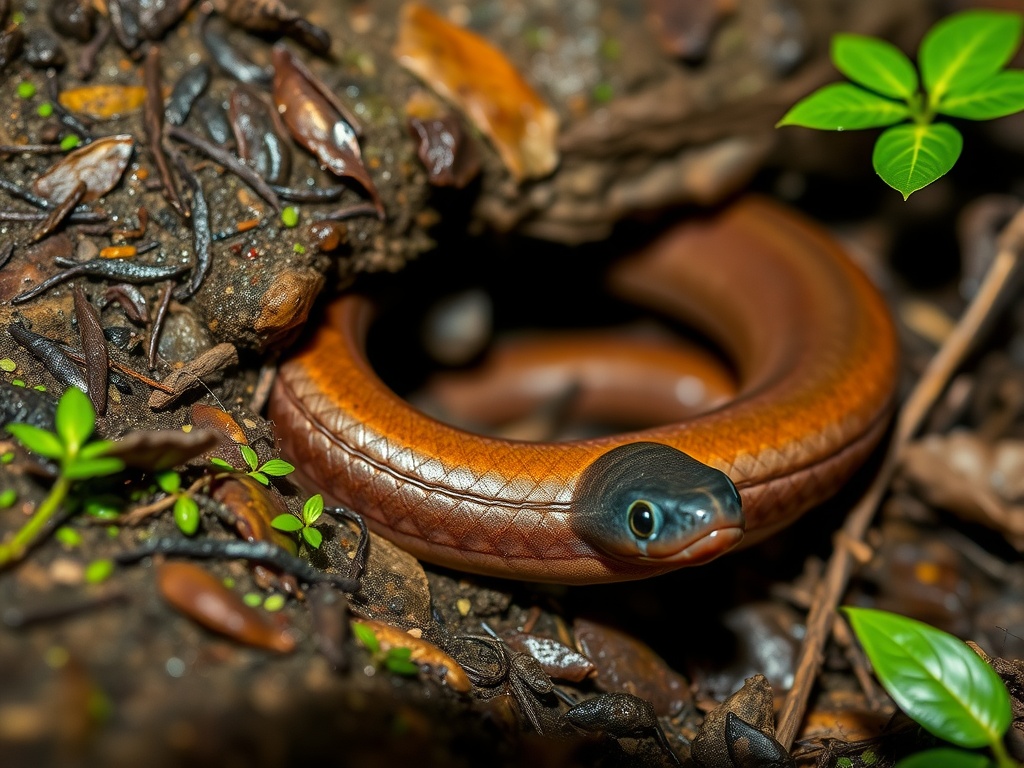
About the Beddome’s Caecilian
Beddome’s Caecilian is a limbless, burrowing amphibian native to the Western Ghats of southern India. Its elongated, worm-like body is adapted for a subterranean lifestyle, with smooth, segmented skin that is typically dark brown to bluish-black in color. This secretive animal spends most of its life hidden in moist soil, leaf litter, or under rotting logs, emerging mainly during the monsoon season. Beddome’s Caecilian is rarely seen due to its underground habits, and much of its biology remains poorly understood.
Fascinating facts
Worm-like Body
Beddome’s Caecilian resembles a large earthworm, with a segmented, limbless body perfectly adapted for burrowing underground.
Monsoon Emergence
This caecilian is most active and likely to be encountered during the monsoon season when the soil is moist.
Reduced Eyesight
Its eyes are tiny and covered by skin, resulting in almost complete blindness—an adaptation to its life beneath the ground.
Detailed description
Beddome’s Caecilian (Ichthyophis beddomei) is a medium-sized, limbless amphibian, typically reaching lengths of 200–400 mm, with a cylindrical, elongated body and a bluntly rounded head. Its skin is smooth and glossy, marked by numerous annular grooves (primary annuli) that give it a segmented appearance, aiding in flexibility and burrowing. The coloration is generally dark brown to bluish-black dorsally, with a lighter ventral surface, and a distinctive yellow lateral stripe running from the head to the tail, which is a key identification feature. The eyes are small, covered by skin, and poorly developed, reflecting its subterranean lifestyle, but they retain some light sensitivity. Nostrils are positioned at the tip of the snout, and a pair of sensory tentacles, unique to caecilians, are located between the eyes and nostrils, used for chemical detection in the soil. The species possesses a strong, ossified skull adapted for head-first burrowing through compact soils and leaf litter. Beddome’s Caecilian is primarily fossorial, spending most of its life underground, but emerges during the monsoon when soils are saturated. It is an opportunistic carnivore, feeding on soil invertebrates such as earthworms, termites, and insect larvae. Social structure is poorly understood, but individuals are generally solitary outside of the breeding season. Reproduction is oviparous, with females laying eggs in moist underground chambers. The species is endemic to the Western Ghats, a biodiversity hotspot, and is rarely encountered due to its cryptic habits, making population assessments challenging.
Did you know?
Unlike most amphibians, Beddome’s Caecilian gives birth to live young that are already fully formed, skipping the typical tadpole stage.
Research & sources
Behaviour & social structure
Beddome’s Caecilian is predominantly nocturnal and fossorial, spending the majority of its time burrowed in moist soil or under decaying organic matter. It exhibits solitary behavior, with little evidence of social interaction except during the breeding season. Its hunting strategy involves active foraging through the substrate, using its sensitive tentacles to detect chemical cues from prey. Feeding is primarily on soft-bodied invertebrates, which are captured by rapid jaw action. The species is highly secretive, emerging above ground mainly during heavy rains or monsoon floods, which facilitate movement and dispersal. Locomotion is achieved through concertina-like movements of the body, aided by the annular grooves. Defensive behaviors include rapid burrowing to escape predators and the secretion of mucous from skin glands, which may deter some predators.
Reproduction & life cycle
Ichthyophis beddomei is oviparous, with breeding typically synchronized to the monsoon season (June–September), when environmental moisture is optimal for egg development. Males and females locate each other via pheromonal cues. Fertilization is internal, with the male using a protrusible cloacal organ to transfer sperm. Females lay clutches of 20–50 elongate, jelly-coated eggs in moist, concealed underground nests. Parental care is notable: the female coils around the eggs, guarding them against desiccation and predation until hatching, which occurs after 1–3 months depending on environmental conditions. Upon hatching, larvae are aquatic, possessing external gills and a lateral line system, and they develop in temporary streams or seepages. Metamorphosis into terrestrial juveniles occurs after several months, at which point they adopt a fossorial lifestyle.
Adaptations & survival
Beddome’s Caecilian exhibits several adaptations for a subterranean existence. Its robust, compact skull and pointed snout facilitate efficient head-first burrowing. The annulated body allows for flexibility and movement through confined spaces. Reduced eyes, covered by skin, minimize injury and are compensated by highly developed chemosensory tentacles for detecting prey and environmental cues. The skin is permeable and secretes mucous, aiding in cutaneous respiration and maintaining moisture, essential for amphibian survival underground. The species can tolerate low-oxygen environments typical of moist soils. Its reproductive strategy, including parental care and terrestrial egg-laying, reduces dependency on open water bodies and increases offspring survival in a variable environment.
Cultural significance
Caecilians, including Beddome’s Caecilian, are largely unknown to local communities due to their cryptic habits. In some rural areas of the Western Ghats, caecilians are mistakenly believed to be venomous or harmful, leading to occasional persecution. However, there is no evidence of traditional medicinal or culinary use. Their role in local folklore is minimal compared to other amphibians. Increasing awareness of their ecological importance as soil aerators and pest controllers is gradually emerging among conservationists and educators.
Recent research
Recent molecular studies have clarified the taxonomy of Ichthyophis beddomei, distinguishing it from closely related species in the Western Ghats complex. Ongoing research is focused on its reproductive biology, larval development, and genetic diversity. Environmental DNA (eDNA) techniques are being explored to improve detection and monitoring of populations without disturbing their habitat. A 2021 study highlighted the importance of microhabitat selection for egg-laying and larval survival, emphasizing the species’ sensitivity to soil moisture and temperature. There is a growing interest in the role of caecilians in ecosystem functioning, particularly in soil health and invertebrate population regulation.
Sources
Systematics and Distribution of Ichthyophis beddomei (Amphibia: Gymnophiona: Ichthyophiidae) in the Western Ghats, India
Gower, D.J., Wilkinson, M., et al. (2004)
scientificIchthyophis beddomei: The IUCN Red List of Threatened Species 2016
IUCN SSC Amphibian Specialist Group
conservationSystematics and Distribution of Caecilians (Amphibia: Gymnophiona) of the Western Ghats, India
Bhatta, G. (1998)
scientificVideos
Habitat
Tropical moist forest floors and underground in the Western Ghats
 Elevated Terrain
Mountain
High-altitude environments with varying climates and specialized wildlife adapted to rugged terrain and thin air.
 Tropical Regions
Rainforest
Dense, wet forests with the highest biodiversity on Earth, containing more than half of the world's plant and animal species.
 Global
Forest
Wooded areas with significant tree cover and diverse plant and animal communities.
 Global
Freshwater
Lakes, rivers, and wetlands with diverse aquatic ecosystems.
Conservation
The Beddome’s Caecilian is currently classified as Data Deficient on the IUCN Red List.
Threats & challenges
The primary threats to Beddome’s Caecilian include habitat loss and degradation due to deforestation, agricultural expansion, and urbanization in the Western Ghats. Soil pollution from pesticides and fertilizers may also impact populations, as caecilians are sensitive to chemical contaminants. Climate change, altering rainfall patterns and soil moisture, poses additional risks to breeding and survival. The species is rarely encountered, leading to a Data Deficient status by the IUCN, and there is a lack of comprehensive population data. Road construction and infrastructure development may fragment habitats, further isolating populations. The secretive nature of the species complicates conservation efforts and ecological studies.
Taxonomy
Scientific name
Ichthyophis beddomei
- Kingdom
- Animalia
- Phylum
- Chordata
- Class
- Amphibia
- Order
- Gymnophiona
- Family
- Ichthyophiidae
- Genus
- Ichthyophis
- Species
- beddomei
Community notes
Share your observations about the Beddome’s Caecilian.
No community notes yet. Be the first!
Discover more wildlife
More fascinating animals from the encyclopedia.