
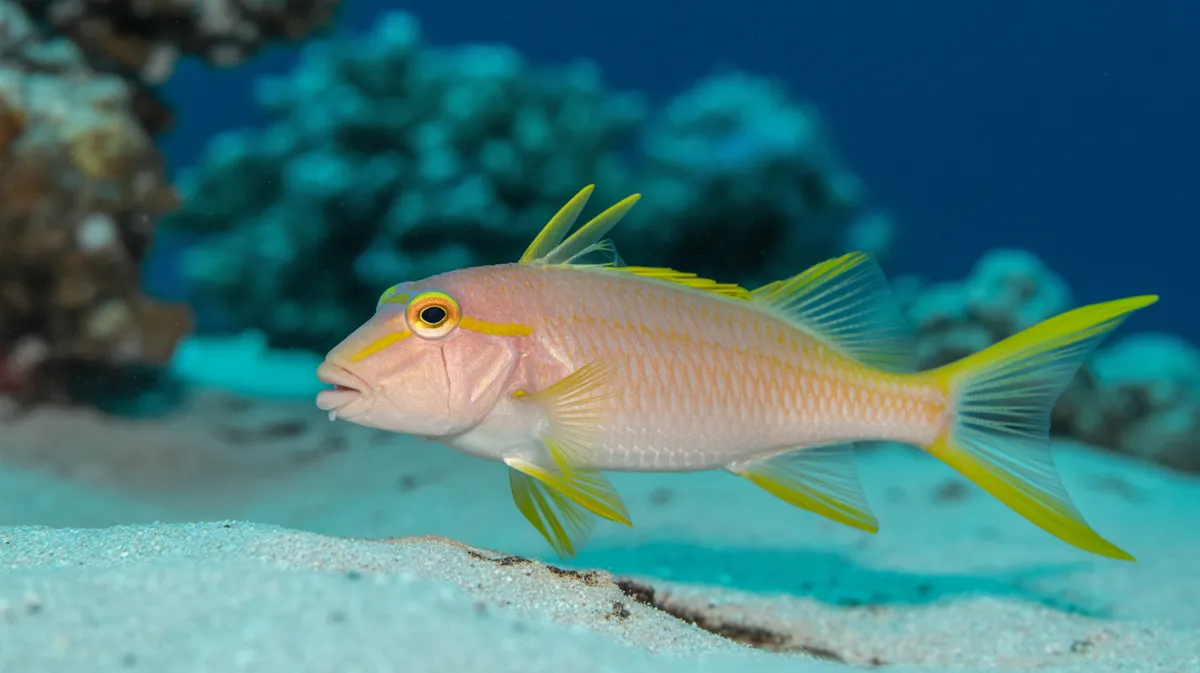
About the Bicolor goatfish
The bicolor goatfish is a vibrant reef fish known for its distinctive coloration and whisker-like barbels. Its body typically displays a striking contrast between a white or pale front half and a yellowish to dark rear portion, often with a dark stripe dividing the two. This species uses its sensitive barbels to search for prey hidden in sandy or muddy substrates. Commonly found in shallow lagoons and coral reefs, the bicolor goatfish is an important part of reef ecosystems as both a predator and prey.
Fascinating facts
Color-Changing Abilities
The bicolor goatfish can rapidly alter its coloration, allowing it to blend with sandy bottoms or coral backgrounds to avoid predators.
Sensory Barbels
Its chin barbels are equipped with chemoreceptors, helping the goatfish detect prey like worms and crustaceans buried in the substrate.
Social Forager
Bicolor goatfish often feed in small groups, using teamwork to disturb sand and flush out hidden prey.
Detailed description
The bicolor goatfish (Parupeneus barberinoides) is a medium-sized member of the family Mullidae, reaching a maximum total length of about 30 cm, though most individuals encountered are closer to 20 cm. Its body is elongated and slightly compressed, with a distinctive bicolored pattern: the anterior half is typically white to pale yellow, sharply contrasting with a darker posterior that can range from yellowish to brown or even black, often divided by a prominent dark lateral stripe. The head is blunt with a slightly convex profile, and the mouth is subterminal, equipped with two long, fleshy barbels beneath the chin. These sensory barbels are highly mobile and packed with chemoreceptors, allowing the fish to detect prey hidden in the substrate. The dorsal fin is divided into two parts, with the first dorsal fin having 8 spines and the second with 9 soft rays; the anal fin has 1 spine and 7 soft rays. The caudal fin is forked, aiding in quick bursts of speed. The scales are ctenoid, providing both protection and hydrodynamic efficiency. Parupeneus barberinoides is diurnal, spending daylight hours actively foraging over sandy patches and seagrass beds adjacent to coral reefs. At night, it often rests on the substrate, sometimes partially buried. The species is known for its social flexibility, forming small, loose aggregations or foraging singly depending on food availability and predation risk. Its coloration can change subtly depending on mood, social interactions, or environmental conditions, a trait common among goatfishes.
Did you know?
Despite their bright coloring, bicolor goatfish can become nearly invisible to predators by adjusting their coloration to match the reef background.
Research & sources
Wikipedia summary
Parupeneus barberinoides, the bicolor goatfish, is a species of goatfish native to the western Pacific Ocean. An inhabitant of coral reefs, it can be found at depths of from 1 to 40 metres. This species can reach a length of 30 centimetres (12 in) TL though most are only around 20 centimetres (7.9 in). This is a commercially important species and can also be found in the aquarium trade.
Behaviour & social structure
Bicolor goatfish are primarily benthic foragers, using their sensitive barbels to probe sand and rubble for hidden invertebrates such as polychaete worms, small crustaceans, and mollusks. They exhibit a methodical hunting behavior, often sifting through sediment with rapid head movements and occasionally blowing jets of water to expose prey. Socially, they are somewhat gregarious, often seen in small groups, especially when juveniles, which may provide safety in numbers. Adults may forage alone or in pairs, and sometimes join mixed-species feeding aggregations with other goatfishes or wrasses. They are generally non-territorial and exhibit little aggression except during brief competitive interactions over food. Bicolor goatfish are crepuscularly active, with peak feeding at dawn and dusk, and they rest on the substrate at night, sometimes changing color to blend with their surroundings for camouflage.
Reproduction & life cycle
Parupeneus barberinoides is oviparous, with external fertilization. Spawning typically occurs in pairs or small groups, often during the warmer months when planktonic food is abundant for larvae. Courtship involves males displaying brighter coloration and circling females, sometimes accompanied by rapid swimming and body quivering. Eggs are pelagic, spherical, and buoyant, drifting with currents until hatching. The incubation period is short, usually 24–48 hours depending on temperature. Larvae are planktonic and undergo several developmental stages before settling to the benthos as juveniles. There is no parental care post-spawning. Sexual maturity is reached at approximately 1–2 years of age, depending on environmental conditions.
Adaptations & survival
The most distinctive adaptation of the bicolor goatfish is its pair of highly sensitive chin barbels, which are used to detect prey through tactile and chemical cues in low-visibility environments. Their bicolored and variable coloration provides camouflage against the dappled light of sandy and reef habitats, reducing predation risk. The ability to rapidly change color also aids in communication and camouflage. Their streamlined body and forked tail enable quick escapes from predators. The species’ omnivorous, opportunistic feeding strategy and ability to exploit a variety of benthic prey make it resilient to changes in food availability. Social flexibility—ranging from solitary to group foraging—allows adaptation to varying predation pressures and resource distributions.
Cultural significance
Bicolor goatfish are of moderate commercial importance in local fisheries throughout their range, valued for their mild, white flesh. They are sometimes featured in traditional diets in Southeast Asia and the Pacific Islands. In the aquarium trade, their striking coloration and active foraging behavior make them popular, though they require large tanks and sandy substrates to thrive. There is limited direct cultural or mythological significance, but goatfishes in general are sometimes associated with abundance and good fortune in Pacific folklore due to their schooling behavior and role as a food source.
Recent research
Recent research on Parupeneus barberinoides has focused on its role in coral reef trophic dynamics, particularly its impact on benthic invertebrate populations and sediment turnover. Stable isotope studies have clarified its position as a mid-level predator, linking benthic and pelagic food webs. Genetic analyses have revealed moderate population structure across its range, suggesting some larval dispersal barriers. Ongoing studies are examining the effects of habitat degradation and climate change on its distribution and reproductive success. Behavioral ecologists have investigated the function of color change and social grouping, contributing to broader understanding of communication and anti-predator strategies in reef fishes.
Videos
Habitat
Coral reefs and lagoon sand flats

Conservation
The Bicolor goatfish is currently classified as Least Concern on the IUCN Red List.
Threats & challenges
Currently assessed as Least Concern by the IUCN, Parupeneus barberinoides faces localized threats from overfishing, particularly in areas where it is targeted for food or the aquarium trade. Habitat degradation, especially coral reef loss and sedimentation from coastal development, can reduce available foraging and breeding grounds. While population trends are generally stable, declines may occur in heavily fished or polluted regions. Bycatch in artisanal and commercial fisheries is a minor but persistent issue. Climate change poses a long-term threat through coral bleaching and altered prey distributions, though the species’ ecological flexibility may buffer some impacts.
Taxonomy
Scientific name
Parupeneus barberinus
- Kingdom
- Animalia
- Phylum
- Chordata
- Class
- Actinopterygii
- Order
- Perciformes
- Family
- Mullidae
- Genus
- Parupeneus
- Species
- barberinus
Community notes
Share your observations about the Bicolor goatfish.
No community notes yet. Be the first!
Discover more wildlife
More fascinating animals from the encyclopedia.