
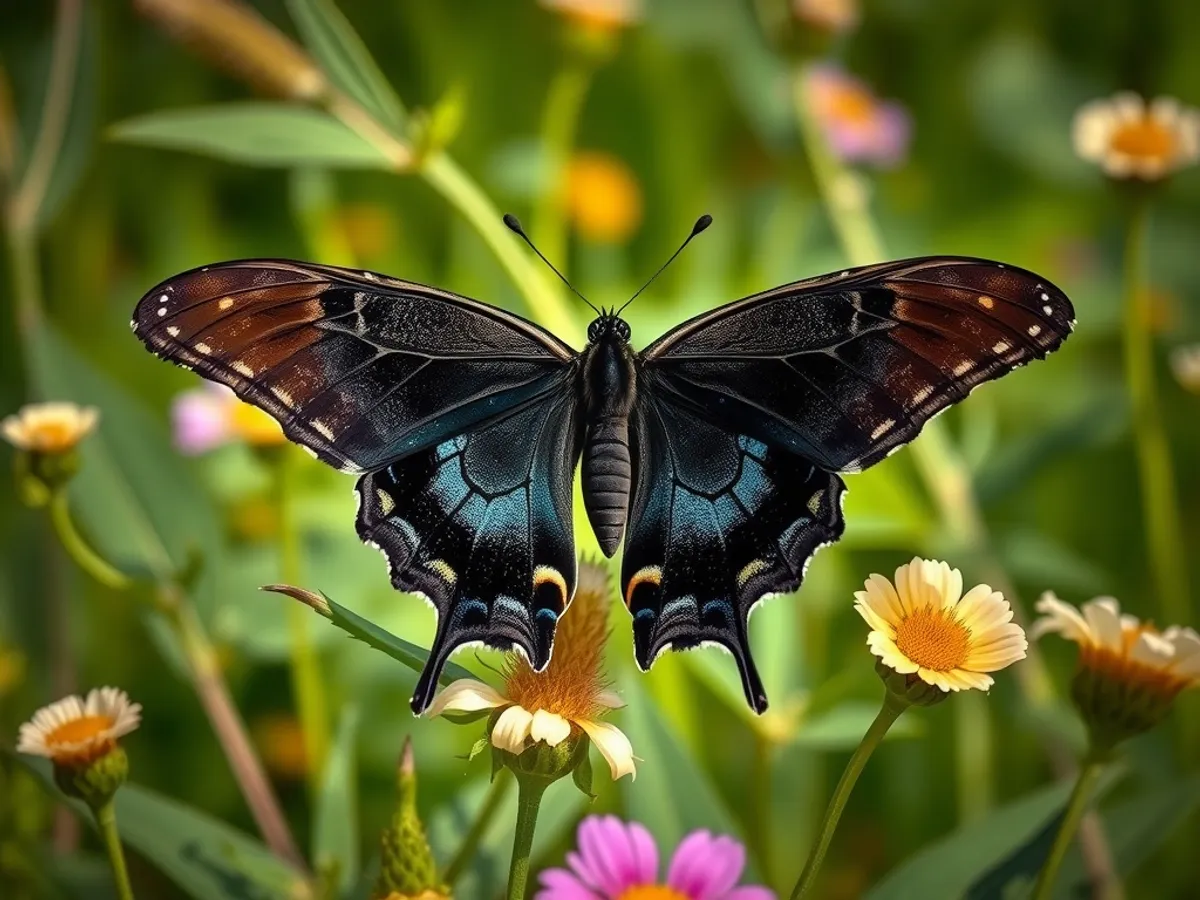
About the Black Swallowtail
The Black Swallowtail is a striking butterfly native to North America, recognized by its velvety black wings adorned with rows of yellow spots and, in females, a distinctive blue band on the hindwings. This species is known for its impressive mimicry and vibrant coloration, which help deter predators. Black Swallowtail caterpillars feed on a variety of plants in the carrot family, including parsley and dill, making them a common sight in gardens and meadows. Adults are strong fliers and are often seen fluttering around open fields, gardens, and roadsides from spring through fall.
Fascinating facts
Beautiful Mimic
The Black Swallowtail mimics the toxic Pipevine Swallowtail, gaining protection from predators through Batesian mimicry.
Herb Garden Visitor
Black Swallowtail caterpillars often feed on parsley, dill, fennel, and related plants, making them a frequent visitor to kitchen gardens.
Unique Defense
The caterpillar's osmeterium, a bright orange, forked gland, pops out and releases a pungent smell when the larva feels threatened.
Detailed description
The Black Swallowtail (Papilio polyxenes) is a medium-sized butterfly, with adults exhibiting a wingspan ranging from 7.9 to 11.5 cm (3.1–4.5 in). The dorsal wing surfaces are predominantly black, adorned with two rows of yellow spots on the forewings and hindwings; females display a more prominent iridescent blue band on the hindwings, a feature less pronounced in males. The ventral side is lighter, with orange and blue markings. The hindwings possess characteristic 'tails'—elongated projections that resemble those of a swallow, which serve as a decoy to predators. The body is robust and black with yellow lateral spots. Larvae, known as parsley worms, are initially dark with a white saddle but become green with black bands and yellow spots as they mature. Black Swallowtails are diurnal and exhibit strong, agile flight, often seen fluttering low over open areas. Their life cycle includes four distinct stages: egg, larva, pupa (chrysalis), and adult. The species is multivoltine, producing two to three generations per year in most regions. Adults are nectarivorous, visiting a wide range of flowers, while larvae feed on various Apiaceae (carrot family) plants. The species demonstrates sexual dimorphism and polymorphism, with females mimicking the toxic Pipevine Swallowtail (Battus philenor) as a form of Batesian mimicry.
Did you know?
When threatened, Black Swallowtail caterpillars can extend orange, forked glands called osmeteria that emit a foul odor to deter attackers.
Research & sources
Wikipedia summary
Papilio polyxenes, the (eastern) black swallowtail, American swallowtail or parsnip swallowtail, is a butterfly found throughout much of North America. An extremely similar-appearing species, Papilio joanae, occurs in the Ozark Mountains region, but it appears to be closely related to Papilio machaon, rather than P. polyxenes. The species is named after the figure in Greek mythology, Polyxena, who was the youngest daughter of King Priam of Troy. Its caterpillar is called the parsley worm because the caterpillar feeds on parsley.
Behaviour & social structure
Black Swallowtails are solitary and territorial, with males often establishing and defending perching sites or 'hilltopping'—ascending to elevated areas to intercept potential mates. Males patrol open habitats, actively seeking receptive females. Adults are primarily active during warm, sunny days, feeding on nectar from thistles, milkweed, clover, and other flowering plants. They exhibit puddling behavior, especially males, gathering on moist soil or mud to ingest minerals and salts essential for reproduction. Larvae are voracious feeders, consuming large quantities of host plant foliage. When threatened, caterpillars display an orange, forked osmeterium—a glandular organ that emits a foul odor to deter predators. Adults are wary of avian predators and rely on rapid, erratic flight and cryptic resting postures for protection.
Reproduction & life cycle
Breeding occurs from spring through late summer, with peak activity varying by latitude. Males locate females through visual and chemical cues, engaging in aerial courtship displays. Females lay spherical, pale yellow eggs singly on the leaves of host plants, mainly in the Apiaceae family (e.g., parsley, dill, fennel, Queen Anne's lace). The eggs hatch in 3–9 days, depending on temperature. The larval stage lasts about 10–30 days, progressing through five instars. Pupation occurs on stems or nearby structures, with the chrysalis stage lasting 9–18 days in summer generations; overwintering pupae (diapause) may remain dormant for several months. There is no parental care; all life stages are independent after oviposition.
Adaptations & survival
The Black Swallowtail exhibits several notable adaptations. The larval osmeterium is a unique defensive organ that releases terpenoid compounds to repel predators such as birds and ants. The green and black banded coloration of mature larvae provides camouflage among host plant foliage, while early instars mimic bird droppings. Adults display Batesian mimicry, with females resembling the unpalatable Pipevine Swallowtail to reduce predation. The swallowtail 'tails' on the hindwings act as false targets, diverting attacks away from vital body parts. The species' broad host plant range and multivoltine life cycle enhance its ecological resilience and adaptability to disturbed habitats.
Cultural significance
The Black Swallowtail holds cultural and symbolic value in North America, often celebrated as a sign of summer and a pollinator in gardens. Its caterpillars are familiar to gardeners and have been used in educational settings to teach about metamorphosis and insect ecology. The species' name references Polyxena, a figure from Greek mythology, reflecting the tradition of classical nomenclature in entomology. The butterfly is sometimes featured in art, literature, and conservation campaigns promoting native plant gardening.
Recent research
Recent research on Papilio polyxenes has focused on its chemical ecology, particularly the composition and function of larval osmeterium secretions. Genetic studies have investigated population structure and gene flow across its extensive range, revealing subtle differentiation among subspecies. Comparative analyses with closely related species, such as Papilio joanae and Papilio machaon, have provided insights into speciation and mimicry evolution. Ongoing citizen science initiatives, such as butterfly monitoring programs, contribute valuable data on phenology, distribution shifts, and responses to climate change.
Sources
Papilio polyxenes: The IUCN Red List of Threatened Species 2021
Puttick, A., Walker, A., Hall, P. (2021)
conservationDescription Of A New Tropical Subspecies Of The Black Swallowtail Butterfly, Papilio Polyxenes (Lepidoptera: Papilionidae) From Venezuela
Orellana-B, Andrés M. (2009)
scientificVideos
Habitat
Fields, meadows, gardens, and open areas


Conservation
The Black Swallowtail is currently classified as Least Concern on the IUCN Red List.
Threats & challenges
Currently classified as Least Concern by the IUCN, the Black Swallowtail maintains stable populations across most of its range. However, localized threats include habitat loss due to agricultural expansion, urbanization, and pesticide use, which can reduce host plant availability and larval survival. Climate change may alter phenology and distribution, potentially affecting synchrony with host plants. In gardens, larvae are sometimes removed as pests, though they rarely cause significant damage. Natural enemies include parasitoid wasps, tachinid flies, birds, and predatory insects.
Taxonomy
Scientific name
Papilio polyxenes
- Kingdom
- Animalia
- Phylum
- Arthropoda
- Class
- Insecta
- Order
- Lepidoptera
- Family
- Papilionidae
- Genus
- Papilio
- Species
- polyxenes
Where to see a black swallowtail
1 zoo and aquarium in 1 country are recorded as keeping this species.
Community notes
Share your observations about the Black Swallowtail.
No community notes yet. Be the first!
Discover more wildlife
More fascinating animals from the encyclopedia.