
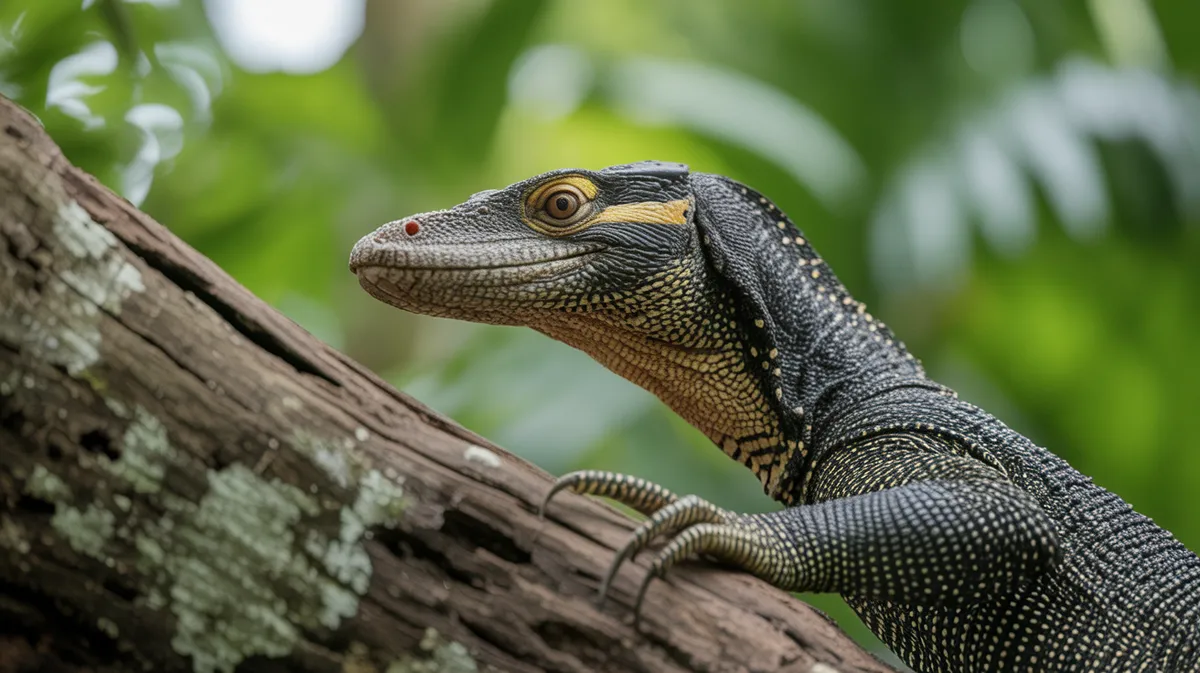
About the Black Tree Monitor
The Black Tree Monitor is a sleek, arboreal lizard native to the tropical rainforests of the Aru Islands in Indonesia. It is renowned for its jet-black coloration, long slender body, and prehensile tail, which aid in navigating the dense canopy. This species is highly agile, spending most of its life in trees where it hunts insects, small vertebrates, and eggs. Black Tree Monitors are known for their intelligence, curiosity, and striking appearance, making them a favorite among reptile enthusiasts. Their populations are threatened by habitat loss and collection for the pet trade.
Fascinating facts
Expert Climber
The Black Tree Monitor spends almost its entire life in trees and is specially adapted for an arboreal lifestyle, featuring long toes and claws for gripping branches.
Prehensile Tail
Its tail is prehensile and can wrap around branches, providing extra support and balance as it moves through the forest canopy.
Insect Hunter
This monitor primarily preys on insects, but will also eat small birds, mammals, and eggs when available.
Detailed description
The Black Tree Monitor (Varanus beccarii) is a strikingly elegant, medium-sized arboreal lizard, with adults typically reaching a total length of 90–120 cm (35–47 in), of which the tail comprises more than two-thirds. The species is characterized by its uniformly jet-black, fine-grained skin, which is both smooth and velvety, providing camouflage in the shadowy rainforest canopy. Its body is slender and elongated, with long limbs and highly recurved claws that facilitate expert climbing and grasping of branches. The tail is prehensile and laterally compressed, functioning as a fifth limb for balance and maneuverability among the treetops. The head is narrow with a pointed snout, large eyes, and a long, forked tongue used for chemoreception. V. beccarii exhibits a high degree of intelligence and problem-solving ability, as demonstrated in both wild and captive settings. Its arboreal lifestyle is supported by a lightweight skeletal structure and strong musculature, enabling rapid, agile movement. The species is diurnal, relying on keen vision to locate prey and avoid predators. Black Tree Monitors are solitary by nature, coming together only for breeding. Their secretive habits and preference for dense canopy make them difficult to observe in the wild.
Did you know?
Despite their slender build and arboreal lifestyle, Black Tree Monitors are capable of leaping several feet between branches when hunting or escaping predators.
Research & sources
Wikipedia summary
The black tree monitor or Beccari's monitor is a species of lizard in the family Varanidae. The species is a relatively small member of the family, growing to about 90–120 cm (35–47 in) in total length. V. beccarii is endemic to the Aru Islands off New Guinea, living in an arboreal habitat. The skin color of adults is completely black, to which one common name refers.
Behaviour & social structure
Black Tree Monitors are highly active and agile, spending the majority of their time in the upper canopy, rarely descending to the ground. They are primarily diurnal, with peak activity during the early morning and late afternoon. Their hunting technique is a combination of stealth and rapid strikes; they use their acute vision to spot prey and their long limbs and tail to navigate branches with precision. Their diet consists mainly of large insects (such as orthopterans and beetles), spiders, small birds, eggs, and occasionally small mammals or reptiles. V. beccarii is known for its investigative behavior, often seen probing crevices and bark with its tongue. Social interactions are minimal outside of the breeding season, and individuals maintain exclusive territories. When threatened, they may flee rapidly through the canopy or use their tail defensively. In captivity, they display a notable degree of curiosity and can learn to recognize keepers, indicating advanced cognitive abilities.
Reproduction & life cycle
Reproduction in Varanus beccarii is oviparous, with breeding typically occurring during the wet season (November to April) in their native range. Courtship involves ritualized displays, including head-bobbing and tail-waving. After mating, females lay clutches of 2–6 elongated eggs, often in arboreal termite nests or decaying wood, which provide stable temperature and humidity for incubation. The incubation period ranges from 160 to 190 days at optimal temperatures (28–30°C/82–86°F). Hatchlings are about 20–25 cm (8–10 in) long and are lighter in color, often with faint banding that fades as they mature. There is no parental care post-oviposition; juveniles are independent from hatching and exhibit rapid growth in their first year. Sexual maturity is reached at approximately 2–3 years of age.
Adaptations & survival
V. beccarii exhibits several specialized adaptations for an arboreal lifestyle. Its prehensile tail and elongated digits with sharp, recurved claws provide exceptional grip and balance on narrow branches. The laterally compressed tail aids in maneuverability and acts as a counterbalance during rapid movements. The smooth, dark skin reduces glare and enhances camouflage in the dimly lit canopy. The species has a highly developed visual system for detecting movement and color, essential for hunting and predator avoidance. Its forked tongue and well-developed vomeronasal organ allow for acute chemosensory tracking of prey. The lightweight, yet robust, skeletal structure reduces energy expenditure during climbing. Additionally, V. beccarii has a relatively high metabolic rate compared to other lizards, supporting its active predatory lifestyle.
Cultural significance
There is limited documented cultural significance of Varanus beccarii among indigenous peoples of the Aru Islands, likely due to its elusive arboreal habits. Unlike some larger monitor species, it does not appear prominently in local folklore or traditional practices. However, in modern times, the Black Tree Monitor has gained recognition among reptile enthusiasts and herpetoculturists worldwide, admired for its striking appearance and intelligence. Its rarity and beauty have made it a symbol of the unique biodiversity of the Aru Islands and the conservation challenges facing Indonesia's lesser-known fauna.
Recent research
Recent scientific research has focused on the phylogenetic relationships within the Varanus prasinus species complex, of which V. beccarii is a member. Molecular studies have clarified its distinctiveness from closely related green tree monitors (V. prasinus), supporting its status as a separate species. Behavioral studies in captivity have highlighted its advanced cognitive abilities, including problem-solving and tool use, rare among reptiles. Ongoing fieldwork aims to better understand its population density, reproductive ecology, and habitat requirements. Conservation genetics is an emerging area of interest, with efforts to assess genetic diversity and inform potential management strategies. There is also increasing interest in the impact of the pet trade on wild populations and the development of sustainable captive breeding programs.
Videos
Habitat
Tropical rainforest canopy


Conservation
The Black Tree Monitor is currently classified as Near Threatened on the IUCN Red List.
Threats & challenges
The primary threats to Black Tree Monitors are habitat loss due to deforestation, logging, and land conversion for agriculture on the Aru Islands. Illegal collection for the international pet trade also poses a significant risk, as wild-caught individuals are highly sought after. The species' limited distribution makes it particularly vulnerable to localized disturbances. Population trends are poorly understood due to the species' secretive nature and the inaccessibility of its habitat, leading to its current IUCN Red List status as Data Deficient (DD). Conservation challenges include a lack of comprehensive field studies, limited legal protection in its native range, and ongoing habitat fragmentation. Climate change may further threaten the stability of its rainforest environment.
Taxonomy
Scientific name
Varanus beccarii
- Kingdom
- Animalia
- Phylum
- Chordata
- Class
- Reptilia
- Order
- Squamata
- Family
- Varanidae
- Genus
- Varanus
- Species
- beccarii
Where to see a black tree monitor
4 zoos and aquariums in 2 countries are recorded as keeping this species.
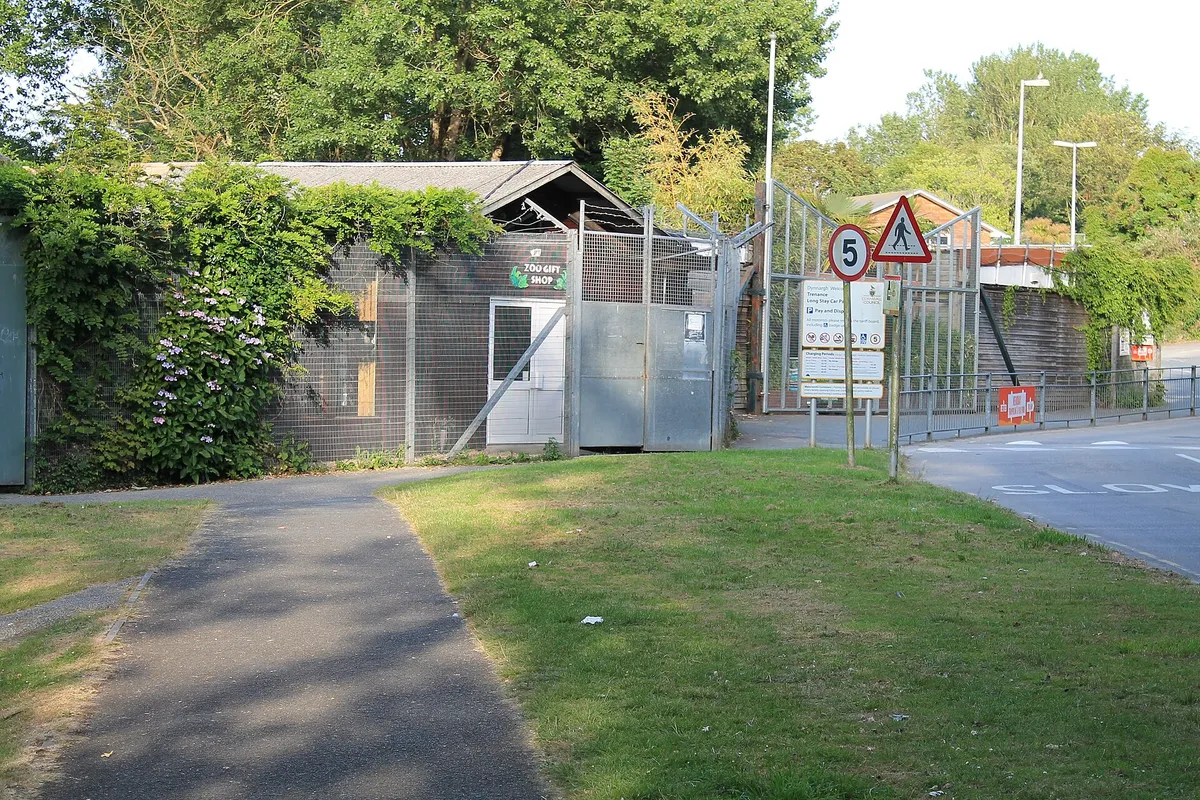 Newquay Zoo🇬🇧 Newquay, United Kingdom
 Oakland Zoo🇺🇸 United States
- 🦁Tulsa Zoo🇺🇸 Tulsa, United States
 Virginia Zoological Park🇺🇸 Norfolk, United States
Community notes
Share your observations about the Black Tree Monitor.
No community notes yet. Be the first!
Discover more wildlife
More fascinating animals from the encyclopedia.