
About the Blacktip Reef Shark
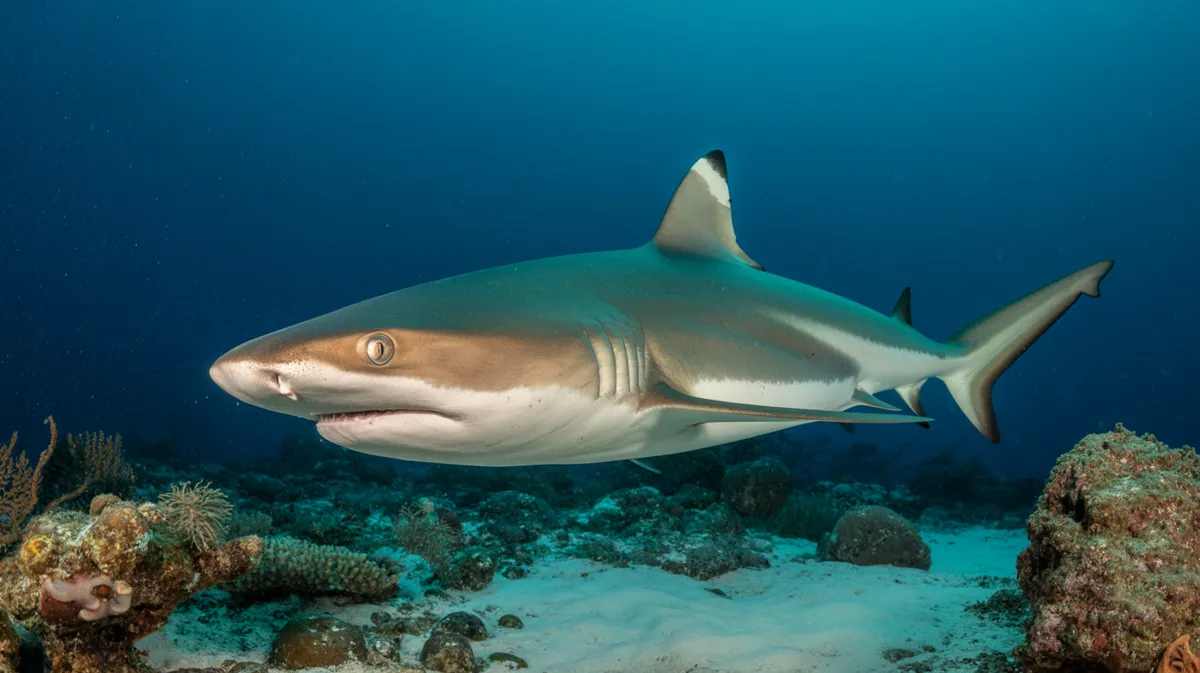
The blacktip reef shark is the shark most people have actually seen: a small, slender 1.6 m animal that patrols reef flats so shallow that its dorsal fin cuts clear of the water. It is startlingly parochial. Individuals have home ranges that can be under a square kilometre and they hold to them for years, and they will not cross deep open water, so populations on neighbouring atolls are genetically distinct despite being a short swim apart in a straight line. That makes them extremely vulnerable to local overfishing, because a wiped-out reef will not be repopulated from next door. It is placentally viviparous, giving birth to two to four live pups after a gestation of around a year, with an umbilical connection much like a mammal's. It is timid and almost never dangerous, and the handful of recorded bites are mostly on the ankles of people wading in murky shallows, where a foot looks like a fish.
Fascinating facts
Shallow Water Resident
Blacktip Reef Sharks are commonly found in water less than 2 meters deep, often visible to snorkelers and waders near coral reefs.
Diet and Hunting
They primarily hunt small bony fish, but their diet also includes crustaceans, squid, and occasionally smaller sharks.
Nursery Habits
Females give birth to live young, and the pups often inhabit shallow nurseries like mangroves to avoid larger predators.
Detailed description
The Blacktip Reef Shark (Carcharhinus melanopterus) is a medium-sized requiem shark, typically reaching lengths of 1.2 to 1.6 meters (4–5.2 ft), though rare individuals may approach 1.8 meters. It is instantly recognizable by the striking black tips on its dorsal, pectoral, pelvic, and caudal fins, contrasting with a pale grey or brownish body and a white ventral surface. The body is slender and streamlined, with a short, bluntly rounded snout and large, oval eyes adapted for low-light vision. This species possesses five prominent gill slits and a large, triangular first dorsal fin that is often visible above the water in shallow habitats. Blacktip reef sharks are highly agile swimmers, capable of rapid bursts of speed when pursuing prey or evading threats. Their dentition consists of narrow, serrated teeth suited for grasping and slicing small fish and invertebrates. They have a well-developed lateral line system for detecting vibrations and electroreceptors (ampullae of Lorenzini) for sensing prey. Socially, blacktip reef sharks are often observed in small groups, particularly juveniles, while adults may be more solitary or loosely associated. Their role as apex mesopredators makes them critical for maintaining the balance of reef ecosystems.
Did you know?
Despite their intimidating appearance, there are no confirmed fatal attacks on humans by Blacktip Reef Sharks.
Research & sources
Wikipedia summary
The blacktip reef shark is a species of requiem shark, in the family Carcharhinidae, which can be easily identified by the prominent black tips on its fins. Among the most abundant sharks inhabiting the tropical coral reefs of the Indian and Pacific Oceans, this species prefers shallow, inshore waters. Its exposed first dorsal fin is a common sight in the region. The blacktip reef shark is usually found over reef ledges and sandy flats, though it has also been known to enter brackish and freshwater environments. It typically attains a length of 1.6 m (5.2 ft). Like other sharks, the females are larger than the males.
Behaviour & social structure
Blacktip reef sharks are diurnal and most active during daylight hours, especially at dawn and dusk when prey is abundant. They exhibit site fidelity, often remaining within a restricted home range of a few square kilometers for extended periods. These sharks are opportunistic feeders, preying mainly on small bony fishes such as mullet, wrasses, and surgeonfish, but also consume cephalopods (octopus, squid) and crustaceans (crabs, shrimp). Hunting is typically solitary or in loose aggregations, with coordinated group foraging occasionally observed, especially during fish spawning events. Blacktip reef sharks use rapid lunges and agile maneuvers to ambush prey, often herding schools of fish into shallow water. Social interactions include dominance displays, such as arching the body and exaggerated swimming, particularly among juveniles. They are generally wary of humans, rarely displaying aggression unless provoked or cornered.
Reproduction & life cycle
Carcharhinus melanopterus is viviparous, meaning embryos develop inside the mother and are nourished via a yolk-sac placenta. Mating occurs seasonally, with timing varying by region (e.g., spring to summer in the Indo-Pacific). Courtship involves males biting the female’s pectoral fins and flanks to maintain position for copulation. Gestation lasts approximately 10–11 months, after which females give birth to litters of 2–5 pups, each measuring 33–52 cm (13–20 in) at birth. Parturition typically occurs in shallow, sheltered nursery areas such as lagoons and mangroves, which offer protection from larger predators. Females may exhibit biennial or annual reproductive cycles, depending on environmental conditions. There is no parental care post-birth; pups are independent from birth and remain in nursery habitats for up to a year.
Adaptations & survival
Blacktip reef sharks are highly adapted to shallow, dynamic reef environments. Their countershaded coloration provides camouflage from both predators and prey—darker dorsally to blend with the ocean floor and lighter ventrally to match the sunlit surface. The black fin tips may serve as visual signals for species recognition or as disruptive coloration to confuse prey. Their streamlined bodies and powerful caudal fins enable swift acceleration and agile turns, crucial for navigating complex reef structures. Electroreceptors allow them to detect the weak bioelectric fields of hidden prey. The ability to tolerate low salinity enables occasional excursions into brackish or even freshwater environments. Site fidelity and use of nursery areas enhance juvenile survival rates.
Cultural significance
In many Indo-Pacific cultures, blacktip reef sharks are featured in local folklore and are sometimes regarded as guardians of the reef or symbols of agility and adaptability. In some Pacific Island traditions, sharks are revered as ancestral spirits or totem animals. The species is popular in ecotourism, with shark-watching and snorkeling excursions providing economic incentives for conservation. However, there is little evidence of significant traditional exploitation for food or materials compared to other shark species.
Recent research
Recent studies have focused on the genetic population structure of blacktip reef sharks, revealing limited gene flow between isolated reef systems and highlighting the importance of local conservation measures. Satellite and acoustic tagging have provided insights into their movement patterns, demonstrating strong site fidelity and limited long-distance migrations. Research into their role as mesopredators has underscored their importance in maintaining reef fish diversity and ecosystem health. Ongoing work is examining the impacts of climate change, particularly coral bleaching and ocean acidification, on their habitat use and reproductive success.
Sources
Carcharhinus melanopterus (Blacktip Reef Shark) – Species Profile
Simpfendorfer, C., Yuneni, R.R., Tanay, D., et al. (2020)
scientificPopulation structure and connectivity of the blacktip reef shark (Carcharhinus melanopterus) in the Indo-Pacific
Mourier, J., Planes, S., Buray, N., et al. (2013)
scientificVideos
Habitat
Coral reefs and shallow coastal waters

Conservation
The Blacktip Reef Shark is currently classified as Near Threatened on the IUCN Red List.
Threats & challenges
The primary threats to blacktip reef sharks include overfishing (both targeted and as bycatch), habitat degradation (especially coral reef destruction), and coastal development. Their preference for shallow, accessible waters makes them particularly vulnerable to artisanal and commercial fisheries. Fins are valued in the shark fin trade, and meat is occasionally consumed locally. Population declines have been documented in several regions, leading to their IUCN listing as 'Near Threatened.' Habitat loss due to coral bleaching, pollution, and mangrove deforestation further exacerbates risks. Their slow reproductive rate and site fidelity limit their ability to recover from population declines.
Taxonomy
Scientific name
Carcharhinus melanopterus
- Kingdom
- Animalia
- Phylum
- Chordata
- Class
- Chondrichthyes
- Order
- Carcharhiniformes
- Family
- Carcharhinidae
- Genus
- Carcharhinus
- Species
- melanopterus
Where to see a blacktip reef shark
6 zoos and aquariums in 4 countries are recorded as keeping this species.
 Georgia Aquarium🇺🇸 Atlanta, United States
 Tierpark Hellabrunn🇩🇪 München, Germany
 Vancouver Aquarium🇨🇦 Vancouver, Canada
 Blue Planet Aquarium🇬🇧 Ellesmere Port, United Kingdom
 Shedd Aquarium🇺🇸 Chicago, United States
Community notes
Share your observations about the Blacktip Reef Shark.
No community notes yet. Be the first!
Discover more wildlife
More fascinating animals from the encyclopedia.