
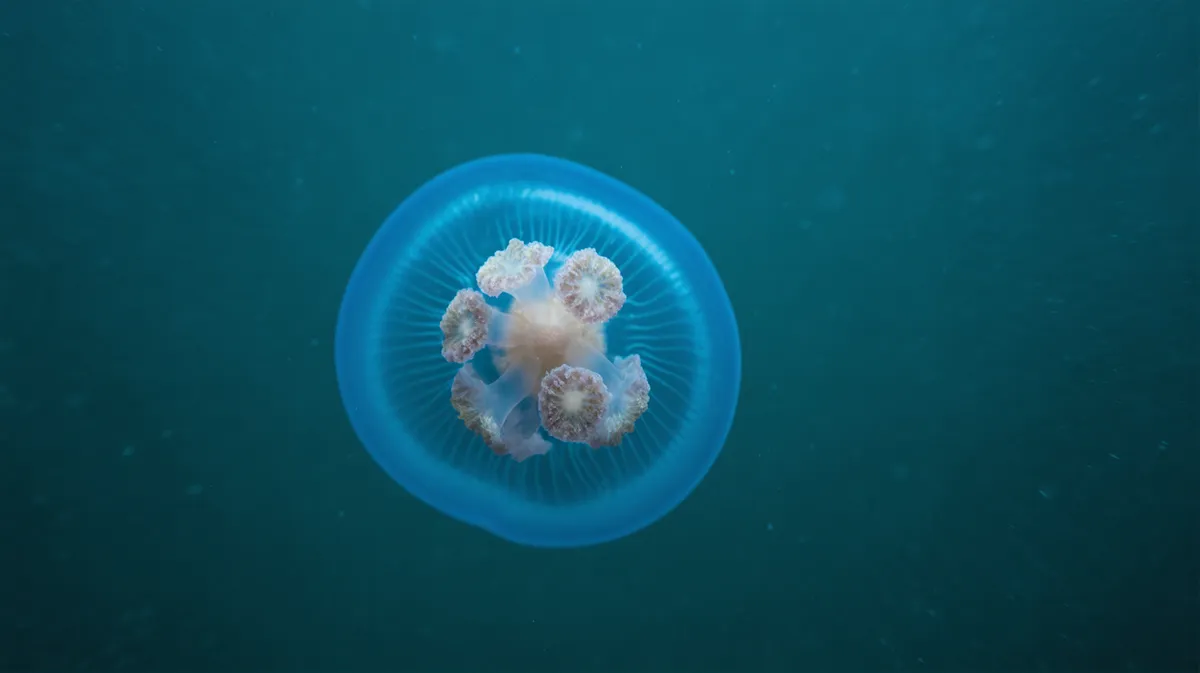
About the Blue bottle jellyfish
The Blue bottle jellyfish, also known as the Pacific man o’ war, is a striking marine invertebrate recognized by its vibrant blue, gas-filled float and long, venomous tentacles. Unlike true jellyfish, it is a siphonophore—a colonial organism made up of specialized, genetically identical individuals called zooids. Blue bottles drift on ocean currents, using their sail-like float to catch the wind and travel across warm, tropical, and subtropical waters. Their tentacles can deliver painful stings to humans, even when washed up on shore. Despite their delicate appearance, they are effective predators of small fish and plankton.
Fascinating facts
Not a True Jellyfish
The Blue bottle jellyfish belongs to the order Siphonophora, making it a colonial organism rather than a single animal like true jellyfish.
Venomous Tentacles
Its tentacles contain venomous nematocysts that paralyze and capture small fish and plankton, and can cause painful stings to humans.
Wind-Powered Travel
The Blue bottle's gas-filled float acts like a sail, allowing it to move across the ocean surface with the wind.
Detailed description
The Blue bottle jellyfish (Physalia utriculus) is a colonial marine organism distinguished by its translucent, blue to violet pneumatophore (float), which typically measures 3–10 cm in length and sits above the water's surface, functioning as a sail. Beneath the float dangle long, trailing tentacles that can extend up to 3 meters, armed with thousands of specialized stinging cells (nematocysts) used for prey capture and defense. Unlike true jellyfish, P. utriculus is a siphonophore, composed of multiple zooids—each highly specialized for functions such as feeding, reproduction, or defense—yet all physiologically integrated and incapable of independent survival. The float contains a mixture of gases, primarily nitrogen, oxygen, and carbon dioxide, produced by a gas gland, allowing the colony to remain buoyant. Blue bottles are predominantly found in the Indo-Pacific region, especially along the coasts of Australia, New Zealand, and Southeast Asia, where they are often washed ashore by prevailing winds. Their vivid coloration serves as a warning to potential predators. The tentacles deliver potent venom capable of paralyzing small fish and plankton, which are then transported to the gastrozooids for digestion. While Blue bottles lack centralized nervous or circulatory systems, they coordinate movement and function through a simple nerve net and chemical signaling. Their life cycle and reproductive strategies remain only partially understood, but they are believed to reproduce sexually via the release of gametes into the water column, leading to the formation of new colonies.
Did you know?
The Blue bottle jellyfish is not a single animal but a colony of four different types of polyps, each with a unique role.
Research & sources
Behaviour & social structure
Blue bottle jellyfish are passive drifters, relying on wind and ocean currents for locomotion, with the orientation of their float's crest (left- or right-handed) determining their drift direction and helping to reduce mass strandings. They are solitary in their movements but can appear in large aggregations, especially after storms or strong onshore winds. Feeding occurs when prey, such as small fish or zooplankton, become ensnared in the tentacles, which instantly fire nematocysts to immobilize and kill the victim. The prey is then transported by specialized tentacles (dactylozooids) to the gastrozooids for digestion. Blue bottles do not actively hunt; instead, they maximize feeding opportunities by extending their tentacles over a wide area. They have few natural predators, but some species, such as the blue dragon sea slug (Glaucus atlanticus) and certain fish, are immune to their venom and may feed on them. Daily activity is largely dictated by environmental conditions, with no evidence of circadian rhythms or complex social interactions.
Reproduction & life cycle
Reproduction in Physalia utriculus is not fully elucidated, but like other siphonophores, it is believed to involve both sexual and asexual phases. Colonies are dioecious, with separate male and female individuals. During spawning events, mature gonozooids release eggs or sperm into the water column, where external fertilization occurs. The resulting planula larvae develop into new colonies through budding and differentiation of zooids. There is no parental care; offspring are planktonic and must survive independently from the earliest stages. Breeding is thought to be opportunistic, potentially triggered by environmental cues such as temperature or food availability, but specific breeding seasons have not been conclusively identified.
Adaptations & survival
Physalia utriculus exhibits several remarkable adaptations for survival in the open ocean. Its gas-filled float allows it to remain at the surface, while the crest acts as a sail to harness wind energy for dispersal. The tentacles are equipped with potent nematocysts capable of delivering venom that paralyzes prey and deters predators. The division of labor among zooids enables efficient specialization: gastrozooids digest food, dactylozooids capture prey, and gonozooids handle reproduction. The vivid blue coloration serves as aposematic (warning) coloration, signaling toxicity to potential predators. The ability to regenerate damaged tentacles and zooids enhances resilience after injury. Additionally, the left- or right-handedness of the float's crest helps reduce the likelihood of entire populations stranding simultaneously.
Cultural significance
The Blue bottle jellyfish is well-known in coastal communities, particularly in Australia and New Zealand, where it is both feared and respected for its painful sting. It features in local folklore and beach safety campaigns, often symbolizing the dangers of the sea. There are no significant traditional uses, but its striking appearance has made it a subject of scientific study and public fascination. In some cultures, it is mistakenly conflated with the Portuguese man o’ war (Physalia physalis), leading to confusion in popular media.
Recent research
Recent research has focused on the biochemical composition of Blue bottle venom, revealing complex mixtures of proteins and peptides with potential biomedical applications, such as novel painkillers or anti-cancer agents. Studies using molecular genetics have clarified the phylogenetic relationships among siphonophores, confirming the distinctiveness of P. utriculus from its Atlantic relative, P. physalis. Ongoing ecological research is examining the effects of climate change on distribution patterns and the frequency of mass strandings. There is also interest in the neural coordination among zooids, providing insights into colonial integration and primitive nervous systems.
Sources
The Biology and Ecology of Physalia utriculus (Bluebottle) in Australian Waters
Graham, C.H. & Munro, A.R. (2020)
scientificVenom composition and function in the siphonophore Physalia
Haddad, V. Jr. & Martins, I.A. (2019)
scientificThe Biology of Physalia physalis and Physalia utriculus (Cnidaria, Siphonophora)
Pugh, P.R. & Baxter, E.J. (2014)
scientificVideos
Habitat
Open ocean (pelagic zone), especially coastal waters

Conservation
The Blue bottle jellyfish is currently classified as Least Concern on the IUCN Red List.
Threats & challenges
Currently, Physalia utriculus is not considered threatened, and populations are stable across its range. However, they face localized threats from pollution, habitat degradation, and climate change, which may alter ocean currents and wind patterns, potentially affecting their distribution. Human activities such as coastal development and increased beach tourism can lead to more frequent encounters and mass strandings, sometimes resulting in culling or removal. While not directly targeted by fisheries, bycatch and entanglement in marine debris pose minor risks. Natural population fluctuations are influenced by weather events, with large aggregations sometimes leading to temporary local declines after mass strandings.
Taxonomy
Scientific name
Physalia utriculus
- Kingdom
- Animalia
- Phylum
- Cnidaria
- Class
- Hydrozoa
- Order
- Siphonophorae
- Family
- Physaliidae
- Genus
- Physalia
- Species
- utriculus
Community notes
Share your observations about the Blue bottle jellyfish.
No community notes yet. Be the first!
Discover more wildlife
More fascinating animals from the encyclopedia.