
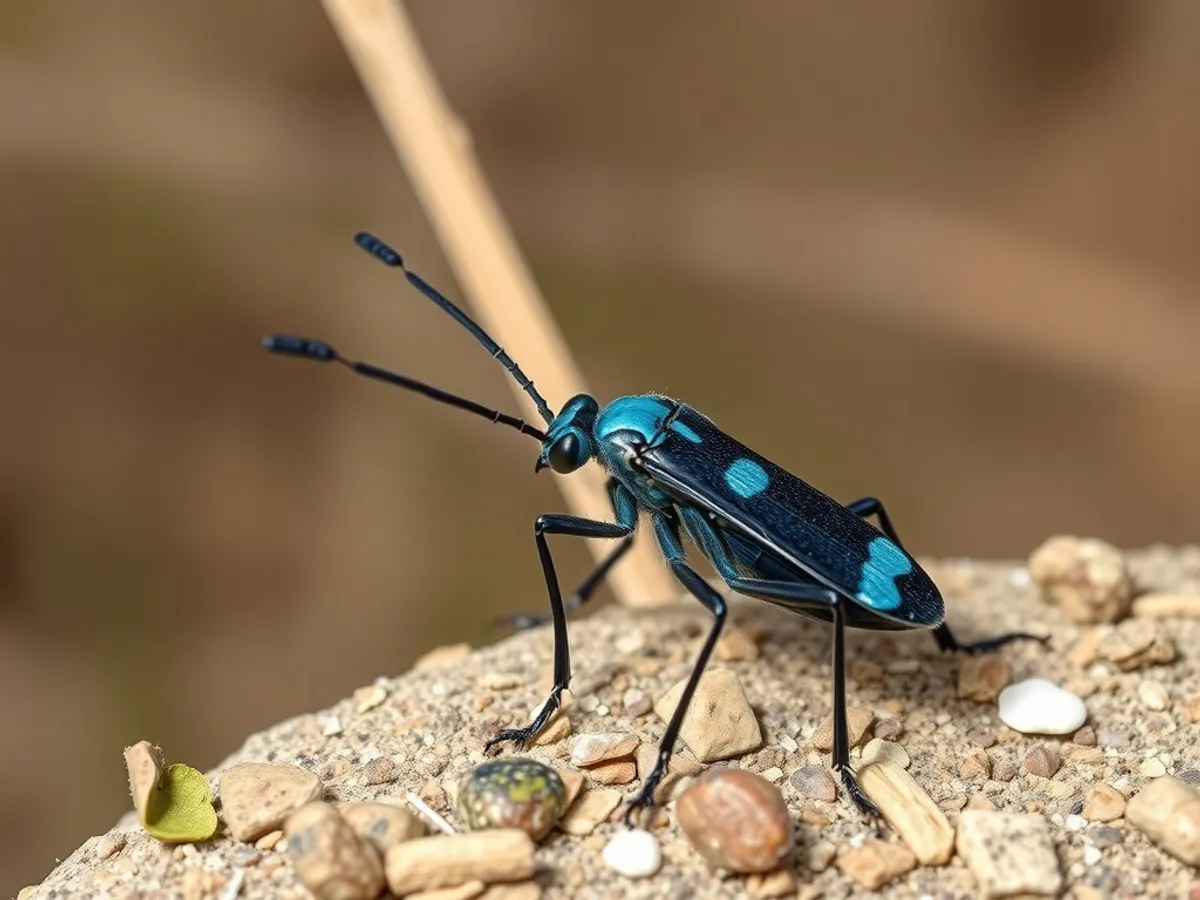
About the Blue mud dauber
The blue mud dauber is a solitary wasp known for its striking metallic blue coloration and slender body. Unlike social wasps, blue mud daubers do not form colonies, instead building individual nests out of mud, often in sheltered locations such as under eaves or inside garages. They are notable for hunting and paralyzing spiders, particularly black widows, which they provision as food for their larvae. Blue mud daubers are generally non-aggressive and rarely sting humans, preferring to focus their efforts on nest building and hunting.
Fascinating facts
Spider Hunters
Blue mud daubers actively seek out spiders, especially black widows, to paralyze and store in their nests as food for their larvae.
Creative Builders
These wasps often reuse and refurbish the abandoned mud nests of other wasps, displaying resourcefulness in nest construction.
Metallic Beauty
Their metallic blue exoskeleton makes them easy to distinguish from other mud dauber species, adding to their visual appeal.
Detailed description
The blue mud dauber (Chalybion californicum) is a solitary sphecid wasp distinguished by its slender, elongated body and striking metallic blue or blue-green exoskeleton, which measures between 15–25 mm in length. Its narrow waist (petiole) and long, spindly legs give it a graceful appearance in flight. The wings are typically dark and iridescent, folding flat over the abdomen when at rest. Unlike social wasps, blue mud daubers do not form colonies; each female independently constructs and provisions her own nest. The wasp’s mandibles are well-adapted for manipulating mud and capturing prey, while its antennae are long and slightly curved, aiding in sensory perception. The species exhibits sexual dimorphism, with females generally larger than males. Blue mud daubers are noted for their ability to reuse abandoned nests of other wasps, particularly those of Sceliphron and Trypoxylon, often removing old prey and debris before provisioning their own brood. Their life cycle includes a complete metamorphosis: egg, larva, pupa, and adult. Adults are most active during warm months, with peak activity in late spring and summer. The species is widely distributed across North America and has been introduced to other regions, such as Hawaii and parts of Europe.
Did you know?
Blue mud daubers are among the few natural predators of the black widow spider, helping to keep its populations in check.
Research & sources
Wikipedia summary
Chalybion is a genus of blue mud dauber wasps in the family Sphecidae. Chalybion species nest in a wide range of natural and artificial cavities such as holes in wood, walls, plant stems, etc., where they typically provision their brood cells with paralyzed spiders. They also reuse old nests of other wasps like Trypoxylon and Sceliphron.
Behaviour & social structure
Blue mud daubers are diurnal and highly active during daylight hours, spending much of their time hunting for spiders and searching for suitable nesting sites. Females exhibit remarkable hunting behavior, paralyzing spiders—primarily orb-weavers and black widows—using their venomous sting, then transporting the immobilized prey to their nests. They are opportunistic in nest site selection, utilizing natural cavities (e.g., hollow stems, wood crevices) and artificial structures (e.g., under eaves, inside sheds). Unlike many wasps, they are non-aggressive and rarely defend their nests, relying instead on their solitary habits and cryptic nesting sites for protection. Adults feed on nectar and honeydew, contributing to incidental pollination. Males are less frequently observed and do not participate in nest building or provisioning. Social interactions are minimal, limited to brief courtship encounters and occasional competition for nesting sites.
Reproduction & life cycle
Reproduction begins with aerial courtship displays, where males patrol territories and attempt to mate with receptive females. Mating typically occurs in late spring to early summer. After mating, the female independently constructs or refurbishes a nest, forming brood cells from mud. She lays a single egg in each cell, then provisions it with several paralyzed spiders (usually 3–9 per cell) as food for the developing larva. There is no parental care beyond provisioning; the female seals the cell with a mud cap and departs. The egg hatches within a few days, and the larva consumes the stored spiders over 1–2 weeks before pupating. Depending on climate, there may be one or two generations per year (univoltine or bivoltine). In colder regions, the pupae overwinter in the nest, emerging as adults the following spring.
Adaptations & survival
Chalybion californicum exhibits several key adaptations for survival. Its metallic blue coloration may serve as aposematic (warning) coloration or provide camouflage among shadows and reflective surfaces. The wasp’s venom is specialized to paralyze, but not kill, spiders, ensuring fresh food for larvae. Its ability to reuse nests of other wasps reduces energy expenditure and increases reproductive efficiency. The long legs and agile flight facilitate spider hunting in complex environments. Behavioral flexibility in nest site selection allows the species to thrive in both natural and human-modified habitats. Additionally, the species’ tolerance for a wide range of climates and habitats has facilitated its expansion beyond its native range.
Cultural significance
While not prominent in folklore or mythology, blue mud daubers are valued in human environments for their role in controlling spider populations, particularly medically significant species like black widows. They are sometimes regarded as beneficial insects in gardens and agricultural settings. Their distinctive nests and metallic coloration have made them subjects of curiosity and informal study among naturalists and entomologists. There are no known traditional uses or symbolic associations in indigenous cultures.
Recent research
Recent research has focused on the blue mud dauber’s prey selection, particularly its impact on black widow spider populations, and its role in urban ecosystems. Studies have documented the wasp’s ability to learn and remember nest locations, as well as its flexibility in adapting to novel nesting substrates. Genetic analyses have clarified its relationships within the Sphecidae family and have tracked its spread into non-native regions. Ongoing research includes investigations into the chemical composition of its venom and the microbiome of its nests, which may influence larval development and pathogen resistance.
Videos
Habitat
Open fields, meadows, woodlands, and areas near human habitation


Conservation
The Blue mud dauber is currently classified as Least Concern on the IUCN Red List.
Threats & challenges
Currently, the blue mud dauber faces few significant threats and is classified as Least Concern. However, localized populations may be affected by habitat loss due to urban development, pesticide use (which can reduce prey availability and directly harm wasps), and competition with invasive wasp species. Climate change may alter the distribution of both the wasp and its spider prey. Despite these challenges, the species’ adaptability and broad ecological niche have contributed to stable or expanding populations in most areas.
Taxonomy
Scientific name
Chalybion californicum
- Kingdom
- Animalia
- Phylum
- Arthropoda
- Class
- Insecta
- Order
- Hymenoptera
- Family
- Sphecidae
- Genus
- Chalybion
- Species
- californicum
Community notes
Share your observations about the Blue mud dauber.
No community notes yet. Be the first!
Discover more wildlife
More fascinating animals from the encyclopedia.