
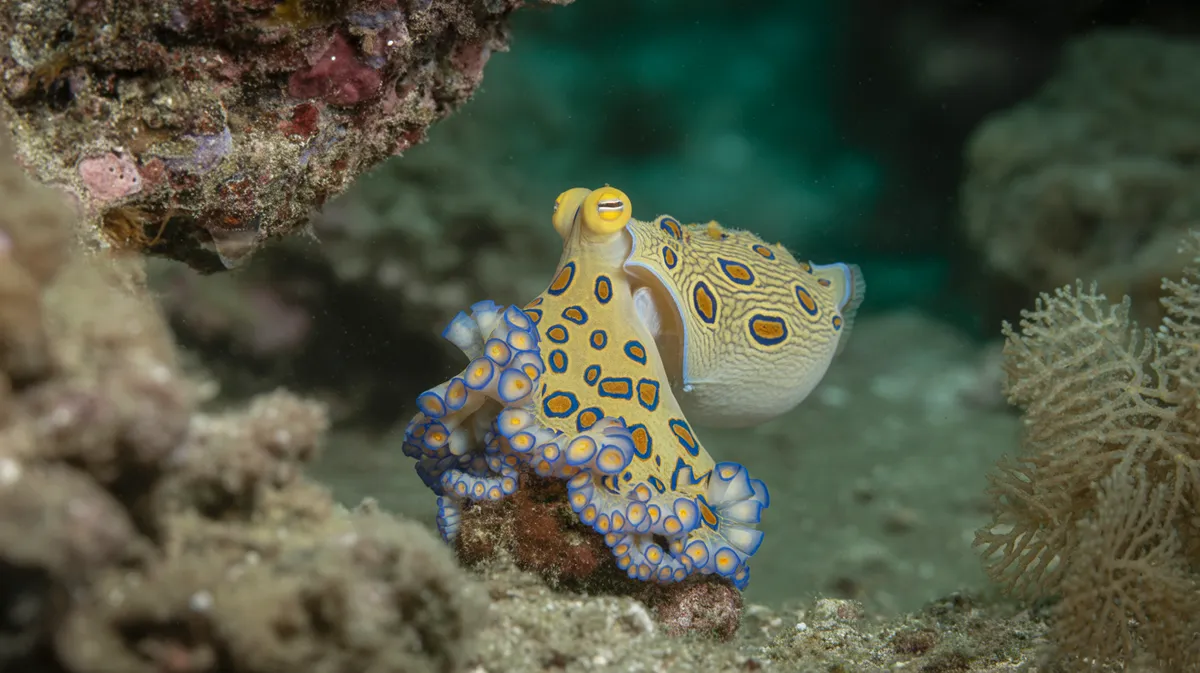
About the Blue-ringed Octopus
The blue-ringed octopus is roughly the size of a golf ball and carries enough tetrodotoxin to kill several adult humans. The toxin is the same one found in pufferfish, and the octopus does not make it — it is produced by symbiotic bacteria living in its salivary glands. There is no antivenom. The toxin paralyses by blocking the nerve signals that drive muscle, including the muscles of breathing, and the horror of it is that it does not touch consciousness: a victim can be fully aware while unable to move or breathe, and survival depends entirely on someone providing artificial respiration until the toxin clears. The bite is often painless and can go unnoticed. Its famous rings are not on constant display — the animal is drab and cryptic most of the time, and the iridescent blue flashes on in under a second when it is threatened, using specialised reflective cells beneath the skin. It is a warning, not a lure, and it means the animal has already decided you are a problem.
Fascinating facts
Warning Colors
The blue rings of this octopus become intensely bright when the animal is agitated or threatened, serving as a visual warning to potential predators.
Potent Venom
Its venom contains tetrodotoxin, which blocks nerve signals and can cause paralysis and respiratory failure in humans within minutes.
Tiny but Deadly
Despite measuring only 12–20 cm when the arms are extended, the Blue-ringed Octopus is one of the most venomous marine animals in the world.
Detailed description
The Greater Blue-ringed Octopus (Hapalochlaena lunulata) is a small cephalopod, typically measuring 12–20 cm in total length, with a mantle length of about 4–6 cm and weighing less than 100 grams. Its most distinctive feature is the presence of 50–60 iridescent blue rings, each bordered by black, scattered across its yellowish to brownish skin. These rings become intensely vivid when the animal is threatened, due to specialized chromatophores and iridophores in the skin. The body is soft and flexible, allowing the octopus to squeeze into crevices and shells for protection. Like other octopuses, it has eight arms lined with suckers, a highly developed nervous system, and excellent vision provided by large, complex eyes. H. lunulata is solitary and cryptic, spending much of the day hidden under rocks or in shells, emerging mainly at dusk or night to hunt. Its venom, delivered through a painless bite, contains tetrodotoxin—a potent neurotoxin that can cause paralysis and death in humans and predators. Despite its lethality, the blue-ringed octopus is not aggressive and will display its rings as a warning before biting. Its life span is short, typically less than two years, and it undergoes a single reproductive event before dying, a pattern known as semelparity.
Did you know?
The venom of the Blue-ringed Octopus contains tetrodotoxin, a neurotoxin for which there is currently no known antidote.
Research & sources
Wikipedia summary
Blue-ringed octopuses, comprising the genus Hapalochlaena, are four extremely venomous species of octopus that are found in tide pools and coral reefs in the Pacific and Indian Oceans, from Japan to Australia. They can be identified by their yellowish skin and characteristic blue and black rings that can change color dramatically when the animals are threatened. They eat small crustaceans, including crabs, hermit crabs, shrimp, and other small sea animals.
Behaviour & social structure
Blue-ringed octopuses are primarily nocturnal and crepuscular, emerging from hiding places at dusk to forage. They are ambush predators, using camouflage to blend into their surroundings before pouncing on prey such as small crabs, shrimp, and occasionally small fish. Prey is subdued with a quick bite that injects venomous saliva, rapidly paralyzing the victim. The octopus then uses its beak to break through the exoskeleton and consume soft tissues. Social interactions are minimal, as individuals are highly territorial and avoid conspecifics except during mating. When threatened, H. lunulata rapidly flashes its blue rings as an aposematic warning display, often accompanied by body flattening and arm extension to appear larger. Daily routines involve alternating periods of rest in secure dens and active foraging, with frequent den relocation to avoid predators and competitors.
Reproduction & life cycle
Reproduction in H. lunulata is seasonal, often peaking in the warmer months. Males actively search for receptive females, using chemoreception to detect pheromones. Courtship is brief; the male grasps a female and uses a specialized arm (the hectocotylus) to transfer spermatophores into her mantle cavity. After mating, the female lays 50–100 eggs, which she attaches to the roof of her den and guards vigilantly, abstaining from feeding during the incubation period of 50–80 days. She aerates and cleans the eggs until they hatch into planktonic larvae. The female dies shortly after the eggs hatch, a characteristic of semelparous species. There is no parental care post-hatching, and juveniles are independent from birth.
Adaptations & survival
Hapalochlaena lunulata exhibits several remarkable adaptations. Its skin contains chromatophores and iridophores, enabling rapid color and pattern changes for both camouflage and warning displays. The venom, primarily tetrodotoxin, is produced by symbiotic bacteria in the salivary glands and is among the most potent in the animal kingdom, providing both defense and an efficient means to subdue prey. The octopus's soft, boneless body allows it to exploit tiny crevices for shelter. Its keen eyesight and advanced nervous system facilitate complex behaviors, including problem-solving and learning. The species' short life cycle and high fecundity are evolutionary strategies to offset high juvenile mortality in a predator-rich environment.
Cultural significance
The blue-ringed octopus holds a prominent place in public consciousness due to its striking appearance and potent venom. It is often featured in educational materials and warning campaigns in Australia and Southeast Asia, where accidental encounters can occur. In some indigenous Australian cultures, the octopus is regarded with caution and respect, symbolizing both beauty and danger. The animal is not traditionally used for food due to its toxicity, but it has become a subject of fascination in marine biology and toxicology research.
Recent research
Recent research has focused on the molecular structure and biosynthesis of tetrodotoxin, aiming to understand its ecological role and potential biomedical applications. Studies have also examined the symbiotic bacteria responsible for toxin production and the genetic basis of the octopus's rapid color change. Behavioral research has highlighted the species' problem-solving abilities and advanced learning capacity. Ongoing monitoring of populations is being conducted to assess the impact of environmental change and human activity on distribution and abundance. There is also growing interest in the species' reproductive biology and larval dispersal mechanisms.
Sources
Cephalopods of the World: An Annotated and Illustrated Catalogue of Cephalopod Species Known to Date
Jereb, P.; Roper, C.F.E. (FAO Species Catalogue for Fishery Purposes) (2005)
scientificVideos
Habitat
Shallow coral reefs and tide pools

Conservation
The Blue-ringed Octopus is currently classified as Least Concern on the IUCN Red List.
Threats & challenges
Currently, the blue-ringed octopus is not considered threatened and is classified as Least Concern by the IUCN. However, it faces localized risks from habitat degradation, pollution, and collection for the aquarium trade. Coastal development and coral reef destruction may reduce available habitat. Human encounters, though rare, can result in accidental bites, often due to handling or stepping on the animal. Climate change, particularly ocean warming and acidification, poses long-term threats to reef ecosystems and the species' prey base. Despite these challenges, populations remain stable, likely due to the species' wide distribution and high reproductive output.
Taxonomy
Scientific name
Hapalochlaena lunulata
- Kingdom
- Animalia
- Phylum
- Mollusca
- Class
- Cephalopoda
- Order
- Octopoda
- Family
- Octopodidae
- Genus
- Hapalochlaena
- Species
- lunulata
Community notes
Share your observations about the Blue-ringed Octopus.
No community notes yet. Be the first!
Discover more wildlife
More fascinating animals from the encyclopedia.