
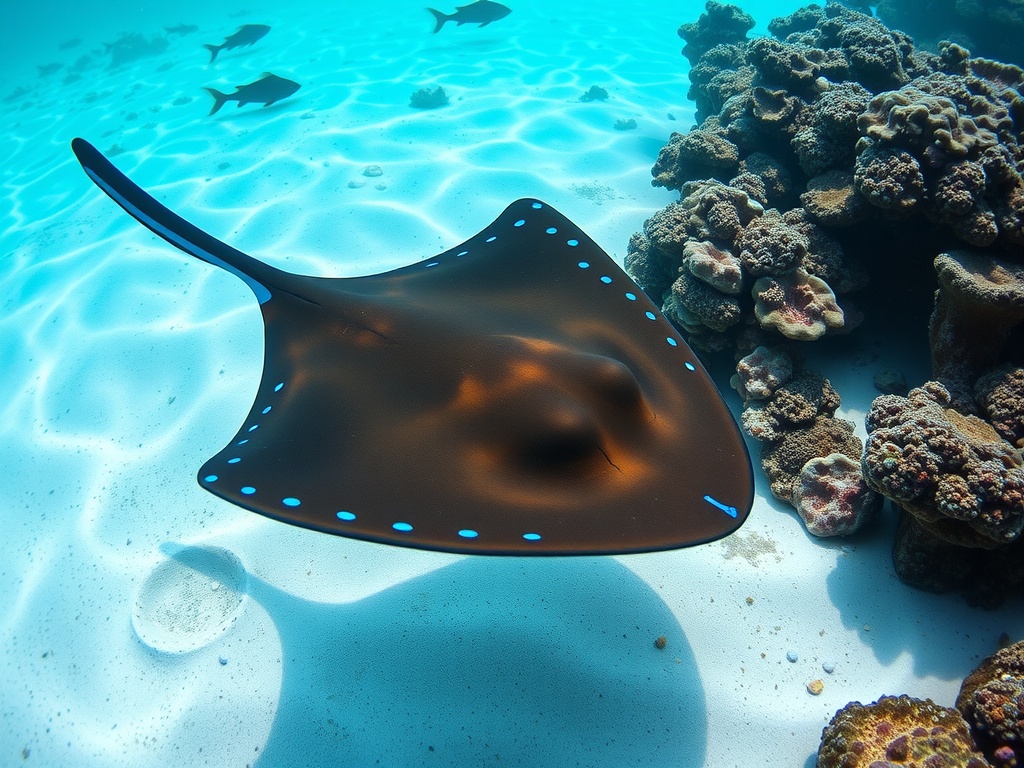
About the Bluespotted ribbontail ray
The bluespotted ribbontail ray is a striking species of stingray known for its vivid blue spots and short, rounded pectoral disc. This ray inhabits shallow, sandy, and coral reef environments in the Indo-Pacific region, often hiding under ledges or within sandy patches. It is a bottom-dwelling carnivore, using its disc to stir up sand and uncover prey such as small fish, worms, and crustaceans. Despite its beautiful appearance, the bluespotted ribbontail ray is equipped with venomous spines on its tail for defense against predators.
Fascinating facts
Master of Disguise
This ray frequently buries itself in the sand, leaving only its eyes and spiracles visible to avoid predators and surprise prey.
Vivid Warning Colors
The bright blue spots on its back are believed to deter predators by signaling that it is dangerous due to its venomous tail spines.
Social Resting
Bluespotted ribbontail rays are often seen resting in small groups during the day, displaying a surprising level of social behavior for rays.
Detailed description
The bluespotted ribbontail ray (Taeniura lymma) is a small, vibrantly colored stingray, easily recognized by its oval-shaped pectoral disc, which is typically 20–35 cm wide and up to 80 cm in total length. Its dorsal surface is a yellowish or olive background densely adorned with numerous bright blue spots, while the tail features two longitudinal blue stripes and ends in a deep, ribbon-like ventral fin fold. The skin is mostly smooth, lacking the thorny denticles found in some related species, except for a few small tubercles near the tail base. The eyes are large and protruding, providing excellent vision for detecting predators and prey. The tail is relatively short and thick, equipped with one or two venomous spines used primarily for defense. This ray is highly adapted to benthic life, spending much of its time partially buried in sand or hiding beneath coral ledges. It is a nocturnal forager, emerging at dusk to hunt. Bluespotted ribbontail rays possess electroreceptors (ampullae of Lorenzini) that allow them to detect the weak electrical fields produced by buried prey. Their gill slits and spiracles are positioned dorsally, enabling respiration while the body is submerged in sediment. The species is generally solitary but may form small, loose aggregations in areas with abundant food or shelter.
Did you know?
Unlike many other rays, the bluespotted ribbontail ray can breathe while buried in sand by drawing water in through special openings called spiracles located just behind its eyes.
Research & sources
Wikipedia summary
The bluespotted ribbontail ray is a species of stingray in the family Dasyatidae. Found from the intertidal zone to a depth of 30 m (100 ft), this species is common throughout the tropical Indian and western Pacific Oceans in nearshore, coral reef–associated habitats. It is a fairly small ray, not exceeding 35 cm (14 in) in width, with a mostly smooth, oval pectoral fin disc, large protruding eyes, and a relatively short and thick tail with a deep fin fold underneath. It can be easily identified by its striking color pattern of many electric blue spots on a yellowish background, with a pair of blue stripes on the tail.
Behaviour & social structure
Bluespotted ribbontail rays are primarily nocturnal, remaining concealed under ledges, within caves, or buried in sand during the day to avoid predators. At night, they actively forage across sandy flats and seagrass beds, using their flexible pectoral fins to uncover hidden prey. Their diet consists mainly of benthic invertebrates such as polychaete worms, shrimps, crabs, and small bony fishes. They use a combination of suction feeding and manipulation with their disc to extract prey from the substrate. Social interactions are limited, but individuals may be observed in small groups, particularly during the breeding season or in areas with high food availability. When threatened, they may flee rapidly, undulating their fins, or use their venomous tail spines defensively. They exhibit site fidelity, often returning to the same resting spots. During low tide, they may become stranded in shallow pools, where they remain motionless until the tide returns.
Reproduction & life cycle
Taeniura lymma is ovoviviparous, meaning embryos develop inside eggs that remain within the mother's body until hatching. Mating typically occurs in the spring and summer, with males trailing and biting the females' pectoral fins to initiate copulation. Gestation lasts approximately 4–12 months, depending on environmental conditions. Females give birth to litters of 1–7 pups, each measuring about 13–14 cm across at birth. There is no parental care post-birth; the young are fully independent and capable of fending for themselves immediately. Breeding frequency is generally annual, but may vary with food availability and environmental stressors. Sexual maturity is reached at around 2–4 years of age, with females maturing slightly later and at a larger size than males.
Adaptations & survival
The bluespotted ribbontail ray exhibits several adaptations for a benthic, reef-associated lifestyle. Its flattened, oval disc and flexible pectoral fins allow it to maneuver easily along the seafloor and squeeze into crevices for shelter. The bright blue spots and stripes serve as aposematic coloration, warning potential predators of its venomous spines. Its eyes are positioned dorsally for a wide field of view while buried, and the spiracles enable respiration without exposing the body. Electroreceptors in the snout detect prey hidden beneath the sand. The venomous tail spines are an effective deterrent against predation by large fish, sharks, and marine mammals. The ray's ability to bury itself rapidly provides camouflage and protection from both predators and strong currents.
Cultural significance
The bluespotted ribbontail ray holds significance in some Indo-Pacific cultures, often featured in local folklore as a symbol of agility and beauty. Its striking appearance makes it a popular subject in underwater photography and ecotourism, contributing to the appeal of coral reef destinations. In some regions, dried specimens or spines have been used in traditional medicine or as curios, though this is less common today. The species is also kept in public aquaria worldwide, where it serves as an ambassador for coral reef conservation.
Recent research
Recent research has focused on the species' ecological role in coral reef systems, including its influence on benthic invertebrate populations and sediment turnover. Genetic studies have revealed low population structure across its range, suggesting high dispersal potential during early life stages. Studies on venom composition have identified unique peptides with potential biomedical applications. Ongoing research is investigating the impacts of habitat loss and climate change on population dynamics, as well as the effectiveness of marine protected areas in safeguarding this and related species.
Videos
Habitat
Coral reefs and sandy flats of the Indo-Pacific

Conservation
The Bluespotted ribbontail ray is currently classified as Near Threatened on the IUCN Red List.
Threats & challenges
Major threats to Taeniura lymma include habitat degradation (especially coral reef destruction), overfishing (both targeted and as bycatch), and collection for the aquarium trade. Coastal development, pollution, and destructive fishing practices have led to declines in suitable habitats. The species is particularly vulnerable to overexploitation due to its site fidelity and relatively slow reproductive rate. Although still common in many areas, local population declines have been reported, and the IUCN currently lists the species as Near Threatened. Ongoing monitoring and habitat protection are crucial for its long-term survival. Marine protected areas and sustainable fisheries management are key conservation measures.
Taxonomy
Scientific name
Taeniura lymma
- Kingdom
- Animalia
- Phylum
- Chordata
- Class
- Chondrichthyes
- Order
- Myliobatiformes
- Family
- Dasyatidae
- Genus
- Taeniura
- Species
- lymma
Community notes
Share your observations about the Bluespotted ribbontail ray.
No community notes yet. Be the first!
Discover more wildlife
More fascinating animals from the encyclopedia.