
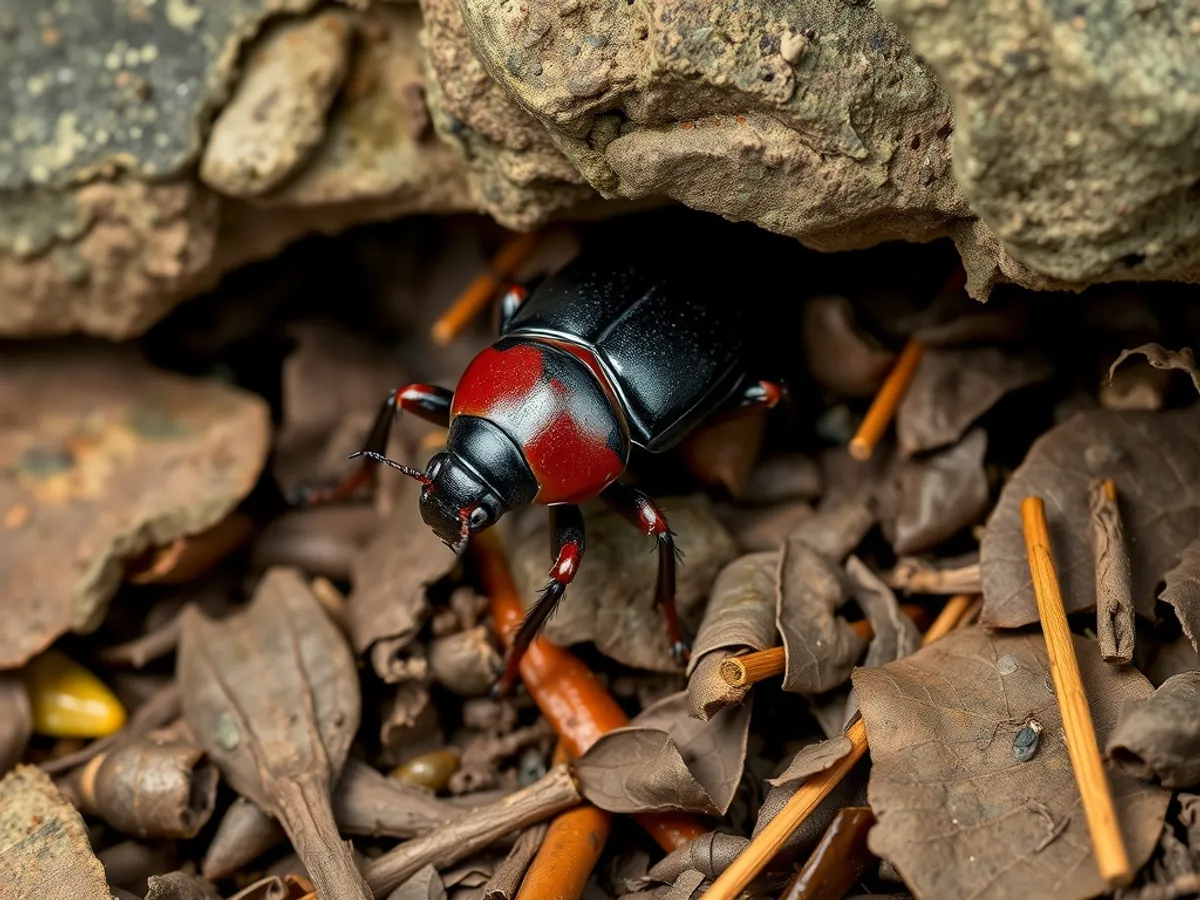
About the Bombardier beetle
The bombardier beetle carries a chemical weapon and detonates it inside its own body. It stores two reagents — hydroquinones and hydrogen peroxide — separately and harmlessly in a reservoir, and when threatened it forces them into a reinforced reaction chamber where enzymes are waiting. The reaction is violent and almost instantaneous: the mixture flashes to around a hundred degrees Celsius and blasts out of a swivelling nozzle at the tip of the abdomen, which the beetle aims with real accuracy at whatever is attacking it. It does not fire a single stream but a pulsed burst, hundreds of pulses a second, and that pulsing is what saves it — each explosion is separated by a moment of cooling, so the chamber is never sustained at a temperature that would destroy the beetle itself. It is enough to make a toad spit it back out, and beetles have been recovered alive after being swallowed, having fired inside the stomach until they were rejected.
Fascinating facts
Explosive Defense
Bombardier beetles mix hydrogen peroxide and hydroquinone in a special chamber, causing a rapid chemical reaction that results in an explosive spray.
Nocturnal Hunters
They are primarily active at night, preying on other insects and small invertebrates.
Superheated Spray
The beetle's defensive spray is not only toxic but also reaches boiling temperature, deterring even the most determined predators.
Detailed description
The Bombardier beetle (Brachinus crepitans) is a small, ground-dwelling carabid beetle, typically measuring 7–9 mm in length. Its body is elongated, with metallic blue-green or bronze elytra and contrasting reddish-orange head, thorax, and legs. The beetle’s most distinctive anatomical feature is its specialized pygidial glands, located at the tip of the abdomen, which produce its signature chemical spray. The antennae are filiform and well-developed, aiding in navigation through leaf litter and under stones. Brachinus crepitans is primarily nocturnal, emerging at dusk to hunt and evade predators. It is a swift runner, relying on agility and rapid reflexes to escape threats. Socially, these beetles are often found in loose aggregations, particularly during the day when they shelter communally under debris. Reproduction involves complex courtship behaviors, with males using tactile and chemical cues to locate receptive females. The species is adapted to temperate environments, favoring well-drained soils in grasslands, open woodlands, and agricultural margins. Its remarkable defense mechanism—rapidly ejecting a boiling, toxic spray—has evolved as a highly effective deterrent against a wide range of predators, including ants, spiders, and small vertebrates.
Did you know?
The chemical spray released by Bombardier beetles can reach temperatures of nearly 100°C (212°F), which is the boiling point of water.
Research & sources
Wikipedia summary
Bombardier beetles are adephagan ground beetles (Carabidae) in the tribes Brachinini, Paussini, Ozaenini, or Metriini—more than 500 species altogether—which are most notable for the defense mechanism that gives them their name: when disturbed, they eject a hot noxious chemical spray from their pygidial glands with a popping sound.
Behaviour & social structure
Bombardier beetles are primarily solitary hunters, preying on small arthropods such as caterpillars, aphids, and other soft-bodied insects. They use their keen sense of smell and touch to locate prey, often ambushing or pursuing them in the leaf litter. When threatened, the beetle adopts a defensive posture, raising its abdomen and orienting its pygidial glands toward the attacker before discharging its chemical spray. Aggregative behavior is observed during daylight hours, with multiple individuals sheltering together in moist microhabitats to reduce desiccation and predation risk. Nocturnal activity peaks shortly after sunset, with individuals dispersing to forage. Communication is largely chemical, involving pheromones for mate attraction and possibly aggregation. They are not territorial and tolerate conspecifics in close proximity, especially outside the breeding season.
Reproduction & life cycle
Brachinus crepitans exhibits seasonal breeding, with mating typically occurring in spring and early summer. Males locate females using pheromonal cues and engage in a brief courtship involving antennal tapping and mounting. Copulation lasts several minutes, after which females lay eggs singly or in small clusters in moist soil or under debris. The eggs hatch after approximately 1–2 weeks, depending on temperature and humidity. Larvae are predatory and undergo three instars before pupating in the soil. The pupal stage lasts 10–14 days, after which adults emerge. There is generally one generation per year (univoltine) in temperate climates. Parental care is absent; females do not guard eggs or larvae.
Adaptations & survival
The most notable adaptation of Brachinus crepitans is its explosive chemical defense. The beetle stores hydroquinone and hydrogen peroxide in separate reservoirs within its abdomen. When threatened, these compounds are mixed in a reaction chamber containing peroxidase and catalase enzymes, triggering a violent exothermic reaction that heats the mixture to nearly 100°C. The resulting gas pressure expels the boiling, noxious spray through a swiveling nozzle, allowing precise targeting of predators. The beetle’s cuticle is thickened around the reaction chamber to withstand repeated explosions. Its coloration provides camouflage among leaf litter, while its agility and nocturnal habits reduce predation risk. Larvae are adapted to a subterranean lifestyle, with strong mandibles for preying on other insect larvae.
Cultural significance
Bombardier beetles have long fascinated scientists and the public due to their extraordinary defense mechanism, which is frequently cited in discussions of evolutionary adaptation and chemical ecology. They are often featured in educational materials, documentaries, and popular science literature as examples of natural engineering. In some cultures, their explosive defense is referenced in folklore as a symbol of resourcefulness or surprise. The beetle’s mechanism has inspired biomimetic research in chemistry and engineering, particularly in the design of controlled-release systems and micro-explosive devices.
Recent research
Recent research has focused on the biomechanics and chemistry of the beetle’s explosive defense, revealing sophisticated microvalve control and pulsed ejection that maximizes deterrence while minimizing self-harm. Genomic studies have begun to elucidate the evolutionary origins of the enzymatic pathways involved in chemical synthesis. Ecological research has examined the beetle’s role in regulating pest populations and its interactions with predators and competitors. Ongoing studies are investigating the potential impacts of climate change on its distribution and the resilience of its chemical defense under varying environmental conditions.
Videos
Habitat
Forest floor and grassland under stones and leaf litter


Conservation
The Bombardier beetle is currently classified as Least Concern on the IUCN Red List.
Threats & challenges
Currently, Brachinus crepitans is classified as Least Concern, with stable populations across its range. However, localized threats include habitat loss due to agricultural intensification, pesticide use, and soil disturbance. Fragmentation of suitable habitats may reduce genetic diversity and limit dispersal. The beetle’s reliance on moist microhabitats makes it sensitive to prolonged droughts and climate change. Despite these challenges, its broad distribution and generalist habitat preferences confer resilience. There is no significant evidence of population decline at a global scale.
Taxonomy
Scientific name
Brachinus crepitans
- Kingdom
- Animalia
- Phylum
- Arthropoda
- Class
- Insecta
- Order
- Coleoptera
- Family
- Carabidae
- Genus
- Brachinus
- Species
- crepitans
Community notes
Share your observations about the Bombardier beetle.
No community notes yet. Be the first!
Discover more wildlife
More fascinating animals from the encyclopedia.