
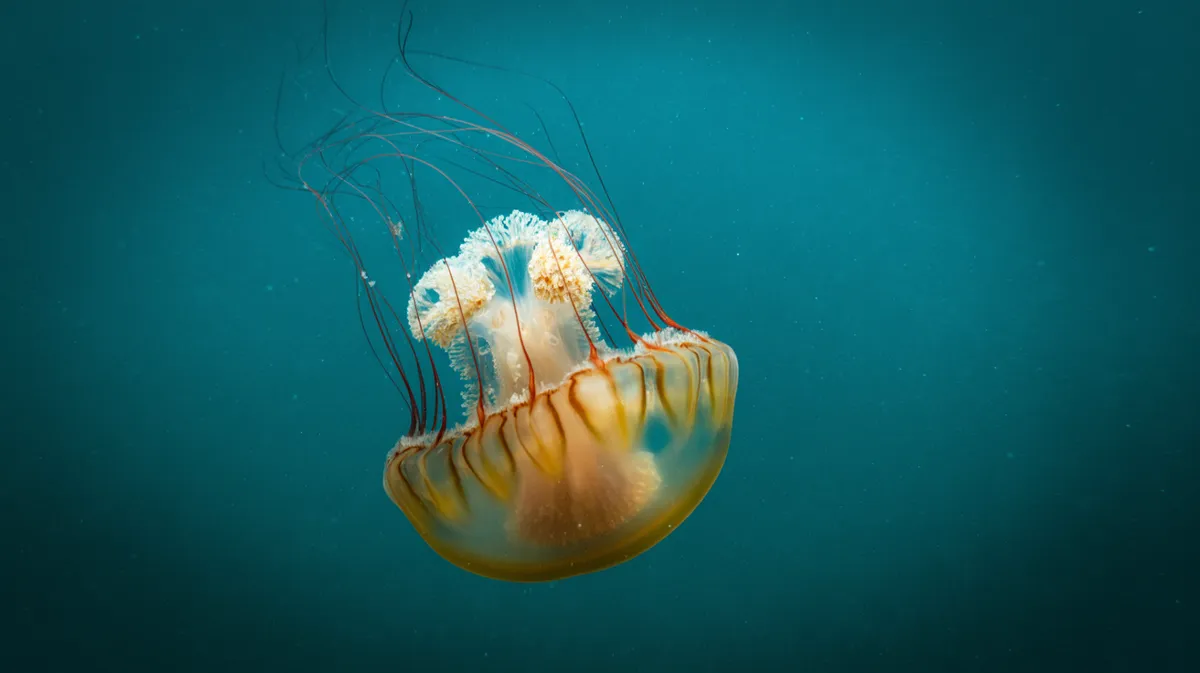
About the Box Jellyfish
The box jellyfish overturns nearly everything the word "jellyfish" implies. It does not drift: it swims actively and with purpose, at a couple of knots, and it steers. And it has eyes — twenty-four of them, in four clusters, including several with corneas, lenses and retinas that form genuine images. This in an animal with no brain at all, only a ring of nerves. Some of those eyes point permanently upward, no matter how the animal tilts, weighted like a spirit level, and appear to be used to look up through the water's surface and navigate by the silhouette of the mangrove canopy, keeping the jellyfish near the roots where its prey lives. Its venom is among the most potent known, delivered by stinging cells that fire on contact and can cause cardiac arrest within minutes. It is very nearly transparent, which is a large part of why it is so dangerous — swimmers do not see it. Vinegar disables undischarged stinging cells but does nothing to venom already delivered.
Fascinating facts
Powerful Venom
The Box Jellyfish’s venom is so powerful it can cause death in humans within minutes if stung by multiple tentacles.
Complex Eyes
They have 24 eyes, some of which can detect color and shapes, helping them navigate and hunt.
Active Swimmers
Unlike most jellyfish, Box Jellyfish can swim rapidly and with purpose, propelling themselves toward prey or away from danger.
Detailed description
The Box Jellyfish (Chironex fleckeri) is widely regarded as one of the most venomous marine animals on Earth. Its bell, or medusa, is distinctly cube-shaped and can reach up to 30 cm (12 inches) across, with tentacles extending up to 3 meters (10 feet) in length from each of the four corners. The body is nearly transparent, rendering it difficult to detect in its natural habitat. Unlike most jellyfish, Chironex fleckeri possesses a complex nervous system with true eyes—up to 24 in total—clustered in specialized sensory structures called rhopalia, enabling it to detect light and navigate with surprising agility. The tentacles are lined with millions of nematocysts, or stinging cells, capable of delivering a venom potent enough to cause cardiac arrest in humans within minutes. Box jellyfish are active swimmers, propelling themselves with muscular contractions of the bell rather than drifting passively. They are solitary hunters, preying primarily on small fish, crustaceans, and occasionally other invertebrates. Reproduction involves both sexual and asexual phases, with adults releasing gametes into the water column and a benthic polyp stage preceding the medusa. Their life cycle, rapid growth, and potent venom make them highly adapted to their ecological niche in warm, shallow coastal waters, particularly across northern Australia and the Indo-Pacific.
Did you know?
A single Box Jellyfish contains enough venom to kill more than 60 adult humans.
Research & sources
Wikipedia summary
Box jellyfish are cnidarian invertebrates distinguished by their box-like body. Some species of box jellyfish produce potent venom delivered by contact with their tentacles. Stings from some species, including Chironex fleckeri, Carukia barnesi, Malo kingi, and a few others, are extremely painful and often fatal to humans.
Behaviour & social structure
Box jellyfish are primarily solitary and display crepuscular activity, being most active during dawn and dusk when prey is abundant and light conditions favor their hunting strategy. They use their advanced visual system to detect and pursue prey, swimming at speeds up to 1.5–2 meters per second. When hunting, they extend their tentacles in a curtain-like fashion to maximize contact with passing prey, instantly immobilizing victims with their venom. Feeding occurs by retracting the tentacles and transferring captured prey to the mouth located on the underside of the bell. Social interactions are minimal, with little evidence of coordinated behavior or aggregation outside of breeding periods. Box jellyfish tend to avoid obstacles and can actively swim away from threats, displaying a level of environmental awareness uncommon among cnidarians.
Reproduction & life cycle
Chironex fleckeri exhibits a complex life cycle with both sexual and asexual stages. Adult medusae reproduce sexually, with males releasing sperm into the water to fertilize eggs carried by females. Fertilized eggs develop into planula larvae, which settle onto substrates and transform into sessile polyps. These polyps can reproduce asexually by budding, increasing local populations. Under favorable conditions, polyps metamorphose into juvenile medusae (ephyrae), which grow rapidly to adulthood in a matter of weeks. Breeding typically coincides with the warmer months (October to May in northern Australia), and there is no parental care after gamete release. The life span of the medusa stage is estimated at 3–6 months.
Adaptations & survival
Box jellyfish possess several unique adaptations for survival. Their cube-shaped bell and muscular contractions enable efficient, directional swimming, allowing them to actively hunt and avoid predators. The sophisticated visual system, with multiple types of eyes, provides spatial awareness and helps in navigation and prey detection. Their transparent, gelatinous body offers camouflage in sunlit, shallow waters. The nematocysts on their tentacles are among the most complex and potent in the animal kingdom, capable of delivering venom that targets both nerve and heart cells, ensuring rapid prey immobilization and defense against predators. The rapid growth rate from polyp to medusa allows them to exploit seasonal abundance of prey and avoid predation during vulnerable juvenile stages.
Cultural significance
Box jellyfish have a prominent place in the cultural consciousness of northern Australia and the Indo-Pacific, often symbolizing the hidden dangers of the sea. They are featured in local folklore and are the subject of public health campaigns due to their medical significance. Traditional knowledge among Indigenous Australian communities includes awareness of seasonal jellyfish blooms and avoidance strategies. In modern times, box jellyfish have influenced coastal management, tourism, and medical research, particularly in the development of antivenoms and first aid protocols.
Recent research
Recent research has focused on the molecular composition of box jellyfish venom, leading to advances in understanding its mechanisms of action on cardiac and nervous tissues. Studies have revealed the presence of unique porins and toxins that rapidly disrupt cellular membranes. Ongoing research aims to develop more effective antivenoms and treatments for stings. Genetic studies are shedding light on population structure, dispersal, and evolutionary history. Additionally, the sophisticated visual system of box jellyfish is a subject of neurobiological research, providing insights into the evolution of eyes and simple nervous systems in animals.
Videos
Habitat
Coastal and shallow tropical oceans

Conservation
The Box Jellyfish is currently classified as Least Concern on the IUCN Red List.
Threats & challenges
Currently, Chironex fleckeri is not considered threatened and is classified as Least Concern by the IUCN. However, local populations may be affected by coastal development, pollution, and climate change, which can alter breeding habitats and prey availability. Human encounters, especially in popular swimming areas, often result in severe envenomations and fatalities, prompting the installation of stinger nets and warning systems in affected regions. Overfishing and habitat degradation may indirectly impact their populations by reducing prey abundance or suitable polyp settlement sites. Despite these challenges, their adaptability and rapid reproductive cycle contribute to stable population trends.
Taxonomy
Scientific name
Chironex fleckeri
- Kingdom
- Animalia
- Phylum
- Cnidaria
- Class
- Cubozoa
- Order
- Cubozoa
- Family
- Chirodropidae
- Genus
- Chironex
- Species
- fleckeri
Community notes
Share your observations about the Box Jellyfish.
No community notes yet. Be the first!
Discover more wildlife
More fascinating animals from the encyclopedia.