
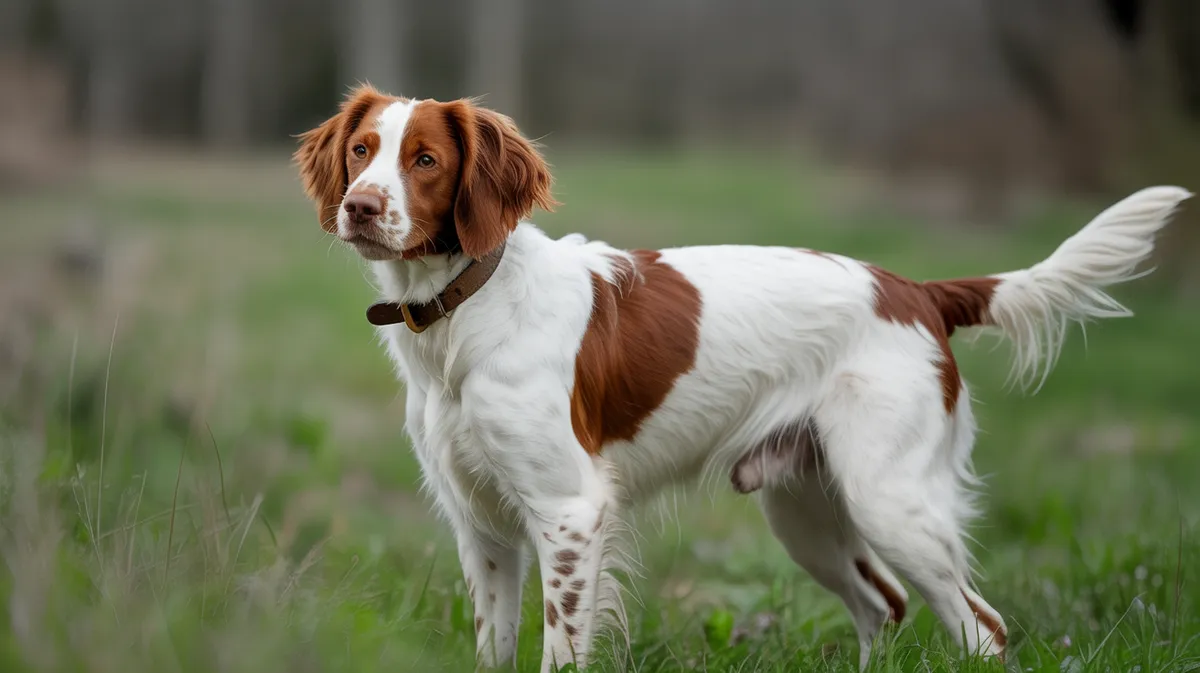
About the Brittany Spaniel
The Brittany Spaniel, commonly known simply as the Brittany, is an energetic and versatile breed of gundog originating from the Brittany region of France. Renowned for its keen nose and remarkable agility, the Brittany is equally adept at pointing and retrieving game, making it a favorite among hunters. This medium-sized dog has a compact, athletic build, expressive eyes, and a dense, often orange and white or liver and white coat. Brittanys are also known for their friendly disposition, intelligence, and eagerness to please, making them excellent family companions.
Fascinating facts
Versatile Hunter
The Brittany is highly valued by hunters for its ability to both point and retrieve game birds.
High Energy
This breed requires a lot of physical activity and mental stimulation to remain happy and healthy.
Excellent Sense of Smell
Brittanys have an outstanding sense of smell, making them exceptional at tracking scents in the field.
Detailed description
The Brittany Spaniel, also known as the Epagneul Breton, is a medium-sized, athletic gundog characterized by a compact, well-proportioned frame and a high degree of agility. Adults typically weigh between 13.5–20.5 kg (30–45 lbs) and stand 47–52 cm (18.5–20.5 in) at the withers, with males and females displaying only minor size differences. The breed’s coat is dense, flat or slightly wavy, and of medium length, providing protection against harsh weather and underbrush; accepted colors include orange and white, liver and white, black and white (in some registries), and various roan patterns. Brittanys have a distinctly expressive face, with large, dark, well-set eyes and high-set, triangular ears that are slightly rounded at the tip. Their tails are naturally short or may be docked, though docking practices vary by country. The breed is renowned for its keen olfactory senses, stamina, and versatility in both pointing and retrieving game, particularly upland birds. Brittanys are highly intelligent, eager to learn, and possess a gentle, affectionate temperament, making them excellent companions as well as working dogs. Their social nature means they thrive in active households and require regular mental and physical stimulation. Anatomically, they are built for endurance and speed, with strong, muscular hindquarters and a deep chest that supports efficient respiration during strenuous activity. The breed’s adaptability and resilience have contributed to its popularity among hunters and families alike.
Did you know?
Despite often being called a 'Spaniel,' the Brittany is technically considered a pointing breed, not a traditional spaniel.
Research & sources
Wikipedia summary
The Brittany Spaniel or Breton Spaniel is a French breed of gun dog of spaniel type, bred primarily for bird hunting.
Behaviour & social structure
Brittany Spaniels are energetic and highly trainable, displaying a strong instinct for hunting and retrieving. In the field, they exhibit a characteristic quartering pattern, systematically searching for scent while maintaining visual contact with their handler. Their pointing behavior is well-developed, often freezing in a classic stance with one foreleg raised when game is detected. Brittanys are known for their soft mouths, allowing them to retrieve birds without causing damage. Socially, they are affectionate and thrive on human companionship, often forming strong bonds with family members and showing a playful, gentle demeanor with children. They are generally sociable with other dogs, especially when properly socialized from a young age. Daily routines should include ample exercise, such as running, hiking, or interactive play, as insufficient activity can lead to restlessness or undesirable behaviors. Brittanys are also noted for their vocalizations, using barks and whines to communicate excitement or alertness.
Reproduction & life cycle
Brittany Spaniels typically reach sexual maturity between 8 and 12 months of age, though breeding is recommended after 18 months to ensure full physical development. The breed does not have a strict breeding season, but most litters are planned for spring or early summer. The average litter size is around 5 puppies, though litters of 3 to 8 are not uncommon. The gestation period lasts approximately 63 days. Females exhibit attentive maternal behavior, providing warmth, grooming, and nursing for their offspring. Puppies are born blind and deaf, opening their eyes at around 10–14 days and beginning to wean at 3–4 weeks. Breeders emphasize early socialization and exposure to various stimuli to foster confident, well-adjusted adults. Responsible breeding practices focus on screening for hereditary conditions such as hip dysplasia and epilepsy, which can affect the breed.
Adaptations & survival
The Brittany Spaniel’s medium-length, weather-resistant coat and dense undercoat protect it from cold, moisture, and thorny vegetation encountered during fieldwork. Its compact, muscular build and long legs provide both speed and endurance, allowing it to cover large areas of terrain efficiently. The breed’s acute sense of smell is a result of selective breeding for scenting ability, making it highly effective in locating game birds. Behavioral adaptations include a strong prey drive, keen focus, and the ability to work closely with humans, responding to hand signals and whistles. Their intelligence and eagerness to please facilitate advanced training for complex tasks such as retrieving from water or dense cover. The breed’s naturally short or docked tail reduces the risk of injury in thick brush.
Cultural significance
The Brittany Spaniel holds a prominent place in French hunting culture, particularly in the Brittany region, where it originated in the mid-19th century. It is celebrated for its versatility and reliability in the field, often depicted in art and literature as the quintessential upland bird dog. The breed’s popularity spread throughout Europe and North America, where it is valued both as a hunting companion and a family pet. In France, the Epagneul Breton is considered a national treasure, with breed standards maintained by the Société Centrale Canine. The Brittany’s friendly and adaptable nature has contributed to its role as a therapy and assistance dog in some regions. While not commonly associated with mythology or symbolism, the breed embodies qualities of loyalty, intelligence, and athleticism in popular culture.
Recent research
Recent genetic studies have focused on the Brittany Spaniel’s relationship to other pointing breeds, revealing a close genetic affinity with the English Setter and other continental spaniels. Research into hereditary health conditions, particularly hip dysplasia and epilepsy, has led to the development of screening protocols and genetic testing, improving breed health outcomes. Behavioral studies highlight the breed’s high trainability and suitability for advanced canine sports, such as agility and scent work. Ongoing research explores the impact of early socialization and enrichment on temperament and working ability. The breed’s adaptability to urban environments, provided sufficient exercise and mental stimulation, is a topic of interest in contemporary canine behavioral science.
Sources
Videos
Habitat
Domestic; originally developed for hunting in fields and woodlands


Conservation
The Brittany Spaniel is currently classified as Domesticated on the IUCN Red List.
Threats & challenges
As a domesticated breed, Brittany Spaniels do not face traditional conservation threats, but several challenges affect their well-being. Overbreeding and irresponsible breeding practices can lead to an increased incidence of hereditary diseases, such as hip dysplasia, epilepsy, and certain eye disorders. The breed’s high energy level and need for mental stimulation mean that under-exercised or neglected Brittanys may develop behavioral problems, leading to abandonment or surrender to shelters. Changes in hunting practices and urbanization have reduced opportunities for fieldwork, potentially impacting the breed’s traditional roles. Breed clubs and responsible breeders advocate for health testing, ethical breeding, and education to ensure the breed’s long-term health and suitability as both a working dog and companion.
Taxonomy
Scientific name
Canis lupus familiaris
- Kingdom
- Animalia
- Phylum
- Chordata
- Class
- Mammalia
- Order
- Carnivora
- Family
- Canidae
- Genus
- Canis
- Species
- lupus familiaris
Community notes
Share your observations about the Brittany Spaniel.
No community notes yet. Be the first!
Discover more wildlife
More fascinating animals from the encyclopedia.