
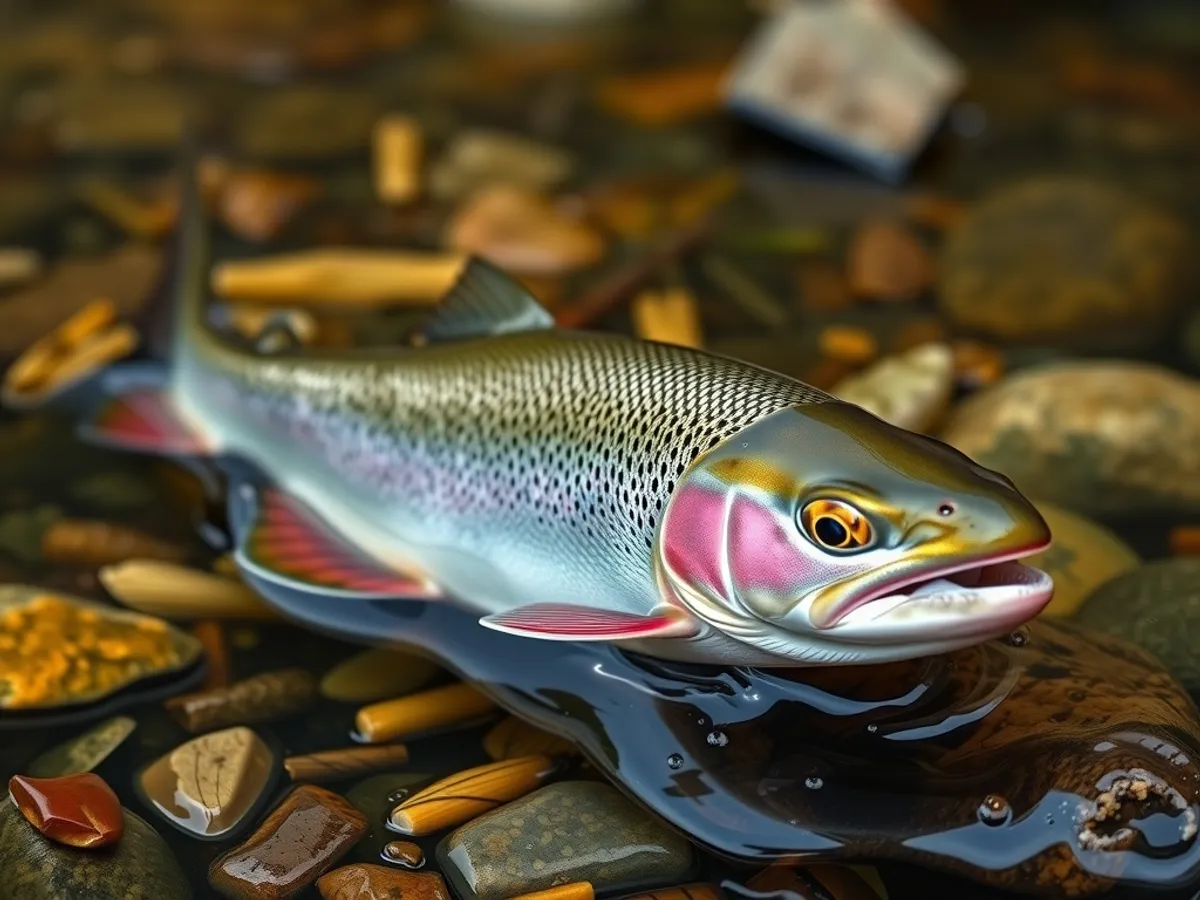
About the Brook trout
The brook trout is a freshwater fish native to eastern North America, known for its vibrant coloration and distinctive marbled patterning along the back and dorsal fin. It inhabits clear, cold, well-oxygenated streams, rivers, and lakes, and is highly sensitive to changes in water quality. Brook trout are prized by anglers for their beauty and fighting spirit and play a key ecological role in their native habitats. They are relatively small compared to other trout species, but are recognized for their adaptability to a range of freshwater environments.
Fascinating facts
Not a True Trout
Despite their name, brook trout belong to the genus Salvelinus, making them a type of char rather than a true trout.
Clean Water Indicator
Brook trout require extremely clean, cold, and well-oxygenated water, making their presence a sign of a healthy aquatic ecosystem.
Angler's Favorite
Their beautiful coloration and spirited fight make brook trout a prized catch among freshwater anglers.
Detailed description
The brook trout (Salvelinus fontinalis) is a medium-sized freshwater char distinguished by its striking coloration: an olive-green to dark brown dorsum adorned with lighter, worm-like vermiculations, and flanks marked by scattered red spots encircled by blue halos. The belly often turns vivid orange or red, especially in breeding males, with lower fins edged in white and black. Adults typically range from 25 to 40 cm (10–16 in) in length and weigh 0.5 to 2.3 kg (1–5 lb), though lake-dwelling 'coaster' forms can exceed 60 cm (24 in) and 6.8 kg (15 lb). Brook trout possess a streamlined, laterally compressed body, a large mouth extending past the eye, and a small, fleshy adipose fin characteristic of Salmonidae. They are highly sensitive to water temperature and dissolved oxygen, thriving in clear, cold, well-oxygenated waters (generally <20°C/68°F). Their lifespan varies by population and environment, typically 3–5 years, but some lake forms may live over 7 years. Brook trout are opportunistic carnivores, feeding on aquatic and terrestrial invertebrates, small fish, and occasionally amphibians. They exhibit both resident and migratory (anadromous and potamodromous) life histories, with complex spawning behaviors and strong site fidelity. Their ecological role includes regulating aquatic insect populations and serving as prey for larger fish, birds, and mammals.
Did you know?
Brook trout are so sensitive to water pollution and temperature changes that they are considered an indicator species for healthy freshwater ecosystems.
Research & sources
Wikipedia summary
The brook trout is a species of freshwater fish in the char genus Salvelinus of the salmon family Salmonidae native to Eastern North America in the United States and Canada. Two ecological forms of brook trout have been recognized by the US Forest Service. One ecological form is long-lived potamodromous populations in Lake Superior known as coaster trout or coasters. The second ecological form is the short-living predaceous anadromous populations which are found in northern lakes and coastal rivers from Long Island to Hudson Bay, which are referred to as salters. In parts of its range, it is also known as the eastern brook trout, speckled trout, brook char, squaretail, brookie, or mud trout, among others. Adult coaster brook trout are capable of reaching sizes over 2 feet in length and weigh up to 6.8 kg (15 lb), whereas adult salters average between 6 and 15 inches in length and weigh between 0.5 and 2.3 kg. The brook trout is characterized by its distinctive olive-green body with yellow and blue-rimmed red spots, white and black edged orange fins, and dorsal vermiculation. The diet of the brook trout is restrictive to the season and location of the fish, but will typically consist of terrestrial and aquatic insects, fry, crustaceans, zooplankton, and worms.
Behaviour & social structure
Brook trout are primarily crepuscular, with peak feeding activity occurring at dawn and dusk. They are solitary or loosely associated outside of spawning, maintaining territories that they defend vigorously, especially in smaller streams. Their feeding strategy is highly opportunistic: they ambush prey from cover such as submerged logs, undercut banks, or overhanging vegetation, using both visual and olfactory cues. Insects (mayflies, caddisflies, stoneflies), crustaceans, zooplankton, and small fish constitute the bulk of their diet, with seasonal shifts reflecting prey availability. Juveniles form loose aggregations for protection, while adults are more territorial. Brook trout exhibit homing behavior, returning to natal streams to spawn. In anadromous 'salter' populations, individuals migrate between freshwater and brackish coastal environments, while 'coasters' migrate within large lakes and tributaries. During non-breeding periods, they may move between habitats to optimize feeding and thermal conditions.
Reproduction & life cycle
Spawning occurs in autumn, typically from September to November, when water temperatures drop to 4–10°C (39–50°F). Females select gravel-bottomed riffles or spring-fed upwellings and excavate shallow nests called redds using vigorous tail movements. Males compete for access, displaying vibrant coloration and engaging in aggressive behaviors. After courtship, the female deposits 100–5,000 eggs (depending on her size) into the redd, which are immediately fertilized by the male. The female then covers the eggs with gravel for protection. Incubation lasts 2–4 months, depending on water temperature; embryos hatch as alevins, remaining in the gravel and absorbing their yolk sacs before emerging as fry. There is no parental care after egg deposition. Sexual maturity is reached at 2–3 years, with some populations exhibiting partial semelparity (death after spawning), though most survive to spawn in subsequent years.
Adaptations & survival
Brook trout display several adaptations for cold-water survival. Their streamlined body and powerful caudal fin enable efficient swimming in fast currents. The coloration provides camouflage against predators and prey, blending with the dappled light and substrate. Physiologically, they have a high tolerance for low temperatures and require high dissolved oxygen, facilitated by efficient gill structures. Their diet flexibility allows them to exploit a wide range of prey. Behavioral adaptations include strong site fidelity, homing ability for spawning, and seasonal habitat shifts to optimize temperature and food availability. In anadromous forms, osmoregulatory adaptations allow brief tolerance of brackish water. Their reproductive strategy—gravel spawning and egg burial—protects developing embryos from predation and sedimentation.
Cultural significance
Brook trout hold significant cultural value in eastern North America. Revered as the state fish of several U.S. states (including New Hampshire, Michigan, New Jersey, New York, Pennsylvania, Vermont, Virginia, and West Virginia) and the provincial fish of Nova Scotia, they are celebrated in angling literature and folklore as symbols of pristine wilderness. Indigenous peoples traditionally harvested brook trout for food and ceremonial purposes. The species features prominently in art, literature, and conservation movements, often representing the health of cold-water ecosystems. Fly fishing for brook trout is a storied tradition, with the fish prized for its beauty and spirited fight.
Recent research
Recent research has focused on the genetic diversity of brook trout populations, revealing distinct lineages and local adaptations, especially in isolated headwater streams. Studies on climate change impacts predict significant range contractions in the southern and low-elevation portions of their range. Restoration ecology projects have demonstrated the effectiveness of stream habitat improvements and barrier removals in re-establishing extirpated populations. Genomic studies are providing insights into hybridization dynamics with introduced trout species and the resilience of native populations. Ongoing research also examines the role of brook trout as ecological indicators of freshwater ecosystem health.
Videos
Habitat
Cold, clear freshwater streams, rivers, and lakes
 Elevated Terrain
Mountain
High-altitude environments with varying climates and specialized wildlife adapted to rugged terrain and thin air.
 Global
Forest
Wooded areas with significant tree cover and diverse plant and animal communities.
 Global
Freshwater
Lakes, rivers, and wetlands with diverse aquatic ecosystems.
Conservation
The Brook trout is currently classified as Least Concern on the IUCN Red List.
Threats & challenges
Brook trout face numerous threats, including habitat degradation from logging, agriculture, urbanization, and dam construction, which increase water temperature and sedimentation. Acid rain and climate change further threaten cold-water habitats by altering pH and temperature regimes. Invasive species, particularly brown trout (Salmo trutta) and rainbow trout (Oncorhynchus mykiss), outcompete or hybridize with brook trout, reducing genetic integrity and survival. Overfishing and fragmentation of populations also pose risks. Despite these challenges, brook trout remain widespread in parts of their native range, but have been extirpated from many lowland and southern habitats. Conservation efforts focus on habitat restoration, removal of barriers, and management of invasive species.
Taxonomy
Scientific name
Salvelinus fontinalis
- Kingdom
- Animalia
- Phylum
- Chordata
- Class
- Actinopterygii
- Order
- Salmoniformes
- Family
- Salmonidae
- Genus
- Salvelinus
- Species
- fontinalis
Where to see a brook trout
2 zoos and aquariums in 2 countries are recorded as keeping this species.
 Blue Planet Aquarium🇬🇧 Ellesmere Port, United Kingdom
- 🦁Pittsburgh Zoo & Aquarium🇺🇸 Pittsburgh, United States
Community notes
Share your observations about the Brook trout.
No community notes yet. Be the first!
Discover more wildlife
More fascinating animals from the encyclopedia.