
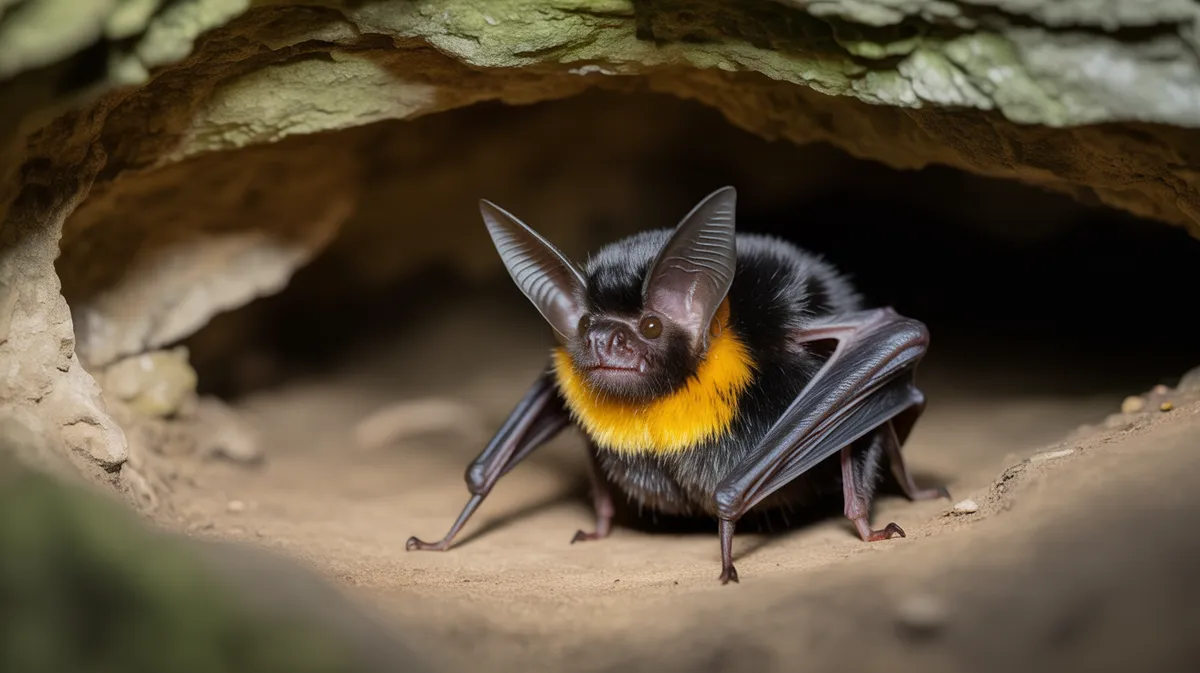
About the Bumblebee Bat
Kitti's hog-nosed bat, or bumblebee bat, weighs about 2 g and has a body 29 to 33 mm long — it is the smallest mammal in the world by body length, and it vies with the Etruscan shrew, which is fractionally lighter, for the title overall. It is so distinct that it is the sole member of its own family, Craseonycteridae, with no close relatives at all; a whole branch of the mammal tree that consists of one tiny animal. It was found only in 1973, in limestone caves in western Thailand, by the Thai zoologist Kitti Thonglongya, who died before he could publish the description. Its life is compressed into two short windows: it emerges for perhaps half an hour at dusk and again briefly at dawn, foraging around bamboo clumps and teak, hovering like a hummingbird to pluck insects and spiders directly off leaves. That hovering — expensive, precise flight — is what its pig-like nose and broad wings support. It roosts in a few dozen limestone caves in Thailand and southeast Myanmar and nowhere else on Earth.
Fascinating facts
World’s Smallest Bat
The Bumblebee Bat measures only about 30 mm in length—smaller than most human thumbs—and is one of the tiniest mammals on the planet.
Specialized Habitat
It is found exclusively in limestone caves along forested rivers in Thailand and Myanmar, with colonies often numbering fewer than 100 individuals.
Tiny Appetite
Despite their size, these bats play a vital role in controlling insect populations by consuming hundreds of small insects each night.
Detailed description
The Bumblebee Bat (Craseonycteris thonglongyai), also called Kitti’s hog-nosed bat, is the world’s smallest mammal by skull size and among the smallest by weight, averaging 1.7–2.0 grams and measuring 29–33 mm in head-body length. Its fur is a soft reddish-brown to grey, with a paler underside. The bat’s most distinctive feature is its pig-like, upturned snout, which is surrounded by prominent nasal pads. Its broad wings, with a wingspan of 130–145 mm, are adapted for slow, highly maneuverable flight within cluttered cave and forest environments. The tail is extremely short and partially enclosed in the interfemoral membrane, aiding in flight control. The ears are relatively large and rounded, with a simple tragus. Bumblebee bats possess small, sharp teeth suited for their insectivorous diet. Their eyes are tiny, reflecting their reliance on echolocation rather than vision. The species is crepuscular, emerging at dusk and dawn to forage. Socially, they roost in small colonies, typically ranging from 10 to 100 individuals, in the dark recesses of limestone caves. Their elusive nature and minute size make them challenging to study, and much of their life history remains poorly understood.
Did you know?
A single Bumblebee Bat can fit comfortably on the tip of a human finger due to its incredibly small size.
Research & sources
Wikipedia summary
Kitti's hog-nosed bat, also known as the bumblebee bat, is a near-threatened species of bat and the only extant member of the family Craseonycteridae. It occurs in western Thailand and southeast Myanmar, where it occupies limestone caves along rivers.
Behaviour & social structure
Bumblebee bats are primarily crepuscular, emerging briefly at dusk and dawn for foraging flights that last only 20–30 minutes. They feed on small flying insects, such as midges and mosquitoes, which they capture in flight using rapid, low-altitude, and highly agile maneuvers. Foraging typically occurs close to cave entrances or along nearby forest edges and riverbanks. Echolocation is used for navigation and prey detection, with calls in the ultrasonic range (approximately 70–80 kHz). During the day, they roost in high, sheltered parts of caves, often clustering in small, loose groups for thermoregulation and protection. Social interactions are limited, with minimal vocal communication observed outside of echolocation. There is little evidence of territoriality, and roost fidelity is high, with bats returning to the same caves nightly.
Reproduction & life cycle
Reproduction in Craseonycteris thonglongyai is seasonal, with mating believed to occur in late January to early February. Females give birth to a single offspring per year, typically in late April or early May, after a gestation period estimated at 2–3 months. Newborns are altricial, weighing less than 0.5 grams at birth, and are carried by the mother for a short period before being left in the roost while she forages. Parental care is provided solely by the female, with weaning occurring after several weeks. Sexual maturity is reached within the first year of life. The low reproductive rate, with only one pup per year, makes the species particularly vulnerable to population declines.
Adaptations & survival
Bumblebee bats exhibit several unique adaptations to their microhabitat and lifestyle. Their extremely small size reduces energy requirements and enables them to exploit narrow crevices in caves for roosting, minimizing predation risk. The broad, short wings provide exceptional maneuverability for navigating dense vegetation and cave interiors. Their pig-like snout may aid in tactile exploration or enhance olfactory sensitivity. Echolocation calls are finely tuned for detecting small insect prey in cluttered environments. The species also demonstrates a capacity for torpor, allowing them to conserve energy during periods of food scarcity or cooler temperatures. Their roosting behavior in groups may assist in maintaining optimal body temperature and humidity.
Cultural significance
Due to its recent scientific discovery (1974) and elusive nature, the Bumblebee Bat holds little traditional cultural significance in local communities. However, it has gained symbolic status as a flagship species for cave and karst ecosystem conservation in Thailand and Myanmar. Its status as the world’s smallest mammal has attracted international attention, promoting awareness of Southeast Asian biodiversity and the importance of protecting unique microhabitats.
Recent research
Recent research has focused on population genetics, echolocation call structure, and habitat requirements. Genetic studies confirm that Craseonycteris thonglongyai is the sole extant member of its family, representing a highly distinct evolutionary lineage. Acoustic monitoring has revealed subtle variation in echolocation calls between populations, possibly reflecting adaptation to different cave environments. Ongoing studies are investigating the effects of habitat disturbance and climate change on population viability. Conservation efforts are supported by local and international NGOs, with some caves designated as protected areas. There is a continued need for ecological and behavioral research to inform effective management strategies.
Videos
Habitat
Limestone caves in forested river valleys

Conservation
The Bumblebee Bat is currently classified as Near Threatened on the IUCN Red List.
Threats & challenges
Major threats to the Bumblebee Bat include habitat loss due to limestone quarrying, deforestation, and disturbance of roosting sites by tourism and local human activities. The species' limited range—restricted to a few cave systems in western Thailand and southeast Myanmar—renders it highly susceptible to localized disturbances. Population trends are difficult to assess, but the IUCN estimates fewer than 10,000 mature individuals remain, with a continuing decline. Conservation challenges include protecting critical cave habitats, managing tourism impacts, and preventing illegal collection. Climate change poses additional risks by altering cave microclimates and insect prey availability.
Taxonomy
Scientific name
Craseonycteris thonglongyai
- Kingdom
- Animalia
- Phylum
- Chordata
- Class
- Mammalia
- Order
- Chiroptera
- Family
- Craseonycteridae
- Genus
- Craseonycteris
- Species
- thonglongyai
Community notes
Share your observations about the Bumblebee Bat.
No community notes yet. Be the first!
Discover more wildlife
More fascinating animals from the encyclopedia.