
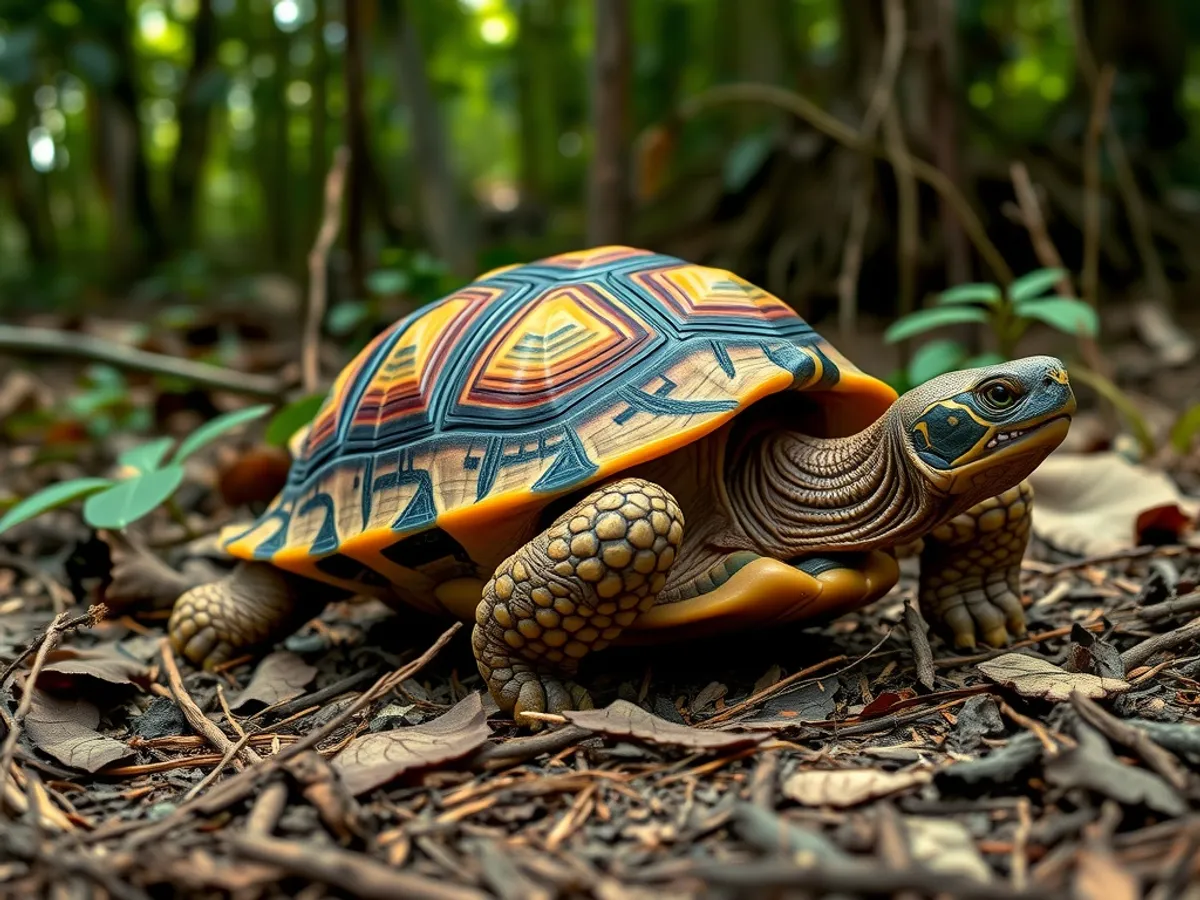
About the Burmese Star Tortoise
The Burmese Star Tortoise is a medium-sized, critically endangered tortoise native to the dry, deciduous forests of central Myanmar. It is renowned for its beautiful, radiating star-like patterns on its domed shell, which provide effective camouflage among the leaf litter. This herbivorous reptile is primarily terrestrial, spending its days foraging for grasses and other vegetation. Due to habitat loss and poaching for the illegal pet trade, its wild population has been reduced to dangerously low numbers.
Fascinating facts
Unique Shell Patterns
Each Burmese Star Tortoise has a distinct star-patterned shell, which helps with camouflage and individual identification.
Slow Reproduction
Females lay only a few eggs per clutch, making population recovery a slow process even under ideal conditions.
Conservation Success
Captive breeding and reintroduction programs have resulted in thousands of Burmese Star Tortoises being released into protected areas in Myanmar.
Detailed description
The Burmese Star Tortoise (Geochelone platynota) is a medium-sized terrestrial tortoise, typically reaching 25–30 cm (10–12 in) in carapace length, with some individuals growing up to 38 cm (15 in). Adults weigh between 3 and 5 kg (6.6–11 lbs). Its most distinctive feature is the high-domed, oval carapace adorned with striking yellow or cream radiating star patterns on a dark brown to black background, a form of disruptive coloration that helps camouflage it among the dappled leaf litter of its native habitat. The plastron is pale yellow with dark markings, and the limbs are sturdy, covered in large, non-overlapping scales. The head is relatively small, with a blunt snout and a beak adapted for grazing. Burmese Star Tortoises are primarily diurnal, spending the hottest part of the day sheltering under vegetation or in burrows. They are solitary by nature, coming together mainly during the breeding season. Their diet consists mainly of grasses, herbs, fallen fruit, and occasionally succulent plants. This species is adapted to the seasonal climate of central Myanmar, with activity peaking during the wet season and reduced movement during the dry, cooler months. Lifespan in the wild is estimated at 50–70 years, though some individuals in captivity have exceeded this.
Did you know?
At one point, the Burmese Star Tortoise was considered functionally extinct in the wild until intensive conservation efforts began to reverse their decline.
Research & sources
Wikipedia summary
The Burmese star tortoise is a critically endangered tortoise species, native to the dry, deciduous forests of Myanmar (Burma).
Behaviour & social structure
Burmese Star Tortoises are predominantly solitary and display minimal social interaction outside of the breeding season. They are most active during the early morning and late afternoon, foraging for a wide variety of fibrous grasses, leafy weeds, and occasionally fallen fruit. Their feeding behavior is methodical, using their strong, serrated beaks to clip vegetation close to the ground. During the hottest midday hours, they seek shelter under shrubs, in leaf litter, or in shallow self-dug scrapes to avoid desiccation. They are not territorial but may show mild aggression during mating encounters, with males occasionally ramming or biting rivals. Communication is limited, relying on visual and tactile cues, especially during courtship. Burmese Star Tortoises are known for their slow, deliberate movements and are generally non-aggressive toward conspecifics outside of breeding contexts.
Reproduction & life cycle
Breeding in the wild is closely tied to the onset of the rainy season, typically from June to October. Males initiate courtship by trailing and nudging females, sometimes engaging in head bobbing or gentle biting. Copulation is accompanied by vocalizations from the male. Females lay 3–10 eggs per clutch, with up to three clutches per season. Eggs are deposited in shallow nests dug in sandy or loose soil, and incubation lasts 95–125 days, depending on temperature and humidity. There is no parental care after egg-laying; hatchlings emerge independently and are immediately self-sufficient, though highly vulnerable to predation. Sexual maturity is reached at 8–12 years of age in the wild, with females generally maturing later than males.
Adaptations & survival
The Burmese Star Tortoise exhibits several adaptations to its arid, seasonal environment. Its domed, star-patterned shell provides camouflage from predators and helps regulate body temperature by maximizing surface area for heat exchange. The tortoise is able to withstand extended dry periods by reducing activity and seeking microhabitats with higher humidity. Its herbivorous diet is supported by a robust digestive system capable of extracting nutrients from coarse, fibrous plants. The species can store water in its bladder, allowing it to survive during droughts. Behavioral adaptations include burrowing and seeking shade to avoid overheating, and seasonal activity patterns that align with rainfall and food availability.
Cultural significance
In Myanmar, tortoises, including the Burmese Star Tortoise, have been historically valued both as food and for use in traditional medicine, where their shells and body parts are believed to have medicinal properties. The species' striking appearance has also made it a coveted item in the illegal pet trade, particularly in East Asian markets. In recent years, the tortoise has become a symbol of national conservation efforts, with local and international organizations highlighting its plight to promote wildlife protection and environmental awareness in Myanmar.
Recent research
Recent research has focused on the genetics and population structure of Geochelone platynota, revealing low genetic diversity due to population bottlenecks. Studies on captive breeding have optimized incubation conditions to improve hatchling survival and sex ratios. Reintroduction programs are being closely monitored using radio telemetry to assess survival, dispersal, and adaptation of released individuals. Conservation biologists are also investigating the species' ecological role in seed dispersal and its interactions with sympatric tortoise species. Ongoing research aims to refine habitat management strategies and evaluate the long-term viability of reintroduced populations.
Videos
Habitat
Dry deciduous forest


Conservation
The Burmese Star Tortoise is currently classified as Critically Endangered on the IUCN Red List.
Threats & challenges
The primary threats to the Burmese Star Tortoise are habitat loss due to agricultural expansion, deforestation, and illegal collection for the international pet trade and traditional medicine markets. Poaching has decimated wild populations, with estimates suggesting fewer than a few hundred individuals remaining in the wild as of the early 21st century. The species' limited range and specialized habitat requirements exacerbate its vulnerability. Conservation efforts are challenged by ongoing habitat degradation, lack of enforcement of protective legislation, and limited public awareness. However, intensive captive breeding and reintroduction programs in Myanmar have shown promise, with thousands of tortoises now in managed care and several hundred released into protected areas. Despite these efforts, the wild population remains critically low and highly fragmented.
Taxonomy
Scientific name
Geochelone platynota
- Kingdom
- Animalia
- Phylum
- Chordata
- Class
- Reptilia
- Order
- Testudines
- Family
- Testudinidae
- Genus
- Geochelone
- Species
- platynota
Community notes
Share your observations about the Burmese Star Tortoise.
No community notes yet. Be the first!
Discover more wildlife
More fascinating animals from the encyclopedia.