
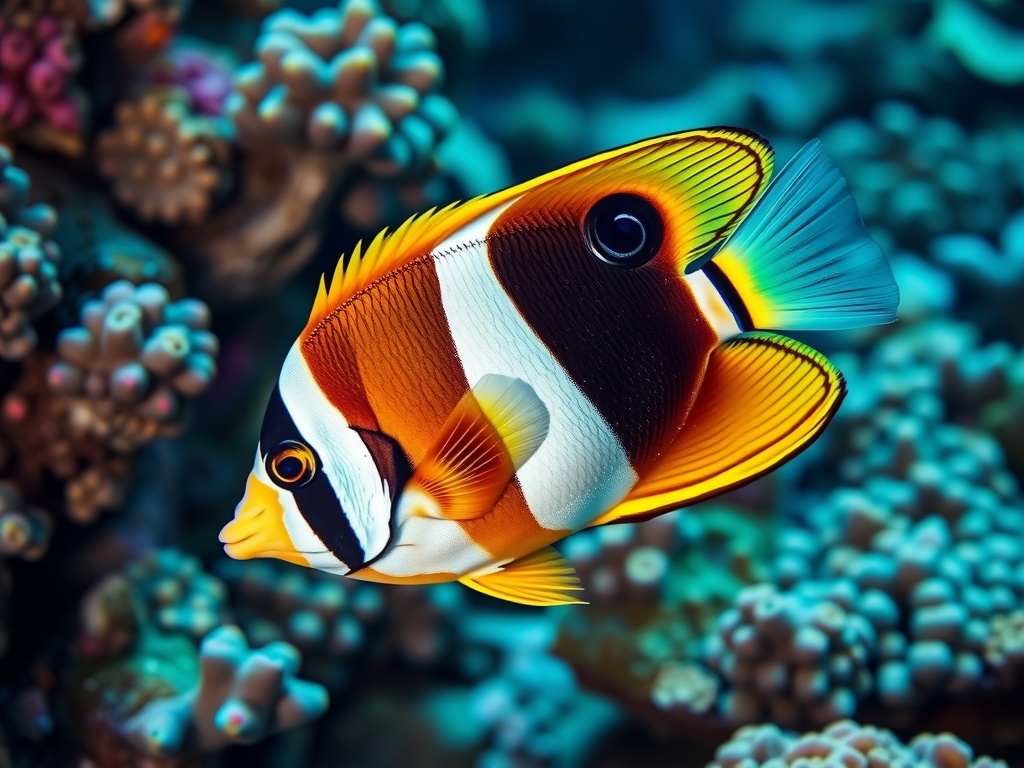
About the Butterflyfish
Butterflyfish are brightly colored, small to medium-sized marine fish known for their striking patterns and laterally compressed bodies. They inhabit coral reefs in tropical and subtropical oceans worldwide, where their vivid colors and prominent eye stripes offer both camouflage and communication. Butterflyfish are agile swimmers that often form monogamous pairs and are frequently observed darting among corals in search of food. Their narrow, elongated snouts allow them to reach into crevices to feed on coral polyps, algae, and small invertebrates. Due to their dependence on healthy reefs, butterflyfish are considered indicators of coral reef ecosystem health.
Fascinating facts
Reef Dwellers
Butterflyfish are almost exclusively found in shallow coral reefs, where they weave through coral branches in search of food and shelter.
Monogamous Pairs
Many butterflyfish species form lifelong monogamous pairs, swimming and feeding together, and defending their territory from other fish.
Eye-Striking Patterns
Distinctive stripes and eye spots on butterflyfish confuse predators about their true head position, increasing their chances of escape.
Detailed description
The threadfin butterflyfish (Chaetodon auriga) is a medium-sized marine fish, typically reaching lengths of 18–23 cm (7–9 inches). It is instantly recognizable by its laterally compressed, disc-shaped body, which is adorned with a striking pattern of yellow and white vertical bands, a prominent black eyestripe, and a distinctive trailing filament or 'thread' extending from the posterior dorsal fin. The mouth is small and elongated, perfectly adapted for extracting prey from narrow crevices in coral reefs. Its large, rounded pectoral fins and continuous dorsal fin facilitate agile maneuvering among complex reef structures. Chaetodon auriga is diurnal, foraging actively during daylight hours and seeking shelter in reef crevices at night. Socially, this species is most often observed in monogamous pairs, although solitary individuals and small aggregations can occur, especially among juveniles. The species exhibits a high degree of site fidelity, often maintaining and defending small territories. Its coloration serves both as camouflage among corals and as a means of intraspecific communication. The threadfin butterflyfish is primarily an invertivore, feeding on coral polyps, small crustaceans, polychaete worms, and occasionally algae. Its dependence on live coral makes it a sensitive indicator of reef health. The species is widely distributed throughout the Indo-Pacific, from the Red Sea and East Africa to the central Pacific islands.
Did you know?
Butterflyfish are so dependent on coral reefs that their populations can rapidly decline if reefs are damaged or destroyed.
Research & sources
Wikipedia summary
The butterflyfish are a group of conspicuous tropical marine fish of the family Chaetodontidae; the bannerfish and coralfish are also included in this group. The approximately 129 species in 12 genera are found mostly on the reefs of the Atlantic, Indian, and Pacific Oceans. A number of species pairs occur in the Indian and Pacific Oceans, members of the huge genus Chaetodon.
Behaviour & social structure
Chaetodon auriga displays complex and highly specialized foraging behaviors, using its elongated snout and protractile jaws to probe into coral branches and crevices for prey. It is predominantly diurnal, with peak activity during early morning and late afternoon. Territorial pairs patrol and defend feeding grounds against conspecifics and other butterflyfish species, using visual displays such as lateral displays and fin spreading. Pair bonding is strong, with partners maintaining close proximity and synchronized swimming. At night, individuals seek shelter within coral heads or under ledges to avoid nocturnal predators. Juveniles are more secretive and tend to remain solitary, often hiding within branching corals. The species is known for its site fidelity, returning to the same shelter sites and feeding areas daily.
Reproduction & life cycle
Threadfin butterflyfish are oviparous, engaging in external fertilization. Spawning typically occurs at dusk, with pairs rising into the water column to release eggs and sperm simultaneously. This behavior reduces predation risk on gametes. Spawning is often synchronized with lunar cycles and seasonal increases in water temperature, usually peaking during late spring and early summer. Females can release thousands of buoyant, pelagic eggs per spawning event. There is no parental care; eggs drift with currents and hatch after approximately 24–48 hours. Larvae are planktonic, undergoing a unique tholichthys stage characterized by bony head plates, before settling onto the reef as juveniles after several weeks.
Adaptations & survival
Chaetodon auriga exhibits several key adaptations for reef life. Its laterally compressed body allows it to navigate tight spaces within coral reefs, while its elongated snout and small, bristle-like teeth are specialized for picking small prey from crevices. The bold eyestripe running through the eye and the false eyespot near the tail serve as anti-predator adaptations, confusing predators about the fish's true orientation. The trailing dorsal filament may also distract predators or play a role in intraspecific signaling. Coloration provides camouflage among corals and may help in species recognition. Physiologically, butterflyfish have a high degree of visual acuity, aiding in foraging and social interactions.
Cultural significance
Butterflyfish, including Chaetodon auriga, are popular in the marine aquarium trade due to their vivid coloration and graceful movements. In some Pacific and Southeast Asian cultures, butterflyfish are considered symbols of beauty, fidelity, and good fortune, likely due to their monogamous pair bonds and striking appearance. They are frequently featured in traditional art, folklore, and tourism marketing as icons of tropical marine biodiversity. However, there are no known traditional uses for food or medicine, as their flesh is generally not considered palatable.
Recent research
Recent research on Chaetodon auriga has focused on its role as a bioindicator for coral reef health, with population declines often preceding or paralleling coral loss. Molecular phylogenetic studies have clarified relationships within the Chaetodontidae family, revealing cryptic speciation and hybridization events. Behavioral ecology research has documented the mechanisms of pair bonding and territory defense, as well as the impact of habitat degradation on social structure. Ongoing studies are investigating the resilience of butterflyfish populations to climate-induced coral bleaching and the potential for adaptation to shifting reef conditions.
Videos
Habitat
Coral reefs

Conservation
The Butterflyfish is currently classified as Least Concern on the IUCN Red List.
Threats & challenges
The primary threat to Chaetodon auriga is the degradation of coral reef habitats due to climate change, ocean acidification, coral bleaching, and destructive fishing practices. Overcollection for the aquarium trade can locally impact populations. Although currently listed as Least Concern by the IUCN, localized declines have been noted in areas with severe reef damage. The species' strong reliance on live coral makes it particularly vulnerable to coral loss. Pollution, coastal development, and invasive species further exacerbate these threats. Long-term population trends are closely tied to the health and resilience of coral reef ecosystems.
Taxonomy
Scientific name
Chaetodon auriga
- Kingdom
- Animalia
- Phylum
- Chordata
- Class
- Actinopterygii
- Order
- Perciformes
- Family
- Chaetodontidae
- Genus
- Chaetodon
- Species
- auriga
Community notes
Share your observations about the Butterflyfish.
No community notes yet. Be the first!
Discover more wildlife
More fascinating animals from the encyclopedia.