
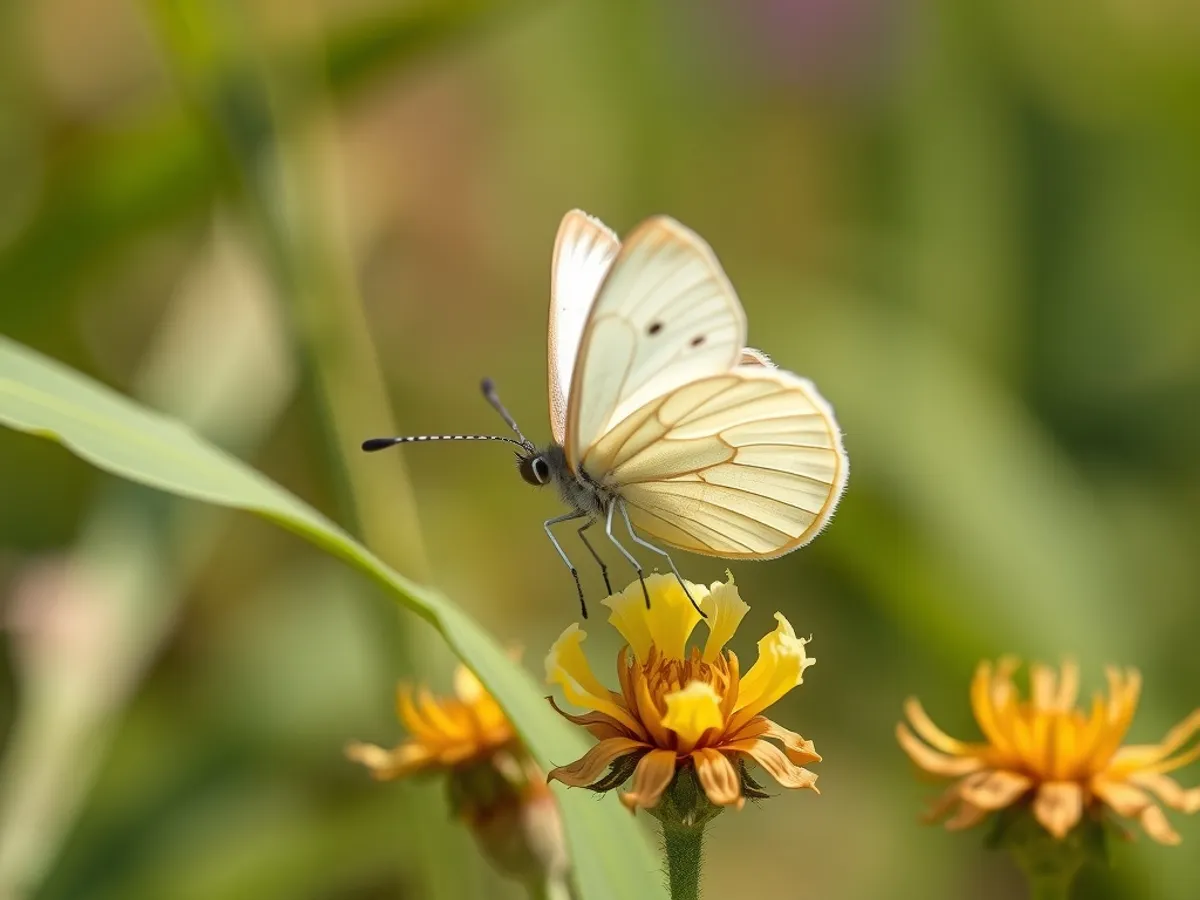
About the Cabbage White Butterfly
The cabbage white is arguably the most successful invasive insect of the modern era. Introduced accidentally into Quebec around 1860, it spread across North America within decades, and it is now on every continent except Antarctica — and the reason is a biochemical arms race that it won. Brassicas, the cabbage family, defend themselves with a "mustard oil bomb": chew a leaf and an enzyme meets a stored glucosinolate, producing toxic isothiocyanates. Cabbage white caterpillars carry a gut protein, a nitrile-specifier protein, that intercepts the reaction and redirects it to produce harmless nitriles instead, which the caterpillar simply excretes. The plant's chemical weapon is defused, so a plant that most insects cannot touch becomes an exclusive private larder. Females can distinguish the sexes at a glance — the male has one black spot on each forewing, the female two — and they inspect plants before laying, avoiding leaves that already carry eggs. It overwinters as a chrysalis, and can produce several generations in a summer.
Fascinating facts
Distinctive Markings
Female Cabbage White Butterflies have two black spots on each forewing, while males have only one, making it easy to distinguish between sexes.
Agricultural Pest
The larvae, known as cabbage worms, are major pests of cabbage, broccoli, and other cruciferous crops, causing significant agricultural damage.
Global Spread
Originally from Europe and Asia, this butterfly has successfully colonized North America, Australia, and New Zealand due to human activity.
Detailed description
The Cabbage White Butterfly (Pieris rapae) is a small to medium-sized lepidopteran, with adults typically exhibiting a wingspan of 32–47 mm. The forewings are predominantly white with one or two black spots in females and a single spot in males, while the hindwings are a pale yellowish-white with faint black margins. The body is slender, covered in fine scales, and the antennae are clubbed, characteristic of the family Pieridae. The ventral (underside) of the hindwings is yellowish with fine speckling, providing camouflage when at rest. Pieris rapae is diurnal and highly active in warm, sunny conditions, often seen fluttering low over vegetation. The species is solitary but may aggregate in areas with abundant host plants. Its larvae, known as cabbage worms, are green with faint yellow stripes, well-camouflaged against Brassicaceae leaves. Adults possess a rapid, erratic flight, which aids in predator evasion. This butterfly is highly adaptable, thriving in disturbed habitats, urban gardens, and agricultural fields, contributing to its global invasive success.
Did you know?
Despite their delicate appearance, Cabbage White Butterflies are among the most widespread and adaptable butterfly species on the planet.
Research & sources
Wikipedia summary
Pieris rapae is a small- to medium-sized butterfly species of the whites-and-yellows family Pieridae. It is known in Europe as the small white, in North America as the cabbage white or cabbage butterfly, on several continents as the small cabbage white, and in New Zealand as the white butterfly. The butterfly is recognizable by its white color with small black dots on its wings, and it can be distinguished from P. brassicae by the latter's larger size and black band at the tip of the forewings.
Behaviour & social structure
Pieris rapae exhibits a range of behaviors adapted for survival in open and disturbed habitats. Adults are primarily nectar feeders, visiting a wide variety of flowers, including dandelions, clovers, and mustards, using their long proboscis. They are most active during daylight hours, especially in warm, sunny weather. Males patrol territories and exhibit mate-locating behavior by flying low and searching for females. Females are selective in oviposition, laying eggs singly on the undersides of host plant leaves, primarily Brassicaceae species. The larvae are voracious feeders, consuming large amounts of foliage, and may drop from plants when disturbed. Both larvae and adults use visual and chemical cues for navigation and host plant selection. Adults may bask with wings open to regulate body temperature and seek shelter during adverse weather.
Reproduction & life cycle
Reproduction in Pieris rapae is characterized by rapid and prolific breeding. Courtship involves males locating females by sight and pheromonal cues, followed by a brief aerial chase and copulation. Females lay up to 200 eggs in their lifetime, depositing them singly on the undersides of host plant leaves. Eggs are small, elongated, and pale yellow, hatching in 4–8 days depending on temperature. The larval stage lasts 2–3 weeks, during which the caterpillars undergo four to five molts. Pupation occurs in a loosely attached chrysalis, which is green or brown and blends with the substrate. The pupal stage lasts 1–2 weeks in summer, but may overwinter in temperate regions. Multiple generations (up to 4–6) can occur annually in favorable climates, contributing to rapid population growth.
Adaptations & survival
Pieris rapae has evolved several adaptations for survival and success as a global pest species. The larvae possess cryptic coloration, blending with host plant leaves to avoid predation. Adults have rapid, erratic flight patterns that reduce capture by birds and other predators. The species is highly polyphagous, with larvae able to feed on a wide range of Brassicaceae and some Capparaceae, enabling colonization of diverse habitats. Females use chemoreceptors on their tarsi to detect glucosinolates, chemicals characteristic of host plants. The butterfly's ability to breed continuously in warm climates and enter diapause as pupae in colder regions enhances survival across broad geographic ranges. Resistance to certain plant defensive compounds and some insecticides has also been documented.
Cultural significance
The Cabbage White Butterfly is a familiar and often symbolic species in many cultures. In Europe and North America, it is commonly associated with gardens and agriculture, sometimes representing transformation or the ephemeral nature of life. In some folklore, white butterflies are seen as omens of good luck or the souls of the departed. However, due to its pest status, it is also viewed negatively by farmers and gardeners. Educationally, it is used as a model organism in studies of insect development, ecology, and pest management. In New Zealand, its introduction has had significant ecological and agricultural impacts, leading to organized eradication efforts.
Recent research
Recent research on Pieris rapae has focused on its interactions with host plant chemistry, mechanisms of insecticide resistance, and the ecological impacts of its global spread. Genomic studies have identified genes involved in detoxification of plant defenses and adaptation to novel environments. Behavioral ecology research has examined mate choice, oviposition preferences, and navigation. Studies on biological control have explored the use of parasitoids and entomopathogenic fungi to manage populations. Climate change modeling predicts further range expansion, particularly into higher latitudes. Ongoing citizen science projects track phenology and migration patterns, contributing valuable data on population dynamics.
Videos
Habitat
Open fields, gardens, agricultural areas, meadows


Conservation
The Cabbage White Butterfly is currently classified as Least Concern on the IUCN Red List.
Threats & challenges
Currently, Pieris rapae faces few significant natural threats due to its adaptability and widespread distribution. Natural enemies include parasitoid wasps (e.g., Cotesia glomerata), tachinid flies, birds, and predatory insects. However, its populations are generally stable or increasing, especially in agricultural landscapes. Human activities, such as pesticide use, can reduce local populations but often lead to resistance development. Climate change may further expand its range. The primary conservation challenge is not for the butterfly itself, but for crop protection, as it is a major pest of cabbage, broccoli, and other crucifers. There are no major conservation concerns for the species, which is listed as Least Concern globally.
Taxonomy
Scientific name
Pieris rapae
- Kingdom
- Animalia
- Phylum
- Arthropoda
- Class
- Insecta
- Order
- Lepidoptera
- Family
- Pieridae
- Genus
- Pieris
- Species
- rapae
Community notes
Share your observations about the Cabbage White Butterfly.
No community notes yet. Be the first!
Discover more wildlife
More fascinating animals from the encyclopedia.