
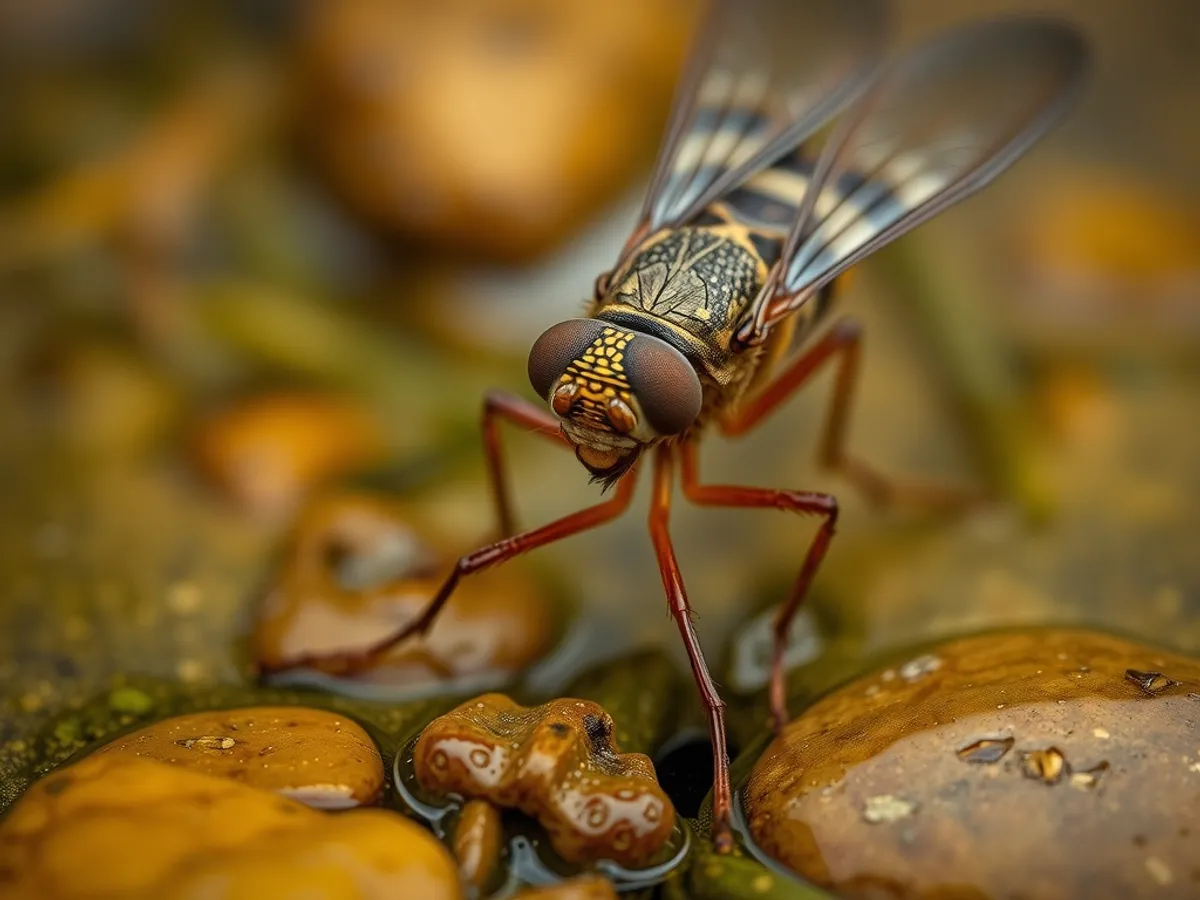
About the Caddisfly
Caddisflies are small, moth-like insects found near freshwater habitats worldwide. Their aquatic larvae are well known for building protective cases out of sand, plant material, and other debris, which they carry around as they feed and grow. Adult caddisflies typically have hairy wings held roof-like over their bodies when at rest and are most active at dusk. They play important ecological roles as both prey and decomposers in aquatic environments. With over 14,000 described species, caddisflies exhibit great diversity in form and behavior.
Fascinating facts
Master Case Builders
Caddisfly larvae construct elaborate protective cases from materials like sand grains, twigs, and shells, held together with silk they produce.
Aquatic Engineers
Their case-building and feeding activities help break down plant material and recycle nutrients in freshwater habitats.
Crucial Fish Food
Many fish species, including trout, rely on caddisfly larvae as a primary food source, making them important for healthy aquatic ecosystems.
Detailed description
Caddisflies (order Trichoptera) are a diverse group of holometabolous insects, closely related to moths and butterflies (Lepidoptera), with approximately 14,500 described species worldwide. Adults typically range from 3 to 20 mm in length and are characterized by soft, slender bodies, long antennae often exceeding body length, and two pairs of membranous, densely hairy wings held tent-like over the abdomen when at rest. Their compound eyes are well-developed, and mouthparts are generally reduced in adults, as feeding is limited or absent. The larvae are aquatic and display remarkable diversity in morphology and behavior, with many constructing portable cases from silk and environmental materials such as sand grains, twigs, or leaf fragments, while others build fixed retreats or live free-living lifestyles. Caddisfly larvae possess chewing mouthparts and well-developed thoracic legs, and often have filamentous gills along the abdomen for underwater respiration. Life cycles typically include egg, larval, pupal, and adult stages, with larval development lasting from several months to over a year depending on species and environmental conditions. Adults are primarily nocturnal, weak fliers, and are attracted to light sources. Caddisflies play vital ecological roles as detritivores, herbivores, and predators in freshwater ecosystems, contributing to nutrient cycling and serving as a key food source for fish and other aquatic organisms.
Did you know?
Adult caddisflies are weak fliers and are often mistaken for small moths, but they are more closely related to butterflies.
Research & sources
Wikipedia summary
The caddisflies are a group of insects with aquatic larvae and terrestrial adults. There are approximately 14,500 described species, most of which can be divided into the suborders Integripalpia and Annulipalpia on the basis of the adult mouthparts. Integripalpian larvae construct a portable casing to protect themselves as they move around looking for food, while annulipalpian larvae make themselves a fixed retreat in which they remain, waiting for food to come to them. The affinities of the small third suborder Spicipalpia are unclear, and molecular analysis suggests it may not be monophyletic. Also called sedge-flies or rail-flies, the adults are small moth-like insects with two pairs of hairy membranous wings. They are closely related to the Lepidoptera which have scales on their wings; the two orders together form the superorder Amphiesmenoptera.
Behaviour & social structure
Caddisfly larvae exhibit a wide range of feeding behaviors, including shredding leaf litter, grazing on periphyton, filtering suspended particles, and preying on other invertebrates. Case-building species (Integripalpia) are mobile and forage while carrying their protective cases, whereas retreat-building species (Annulipalpia) construct silken nets or tubes attached to substrates and filter food from flowing water. Free-living predatory larvae (e.g., Rhyacophilidae) actively hunt small aquatic invertebrates. Larvae are generally solitary, though high densities can occur in favorable habitats. Adults are crepuscular or nocturnal, often found resting on vegetation near water bodies during the day. Swarming behavior is observed in some species during mating flights. Adults do not feed extensively, but may take in water or nectar. Both larvae and adults are important prey for fish, amphibians, birds, and bats.
Reproduction & life cycle
Caddisfly reproduction involves complex courtship behaviors, often mediated by pheromones or species-specific acoustic signals produced by wing or leg movements. Mating typically occurs soon after adult emergence, with females laying eggs in gelatinous masses on submerged vegetation, rocks, or directly into the water. Fecundity varies widely, with females depositing from a few dozen to several hundred eggs. The eggs hatch within 1–3 weeks, depending on temperature and species. Larval development proceeds through 5–7 instars, followed by pupation within a sealed case or cocoon constructed from silk and debris. The pupal stage lasts from several days to a few weeks. There is usually one generation per year (univoltine), but some species may be multivoltine or have extended larval diapause in cold climates. Parental care is absent after oviposition.
Adaptations & survival
Caddisfly larvae are renowned for their ability to spin silk underwater using specialized labial glands, a trait unique among aquatic insects. This silk is used to construct portable cases, fixed retreats, or capture nets, providing protection from predators, environmental stress, and facilitating feeding. The composition and architecture of cases are highly species-specific and often used in taxonomy. Larval gills enable efficient oxygen uptake in low-oxygen aquatic environments. Some species have evolved antifreeze proteins to survive freezing temperatures. Adults possess cryptic coloration and hairy wings that reduce predation risk and may aid in thermoregulation and water repellency. The diversity of larval feeding strategies allows caddisflies to exploit a wide range of ecological niches.
Cultural significance
Caddisflies have featured in human culture primarily through their ecological importance. Fly fishers highly value caddisfly adults and larvae as model organisms for artificial lures, given their significance as fish prey. In some regions, caddisfly cases are used in jewelry, with artisans incorporating gold or precious stones into the larval constructions. The unique case-building behavior has inspired biomimetic research in materials science. Caddisflies are also referenced in folklore and natural history literature as indicators of clean water.
Recent research
Recent scientific research has focused on the molecular phylogeny of Trichoptera, revealing complex evolutionary relationships and challenging traditional suborder classifications, particularly regarding the monophyly of Spicipalpia. Advances in DNA barcoding have improved species identification and understanding of cryptic diversity. Studies on caddisfly silk have uncovered its unique protein composition and potential applications in bioengineering and medicine. Ecotoxicological research continues to use caddisflies as sentinel organisms for monitoring freshwater pollution. Climate change impact studies are examining shifts in distribution and phenology. Ongoing work explores the role of caddisflies in ecosystem functioning and their responses to habitat restoration.
Videos
Habitat
Freshwater streams, rivers, ponds, and lakes
 Global
Freshwater
Lakes, rivers, and wetlands with diverse aquatic ecosystems.
 Global
Forest
Wooded areas with significant tree cover and diverse plant and animal communities.
 Various Continental Regions
Grassland
Open areas dominated by grasses rather than trees, supporting numerous herbivores and their predators.
 Elevated Terrain
Mountain
High-altitude environments with varying climates and specialized wildlife adapted to rugged terrain and thin air.
Conservation
The Caddisfly is currently classified as Least Concern on the IUCN Red List.
Threats & challenges
While many caddisfly species are widespread and abundant, some are threatened by habitat degradation, water pollution (especially from pesticides, heavy metals, and eutrophication), sedimentation, and hydrological alterations such as damming and channelization. Larvae are sensitive to changes in water quality, making them valuable bioindicators in freshwater biomonitoring programs. Climate change poses additional risks through altered hydrological regimes and increased frequency of extreme events. Invasive species and loss of riparian vegetation also impact caddisfly diversity and abundance. Despite these challenges, the overall conservation status of the order is 'Least Concern', though localized declines and extinctions have been documented.
Taxonomy
Scientific name
Trichoptera spp.
- Kingdom
- Animalia
- Phylum
- Arthropoda
- Class
- Insecta
- Order
- Trichoptera
- Family
- Various (e.g., Limnephilidae, Hydropsychidae, Leptoceridae)
- Genus
- Various
- Species
- spp.
Community notes
Share your observations about the Caddisfly.
No community notes yet. Be the first!
Discover more wildlife
More fascinating animals from the encyclopedia.