
About the Cane Toad
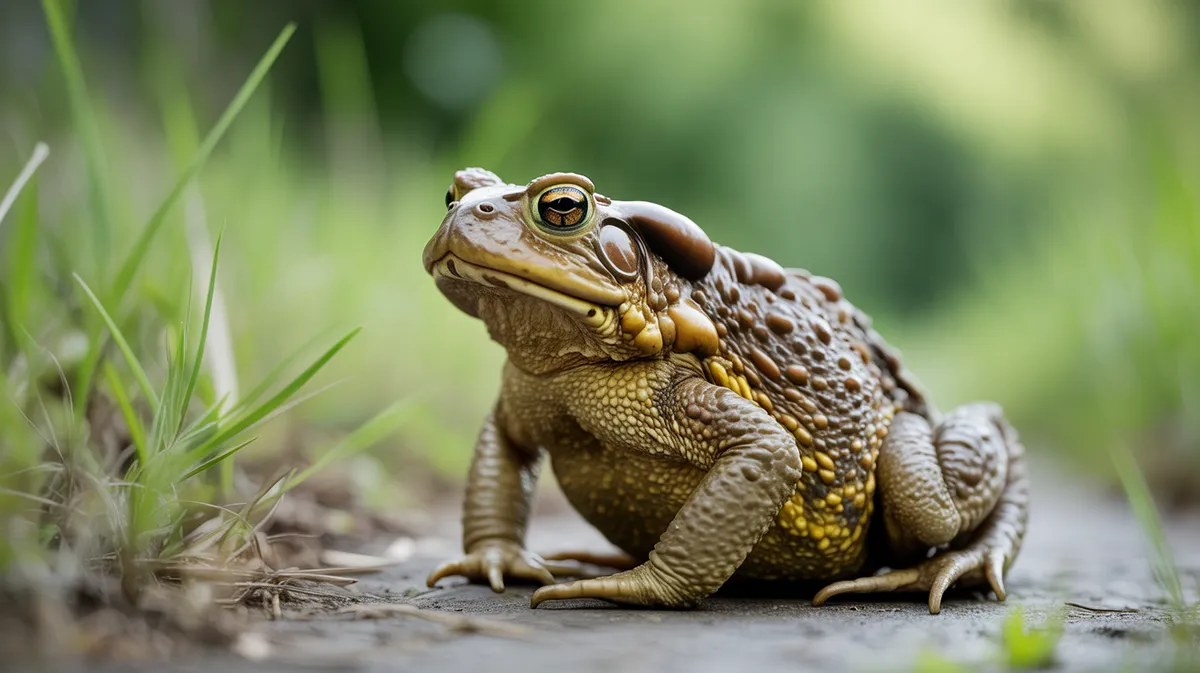
The cane toad is a textbook lesson in ecological hubris. It was released into Queensland in 1935 to control a beetle attacking sugarcane, and it failed immediately and completely: the beetles lived high on the cane stalks, and the toads could not climb. What the toads could do was spread, and they have been marching across northern Australia ever since. The damage they do is not predation but poisoning. Bufotoxin, secreted from the large parotoid glands behind the eyes, is lethal to native predators that have no evolutionary experience of it — quolls, goannas and freshwater crocodiles die from mouthing a single toad — and every life stage, eggs and tadpoles included, is toxic. It breeds prodigiously, tens of thousands of eggs at a time, and eats nearly anything it can fit in its mouth. There is one hopeful thread: researchers have taught quolls to avoid them by feeding them small, sub-lethal toads laced with a nausea-inducing chemical, and the aversion is passed on to their young.
Fascinating facts
Toxic Defense
Cane toads secrete a milky toxin from glands behind their eyes, which is highly poisonous to many animals.
Prolific Breeders
Females can lay thousands of eggs at a time, contributing to their rapid population growth in introduced areas.
Global Invader
Originally from the Americas, cane toads have become invasive in Australia, the Caribbean, and several Pacific islands.
Detailed description
The cane toad (Rhinella marina) is one of the world’s largest true toads, with adults typically ranging from 10 to 15 cm in snout-vent length, though exceptional individuals may reach up to 24 cm and weigh over 1.5 kg. Its robust, squat body is covered in dry, warty skin, varying in color from olive-brown to grayish or yellowish, often with darker mottling. The head is broad and features prominent, raised parotoid glands behind each eye, which secrete a potent bufotoxin as a defense mechanism. Cane toads have short, muscular limbs with unwebbed fingers and partially webbed toes, adapted for terrestrial locomotion. Their eyes have horizontal pupils and a bony ridge runs from the snout to the parotoid gland. Primarily nocturnal, cane toads spend daylight hours sheltering under debris, leaf litter, or in burrows, emerging at dusk to forage. They are opportunistic omnivores, consuming a wide range of invertebrates, small vertebrates, carrion, and even pet food in urban areas. The species is highly fecund, with females capable of laying up to 30,000 eggs in a single clutch. Cane toads are solitary outside of the breeding season, exhibiting minimal social interaction except during explosive breeding events.
Did you know?
A single female cane toad can lay up to 30,000 eggs in one breeding season.
Research & sources
Wikipedia summary
The cane toad, also known as the giant neotropical toad or marine toad, is a large, terrestrial true toad native to South and mainland Central America, but which has been introduced to various islands throughout Oceania and the Caribbean, as well as Northern Australia. It is a member of the genus Rhinella, which includes many true toad species found throughout Central and South America, but it was formerly assigned to the genus Bufo.
Behaviour & social structure
Cane toads are predominantly nocturnal, becoming active shortly after sunset. They exhibit sit-and-wait predation, remaining motionless until prey approaches, then lunging forward with a rapid flick of their sticky tongue. Their diet is highly varied, including insects, spiders, small mammals, reptiles, amphibians, and even plant matter or household scraps. In urban environments, they are known to congregate around artificial lights that attract insects. Social interactions are limited, with individuals generally avoiding each other except during breeding aggregations. When threatened, cane toads inflate their bodies and secrete toxins from their parotoid glands. They are capable of short hops but are not strong jumpers compared to other anurans. During dry periods, they seek humid microhabitats or burrow into moist soil to avoid desiccation.
Reproduction & life cycle
Breeding typically occurs during the rainy season, triggered by heavy rainfall and increased humidity. Males congregate in shallow, slow-moving or still water bodies, such as ponds, ditches, or flooded fields, and produce a distinctive, low-pitched trill to attract females. Amplexus (the mating embrace) is axillary, with males grasping females behind the forelimbs. Females lay long, gelatinous strings of eggs, often exceeding 10 meters in length, which are anchored to aquatic vegetation or debris. Each clutch can contain between 8,000 and 30,000 eggs. Embryonic development is rapid, with eggs hatching in 2–3 days and tadpoles metamorphosing into juvenile toads within 3–8 weeks, depending on temperature and food availability. There is no parental care; adults leave the eggs immediately after spawning. Tadpoles are black, highly toxic, and form dense aggregations for protection.
Adaptations & survival
Cane toads possess several adaptations that contribute to their success as an invasive species. Their parotoid glands secrete a complex cocktail of bufotoxins, deterring most native predators and causing mortality in many that attempt to consume them. Their skin is relatively impermeable, reducing water loss and allowing survival in drier habitats. Cane toads are highly fecund, with large clutches and rapid larval development, enabling swift population expansion. Their broad diet and ability to exploit anthropogenic food sources further enhance their adaptability. Tadpoles and adults are both toxic, providing defense at multiple life stages. Behavioral plasticity, such as the ability to burrow or utilize human-modified environments, also facilitates survival in diverse habitats.
Cultural significance
Cane toads have a complex relationship with humans. Originally introduced to Australia, Hawaii, and other regions in the 20th century as a biological control agent for agricultural pests, their release is now considered a classic example of unintended ecological consequences. In some cultures, cane toad toxins have been used in traditional medicine or as arrow poisons, though their use is limited by the risk of poisoning. The species has become an iconic example in discussions of invasive species management and environmental policy. In popular culture, cane toads have been featured in documentaries, literature, and art, often symbolizing ecological imbalance or human folly.
Recent research
Recent research has focused on the rapid evolutionary changes observed in invasive cane toad populations, particularly in Australia. Studies have documented increased dispersal rates and longer limb lengths in toads at the invasion front, a phenomenon known as 'spatial sorting.' Ongoing research investigates the ecological impacts of cane toads on native fauna, the development of resistance to toxins in predators, and potential biocontrol strategies. Genomic studies have provided insights into the genetic diversity and adaptability of both native and invasive populations. There is also active research into the chemical composition of cane toad toxins and their potential biomedical applications.
Sources
Rhinella marina (Cane Toad): Taxonomy, Distribution, and Biology
Frank Solís et al., IUCN SSC Amphibian Specialist Group (2009)
scientificAround the world in 10 million years: biogeography of the nearly cosmopolitan true toads (Anura: Bufonidae)
Pramuk, Robertson, Sites, and Noonan (2008)
scientificVideos
Habitat
Tropical and subtropical grasslands, forests, and urban areas
 Various Continental Regions
Grassland
Open areas dominated by grasses rather than trees, supporting numerous herbivores and their predators.
 Global
Forest
Wooded areas with significant tree cover and diverse plant and animal communities.
 Global
Freshwater
Lakes, rivers, and wetlands with diverse aquatic ecosystems.
Conservation
The Cane Toad is currently classified as Least Concern on the IUCN Red List.
Threats & challenges
In their native range, cane toads face predation from specialized predators and are regulated by environmental factors. However, in introduced regions, they have few natural enemies and can reach high densities, leading to significant ecological disruption. Their toxins are lethal to many native predators, including snakes, lizards, and mammals, causing declines in these populations. Cane toads also compete with native amphibians for food and breeding sites. Human impacts include road mortality, habitat modification, and targeted eradication efforts. Despite these challenges, cane toad populations remain robust and continue to expand in many introduced areas. Globally, the species is classified as Least Concern by the IUCN due to its wide distribution and large population.
Taxonomy
Scientific name
Rhinella marina
- Kingdom
- Animalia
- Phylum
- Chordata
- Class
- Amphibia
- Order
- Anura
- Family
- Bufonidae
- Genus
- Rhinella
- Species
- marina
Where to see a cane toad
8 zoos and aquariums in 2 countries are recorded as keeping this species.
 Santa Barbara Zoological Gardens🇺🇸 Santa Barbara, United States
 Brevard Zoo🇺🇸 Melbourne, United States
 Perth Zoo🇦🇺 Australia
- 🦁The Maryland Zoo in Baltimore🇺🇸 Baltimore, United States
- 🦁Cheyenne Mountain Zoo🇺🇸 United States
Community notes
Share your observations about the Cane Toad.
No community notes yet. Be the first!
Discover more wildlife
More fascinating animals from the encyclopedia.