
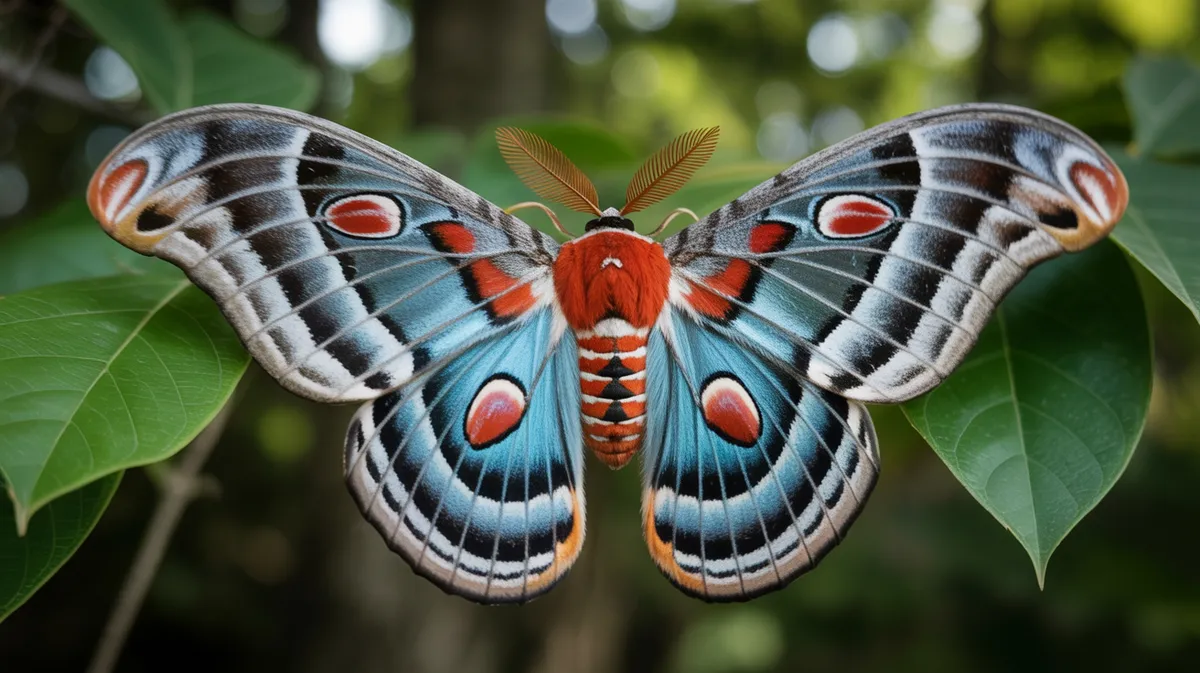
About the Cecropia Moth
The Cecropia Moth is the largest native moth in North America, with a wingspan that can reach up to 7 inches (18 cm). Its striking appearance features reddish-brown wings with bold white, red, and black markings, and crescent-shaped spots. Adults do not eat and live only for a few weeks, focusing solely on reproduction. The caterpillars are equally impressive, growing up to 4 inches long and displaying bright green bodies adorned with blue and yellow tubercles. Cecropia Moths are primarily nocturnal and are often found near light sources during late spring and early summer.
Fascinating facts
Giant Moth
The Cecropia Moth is the largest native moth in North America, with a wingspan up to 7 inches.
Hungry Caterpillars
Cecropia caterpillars feed voraciously on the leaves of many trees and shrubs, including maple, birch, and cherry.
Silky Cocoons
Before becoming adults, Cecropia caterpillars spin tough, brown cocoons that hang from branches for the winter.
Detailed description
The Cecropia Moth (Hyalophora cecropia) is a striking member of the Saturniidae family, renowned for being the largest native moth in North America. Adult moths exhibit a robust, hairy body with a reddish-brown thorax and abdomen banded with white and orange. Their forewings and hindwings are deep mahogany to brown, each adorned with crescent-shaped white spots bordered by red and black, and a distinctive eyespot near the tips. The wingspan typically ranges from 13 to 18 cm (5 to 7 inches), with females generally larger than males. Males are easily recognized by their broad, feathery antennae, which are highly sensitive to female pheromones. The caterpillars are equally notable, reaching lengths of up to 10 cm (4 inches), with bright green bodies and rows of blue, yellow, and orange tubercles tipped with black spines. Cecropia moths are univoltine, producing one generation per year, and adults are strictly nocturnal, being most active during the late spring and early summer. Adults lack functional mouthparts and do not feed, relying entirely on energy reserves accumulated during the larval stage. Their life cycle includes a prolonged pupal stage within a silken cocoon, which provides protection during overwintering.
Did you know?
The Cecropia Moth's cocoons were once studied for potential commercial silk production in North America.
Research & sources
Wikipedia summary
Hyalophora cecropia, the cecropia moth, is North America's largest native moth. It is a member of the family Saturniidae, or giant silk moths. Females have been documented with a wingspan of five to seven inches or more. These moths can be found predominately across the east of North America, with occurrences as far west as Washington and north into the majority of Canadian provinces. Cecropia moth larvae are most commonly found on maple trees, but they have also been found on cherry and birch trees among many others. The species was first described by Carl Linnaeus in his 1758 10th edition of Systema Naturae.
Behaviour & social structure
Cecropia moths are solitary and primarily nocturnal, with adults emerging from their cocoons at dusk. Males are strong fliers and will travel several kilometers in search of females, guided by pheromones released by receptive females. Courtship and mating typically occur during the late night hours. Adults do not feed and spend their brief lifespan (about 1–2 weeks) focused exclusively on reproduction. Larvae are voracious feeders, consuming large quantities of foliage from a variety of host plants, especially maples, cherries, birches, and willows. Larval feeding occurs both day and night, with peak activity during the early morning and late afternoon. There is no evidence of social behavior or group living; larvae may be found on the same tree but do not coordinate activities.
Reproduction & life cycle
The reproductive cycle of Hyalophora cecropia begins shortly after adult emergence. Females release powerful sex pheromones to attract males, which can detect these signals from several kilometers away using their plumose antennae. Mating typically occurs during the early morning hours and can last several hours. After mating, females lay between 100 and 250 eggs, singly or in small clusters, on the undersides of host plant leaves. The eggs hatch in 10–14 days, releasing black, spiny larvae that molt through five instars over a period of 5–6 weeks. Mature larvae spin large, spindle-shaped cocoons attached to branches or stems, where they pupate and overwinter. There is no parental care; all developmental stages are independent after oviposition. The species is univoltine, with adults emerging in late spring to early summer, depending on latitude.
Adaptations & survival
Cecropia moths possess several notable adaptations. The large, feathery antennae of males are highly specialized for detecting female pheromones, enabling mate location over long distances. The bold wing markings and eyespots may serve as anti-predator adaptations, startling or deterring birds and small mammals. Larvae are cryptically colored in early instars, becoming more conspicuous as they grow, which may function as aposematic signaling due to their unpalatability. The tough, silken cocoon provides physical protection from predators and environmental extremes during the vulnerable pupal stage. Adults' inability to feed is an evolutionary trade-off, maximizing reproductive output at the expense of longevity.
Cultural significance
The Cecropia moth holds a place in North American natural history as an emblem of native biodiversity and is often featured in educational programs about metamorphosis and insect life cycles. Its impressive size and beauty have made it a subject of fascination for naturalists, artists, and collectors. In some Indigenous cultures, large moths symbolize transformation and renewal, though specific references to Hyalophora cecropia are rare. The species is also occasionally used in silk production for educational purposes, though it is not commercially significant.
Recent research
Recent research on Hyalophora cecropia has focused on its chemical communication, particularly the identification and synthesis of its sex pheromones, which have applications in ecological monitoring and pest management. Studies have also examined the impact of invasive parasitoids on population dynamics, highlighting the unintended consequences of biological control introductions. Genomic and transcriptomic analyses are providing insights into the molecular basis of metamorphosis, silk production, and immune responses. Ongoing citizen science initiatives, such as moth monitoring programs, contribute valuable data on distribution and phenology in response to environmental change.
Videos
Habitat
Deciduous forests and wooded areas


Conservation
The Cecropia Moth is currently classified as Least Concern on the IUCN Red List.
Threats & challenges
While Hyalophora cecropia is currently classified as Least Concern, several threats impact local populations. Habitat loss due to urbanization and deforestation reduces the availability of host plants. Parasitism by introduced tachinid flies (notably Compsilura concinnata, released for gypsy moth control) has significantly increased larval mortality in some regions. Light pollution can disrupt adult behavior, leading to increased predation and reduced mating success. Pesticide use and climate change may also pose emerging threats. Despite these challenges, the species remains widespread and relatively abundant across its range.
Taxonomy
Scientific name
Hyalophora cecropia
- Kingdom
- Animalia
- Phylum
- Arthropoda
- Class
- Insecta
- Order
- Lepidoptera
- Family
- Saturniidae
- Genus
- Hyalophora
- Species
- cecropia
Community notes
Share your observations about the Cecropia Moth.
No community notes yet. Be the first!
Discover more wildlife
More fascinating animals from the encyclopedia.