
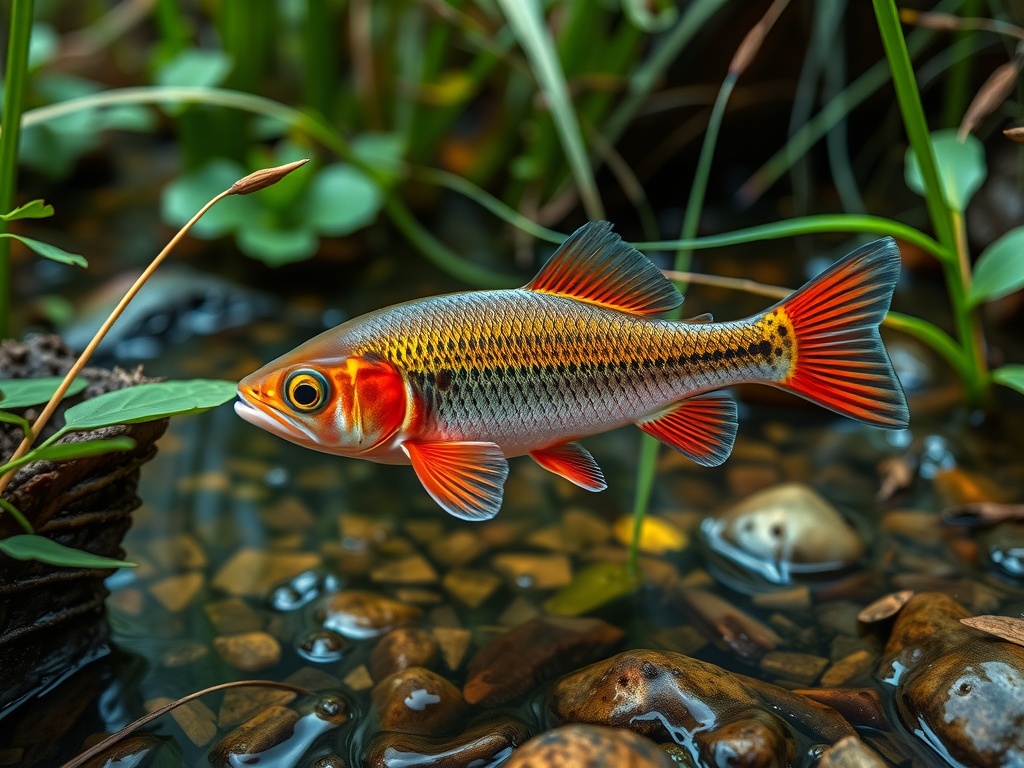
About the Cherry Barb
The Cherry Barb is a small, vibrant freshwater fish native to Sri Lanka, renowned for its striking red coloration, especially in males during breeding. This peaceful species is popular in home aquariums due to its attractive appearance, gentle temperament, and ease of care. Cherry Barbs prefer densely planted habitats with slow-moving or still waters and thrive in schools, which helps reduce their naturally shy behavior. They are hardy and adaptable, making them suitable for both novice and experienced aquarists.
Fascinating facts
Colorful Displays
Male Cherry Barbs display intense red hues during mating, making them one of the most visually striking small aquarium fish.
Habitat Lovers
They thrive in densely planted tanks that mimic their natural, vegetation-rich habitats in Sri Lanka.
Schooling Nature
Cherry Barbs are social and do best when kept in groups, which helps them feel secure and exhibit natural behaviors.
Detailed description
The Cherry Barb (Rohanella titteya, formerly Puntius titteya) is a small cyprinid fish, typically reaching an adult size of 4–5 cm in length, with females being slightly larger and more robust than males. Males are renowned for their vivid cherry-red coloration, which intensifies during courtship and breeding, while females display a more subdued, yellowish-brown hue with a distinct, dark lateral stripe. The species exhibits a streamlined, laterally compressed body, adapted for maneuvering through densely vegetated, slow-flowing streams. Cherry Barbs are schooling fish, often found in groups of 5–20 individuals in the wild, which provides safety from predators and reduces stress. Their large, round eyes and sensitive lateral line system allow them to detect subtle movements and changes in water currents. The mouth is terminal and slightly upturned, suited for foraging on small invertebrates, algae, and detritus. Cherry Barbs are diurnal, displaying peak activity during daylight hours. Their social structure is loosely hierarchical, with dominant males displaying brighter coloration and engaging in frequent courtship displays. In captivity, they are peaceful and compatible with other small, non-aggressive fish, making them a staple in community aquaria.
Did you know?
Cherry Barbs can sometimes change color based on their mood or environmental conditions, with stress causing their coloration to fade.
Research & sources
Wikipedia summary
The cherry barb is a tropical freshwater fish belonging to the family Cyprinidae. It is endemic to Sri Lanka, and introduced populations have become established in Mexico and Colombia. The cherry barb was named Puntius titteya by Paules Edward Pieris Deraniyagala in 1929. Synonyms include Barbus titteya and Capoeta titteya. It is the only species in the genus Rohanella.
Behaviour & social structure
Cherry Barbs are primarily micro-predators and omnivores, grazing on filamentous algae, aquatic insects, zooplankton, and detritus. In the wild, they spend much of their time weaving through submerged vegetation, foraging for food and seeking refuge from predators. They exhibit shoaling behavior, which not only provides protection but also facilitates social interactions such as synchronized swimming and cooperative foraging. Males are territorial during the breeding season, often displaying vibrant colors and chasing rivals while courting females with elaborate displays that include fin flaring and rapid darting movements. Outside of breeding, aggression is minimal, and the species is generally shy, preferring to remain within the cover of plants. Daily routines include periods of active foraging interspersed with rest among vegetation. In aquaria, they are known to be more active and less timid when kept in groups of at least six individuals.
Reproduction & life cycle
Cherry Barbs are egg-scattering, non-guarding spawners. Breeding typically occurs at the onset of the rainy season in their native habitats, when water temperature rises to 26–28°C and food availability increases. Males intensify their coloration and court females by displaying and chasing. Females lay 200–300 adhesive eggs among fine-leaved aquatic plants or submerged roots. Fertilization is external, and there is no parental care; adults may consume eggs if not separated. Incubation lasts 24–36 hours at optimal temperatures, after which larvae become free-swimming within 3–4 days. Sexual maturity is reached at around 6–8 months. In captivity, breeders often use spawning mops or dense plants to protect eggs and remove adults post-spawning to maximize fry survival.
Adaptations & survival
Cherry Barbs possess several adaptations for survival in densely vegetated, slow-moving streams. Their slender, laterally compressed bodies facilitate navigation through thick aquatic plants, while their cryptic coloration in females and juveniles provides camouflage from predators. The species' shoaling behavior reduces individual predation risk and enhances foraging efficiency. Males' bright breeding colors serve as both mate attractants and territorial signals. Their omnivorous diet and flexible feeding strategies allow them to exploit a wide range of food resources, contributing to their resilience in both natural and introduced habitats. Physiologically, they tolerate a range of water parameters, including slightly acidic to neutral pH (6.0–7.5) and temperatures from 23–28°C, which aids their survival in varying environments.
Cultural significance
While the Cherry Barb does not have a prominent role in Sri Lankan folklore or traditional practices, it holds significant value in the global aquarium trade, being one of the most popular small freshwater species for hobbyists. Its peaceful nature and striking appearance have made it a symbol of ornamental aquaculture. In some regions, it is used in educational settings to teach about freshwater ecology and responsible pet ownership. The species' popularity has indirectly promoted awareness of Sri Lanka's unique freshwater biodiversity.
Recent research
Recent taxonomic revisions have placed the Cherry Barb in the monotypic genus Rohanella, based on molecular phylogenetic studies (Sudasinghe et al., 2020), distinguishing it from closely related barbs. Ongoing research in Sri Lanka focuses on population genetics, habitat requirements, and the impact of habitat fragmentation. Studies have highlighted the importance of riparian vegetation in maintaining water quality and supporting Cherry Barb populations. There is also interest in the species' adaptability to captive breeding, with research into optimal spawning conditions and fry survival rates. Conservation genetics is being used to assess genetic diversity in wild and captive populations to inform management strategies.
Videos
Habitat
Freshwater streams and ponds with dense vegetation


Conservation
The Cherry Barb is currently classified as Near Threatened on the IUCN Red List.
Threats & challenges
The Cherry Barb is listed as Vulnerable by the IUCN due to ongoing habitat loss, primarily from deforestation, agricultural expansion, and urbanization in Sri Lanka. Pollution from agricultural runoff and domestic waste further degrades water quality in their native streams. Overcollection for the aquarium trade has historically impacted wild populations, though captive breeding now supplies most demand. Introduced populations in Mexico and Colombia have established due to aquarium releases, but these do not offset declines in the native range. Fragmentation of suitable habitats and competition with invasive species also pose challenges. Conservation efforts focus on habitat protection, sustainable collection practices, and public awareness.
Taxonomy
Scientific name
Puntius titteya
- Kingdom
- Animalia
- Phylum
- Chordata
- Class
- Actinopterygii
- Order
- Cypriniformes
- Family
- Cyprinidae
- Genus
- Puntius
- Species
- titteya
Community notes
Share your observations about the Cherry Barb.
No community notes yet. Be the first!
Discover more wildlife
More fascinating animals from the encyclopedia.