
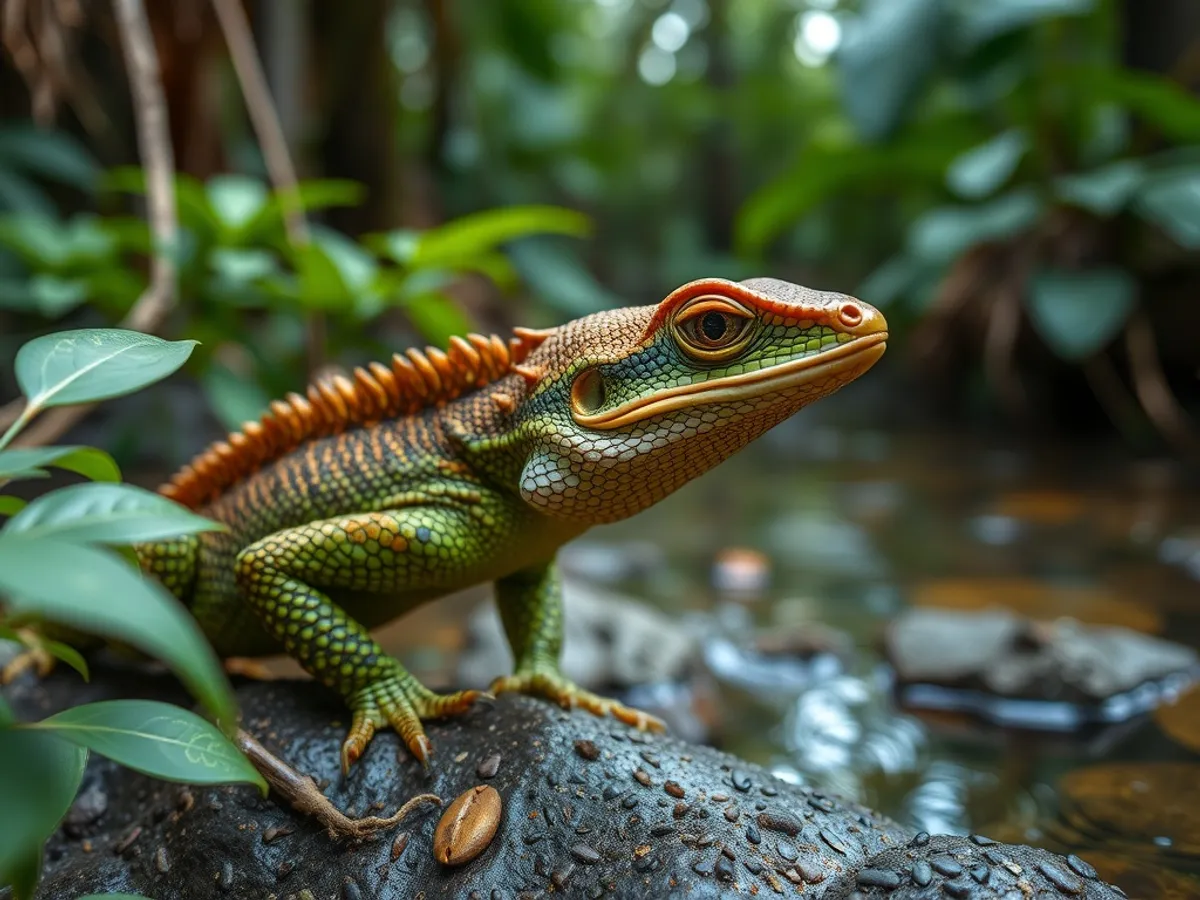
About the Chinese Water Dragon
The Chinese Water Dragon is a vibrant green, semi-aquatic lizard native to the forests and riverbanks of Southeast Asia. With a long, muscular tail and a prominent crest running from the head down the spine, these reptiles are excellent climbers and swimmers. They are known for their striking appearance, including a row of spines and the ability to change color slightly in response to their environment. Chinese Water Dragons are popular in the pet trade due to their docile temperament and striking looks, but they require specialized care to thrive.
Fascinating facts
Aquatic Escape Artist
Chinese Water Dragons are adept swimmers and often dive into water to evade predators, staying submerged for extended periods.
Color-Changing Abilities
They can change their skin tone from bright green to darker shades to help regulate temperature or camouflage themselves.
Omnivorous Diet
Their diet consists of insects, small mammals, fish, and plant matter, making them true omnivores.
Detailed description
The Chinese Water Dragon (Physignathus cocincinus) is a medium to large-sized agamid lizard, typically reaching 80–100 cm (31–39 in) in total length, with the tail comprising nearly two-thirds of its body length. Its vibrant emerald to forest green coloration is complemented by subtle turquoise or blue hues along the flanks, and mature males may display pinkish or orange tints on the throat and jowls. The species is characterized by a prominent nuchal and dorsal crest, a series of spines running from the head down the back, and a laterally compressed tail that aids in swimming. The head is angular with large, expressive eyes and a distinct tympanic membrane (external ear). Chinese Water Dragons possess strong limbs with long, sharp claws adapted for climbing and gripping wet vegetation. Their skin is covered in fine, keeled scales, providing both camouflage and protection. These lizards are semi-arboreal and semi-aquatic, spending much of their time basking on branches overhanging water bodies, and will dive into water to escape predators. They are diurnal, relying on keen vision to detect prey and threats. Sexual dimorphism is present, with males generally larger, possessing more pronounced crests and broader heads. Lifespans in the wild are estimated at 10–15 years, though captive individuals can live over 15 years with proper care.
Did you know?
If threatened, Chinese Water Dragons can drop from branches into water and swim away to escape danger.
Research & sources
Wikipedia summary
Physignathus cocincinus is a species of agamid lizard native to southern China and mainland Southeast Asia. It is commonly known as the Chinese water dragon, Indochinese water dragon, Asian water dragon, Thai water dragon, or green water dragon.
Behaviour & social structure
Chinese Water Dragons are primarily solitary but may be observed in loose aggregations in areas with abundant resources. They are territorial, especially males, which display dominance through head-bobbing, arm-waving, and posturing. These lizards are adept climbers, spending most daylight hours basking on branches or sunlit rocks near water. When threatened, they exhibit a rapid escape response, diving into water and swimming with powerful lateral tail movements, often remaining submerged for up to 25 minutes. Their omnivorous diet includes insects (crickets, locusts, beetles), small vertebrates (fish, amphibians, rodents), and a variety of fruits, flowers, and leaves. Hunting is primarily visual, involving stalking and rapid tongue projection to capture prey. Juveniles are more insectivorous, while adults consume a higher proportion of plant matter. Social interactions are generally limited to breeding season, with males defending territories and courting females through visual displays.
Reproduction & life cycle
Breeding occurs in the early rainy season (typically March to July), triggered by increased humidity and temperature. Males court females with head-bobbing, bright coloration, and tactile stimulation. After successful copulation, females lay 6–15 elliptical eggs in moist, sandy soil, often digging nests up to 10–15 cm deep along riverbanks or forest clearings. Incubation lasts 60–75 days at optimal temperatures (28–32°C/82–90°F). Hatchlings emerge fully independent, measuring 10–15 cm (4–6 in) in length, and receive no parental care. Sexual maturity is reached at 2–3 years. In captivity, reproductive success is highly dependent on environmental cues such as photoperiod, humidity, and temperature gradients.
Adaptations & survival
Chinese Water Dragons exhibit several adaptations for their semi-aquatic, arboreal lifestyle. Their laterally compressed tails function as efficient paddles for swimming and as a whip-like defense against predators. The long, strong limbs and sharp claws facilitate agile climbing and gripping of wet, slippery surfaces. Their coloration provides camouflage among foliage and dappled sunlight. The ability to remain submerged for extended periods (up to 25 minutes) allows escape from terrestrial threats. They possess a parietal eye (a photosensitive scale atop the head) that aids in detecting changes in light and potential predators. Behavioral thermoregulation—basking and seeking shade—enables them to maintain optimal body temperature in fluctuating rainforest environments.
Cultural significance
In several Southeast Asian cultures, the Chinese Water Dragon is associated with prosperity, longevity, and good fortune, partly due to its dragon-like appearance—a symbol of power in Chinese mythology. In traditional medicine, body parts have been used in remedies, though this practice is declining. The species is popular in the exotic pet trade worldwide, valued for its striking appearance and docile temperament. However, improper husbandry and lack of awareness about their complex needs have led to high mortality in captivity, prompting educational initiatives on responsible ownership.
Recent research
Recent studies have focused on the species' ecological role in riparian forest ecosystems, highlighting its function as both predator and prey. Genetic research has revealed significant population structuring across its range, suggesting limited gene flow due to habitat fragmentation. Ongoing research includes the impact of environmental contaminants on reproductive health, and the development of non-invasive monitoring techniques (e.g., environmental DNA) for population assessment. Captive breeding programs are being refined to improve hatchling survival and reduce pressure on wild populations. Notably, studies on thermoregulation and stress physiology have provided insights into optimal husbandry practices for ex situ conservation.
Videos
Habitat
Tropical rainforest near freshwater sources
 Tropical Regions
Rainforest
Dense, wet forests with the highest biodiversity on Earth, containing more than half of the world's plant and animal species.
 Global
Forest
Wooded areas with significant tree cover and diverse plant and animal communities.
 Global
Freshwater
Lakes, rivers, and wetlands with diverse aquatic ecosystems.
Conservation
The Chinese Water Dragon is currently classified as Least Concern on the IUCN Red List.
Threats & challenges
The Chinese Water Dragon is classified as Vulnerable by the IUCN due to habitat loss, over-collection for the international pet trade, and local hunting for food and traditional medicine. Deforestation, river pollution, and fragmentation of riparian habitats are major threats, particularly in southern China, Vietnam, Laos, Cambodia, and Thailand. Wild populations have declined significantly in some regions, with illegal capture for export remaining a persistent problem despite CITES Appendix II protection. Climate change, leading to altered rainfall patterns and increased frequency of extreme weather events, may further impact breeding success and habitat suitability. Conservation efforts focus on habitat protection, regulation of trade, and captive breeding programs.
Taxonomy
Scientific name
Physignathus cocincinus
- Kingdom
- Animalia
- Phylum
- Chordata
- Class
- Reptilia
- Order
- Squamata
- Family
- Agamidae
- Genus
- Physignathus
- Species
- cocincinus
Where to see a chinese water dragon
2 zoos and aquariums in 2 countries are recorded as keeping this species.

Community notes
Share your observations about the Chinese Water Dragon.
No community notes yet. Be the first!
Discover more wildlife
More fascinating animals from the encyclopedia.