
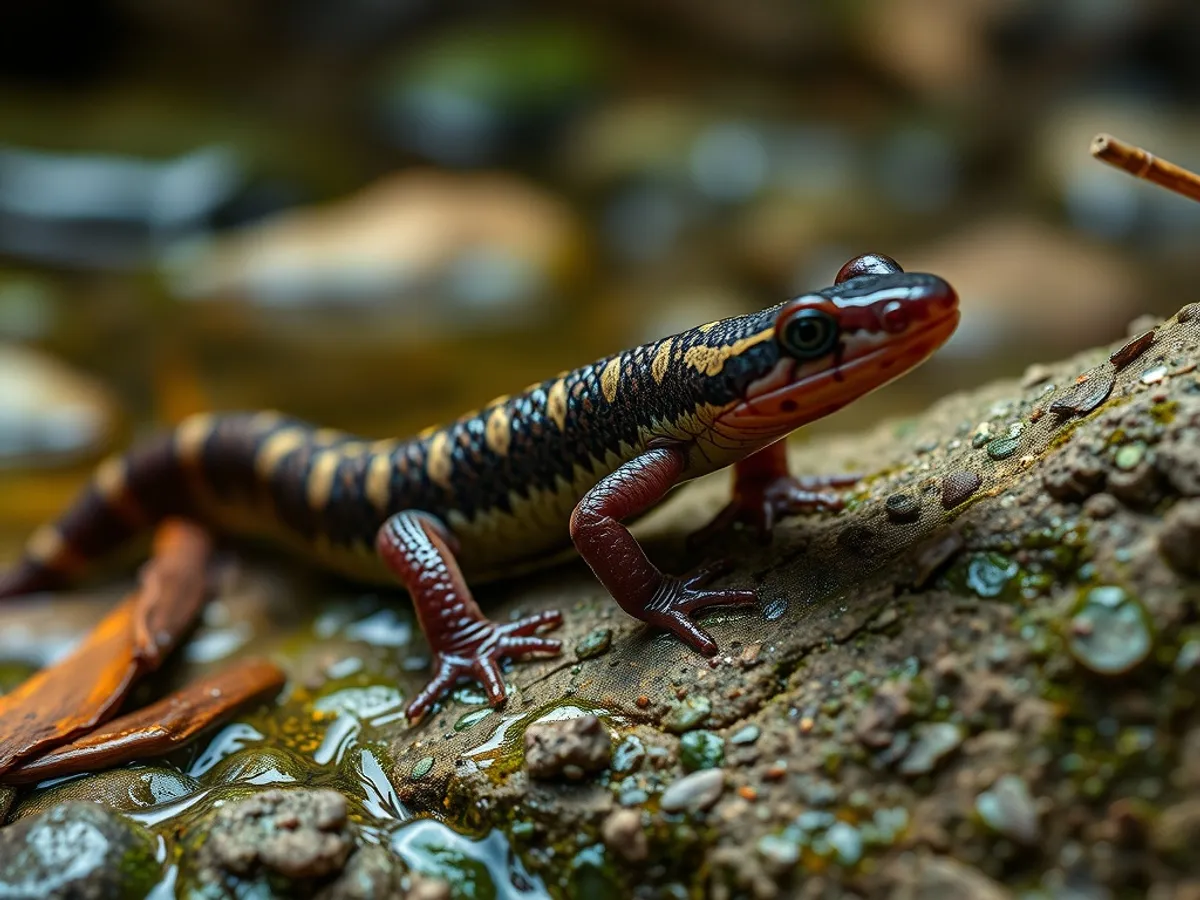
About the Clawed Salamander
The Clawed Salamander is a semi-aquatic amphibian native to East Asia, primarily found in forested mountain streams in Japan. Distinguished by its slender, elongated body and conspicuous claws on its toes, it is one of the few salamanders with well-developed claws. Its coloration is generally grayish-brown with faint darker markings, which helps it blend in with the rocky stream beds. This species is secretive and mostly nocturnal, often hiding under rocks or in crevices during the day.
Fascinating facts
Lungless Breathers
Clawed Salamanders have no lungs and rely completely on cutaneous (skin) respiration and buccal (mouth) respiration for oxygen.
Stream Dwellers
They are highly adapted to life in cold, fast-moving mountain streams, where their claws help them cling to rocks.
Unique Claws
Unlike most salamanders, this species has keratinized claws on its toes, which are used for digging and gripping.
Detailed description
Onychodactylus japonicus, the Japanese clawed salamander, is a medium-sized, slender amphibian reaching adult total lengths of 14–19 cm. Its body is elongated with a laterally compressed tail, well-suited for aquatic locomotion. The skin is smooth and moist, typically grayish-brown to olive with subtle darker mottling, providing effective camouflage among wet rocks and leaf litter. A distinctive feature is the presence of keratinized claws on the tips of its toes, unique among most salamanders and aiding in gripping slippery substrates in fast-flowing streams. The head is relatively small with a blunt snout, and the eyes are moderately prominent, adapted for low-light environments. Like all members of the family Hynobiidae, O. japonicus is lungless, relying entirely on cutaneous and buccopharyngeal respiration, which necessitates a consistently moist habitat. Parotoid glands are present but only moderately developed, possibly offering some chemical defense. The species is primarily nocturnal, emerging at night to forage and remaining concealed under rocks or within crevices during the day. Its life cycle is closely tied to cold, oxygen-rich mountain streams, where both adults and larvae are semi-aquatic.
Did you know?
Despite their aquatic lifestyle, Clawed Salamanders are one of the few salamanders with true claws on their toes, an adaptation to their rocky habitats.
Research & sources
Wikipedia summary
The genus Onychodactylus, commonly known as clawed salamanders, is composed of three species, all endemic to eastern Asia. O. koreanus is found on the Korean peninsula, while O. fischeri is found in the Russian Far East and O. japonicus is found in Japan, on the islands of Shikoku and Honshū. All species are lungless with moderately developed parotoid glands. They inhabit moist, forested mountains near small rivers, streams, and lakes. Adults of each species can reach a length of 19 cm.
Behaviour & social structure
O. japonicus is a solitary and secretive species, exhibiting strong site fidelity to specific stream sections. It is most active during the night, when it emerges to hunt for small invertebrates such as aquatic insects, worms, and crustaceans. Feeding is accomplished via a rapid tongue projection and jaw snap, typical of salamanders. During the day, individuals seek refuge under stones, logs, or within submerged crevices to avoid predation and desiccation. Territoriality is not strongly developed, but males may display mild aggression during the breeding season. The species is highly sensitive to environmental changes, particularly fluctuations in humidity and water quality, and will retreat deeper into crevices during dry or disturbed conditions. Seasonal activity peaks in spring and autumn, coinciding with optimal moisture and temperature conditions.
Reproduction & life cycle
Breeding occurs primarily from late winter to early spring (February–April), triggered by rising water levels and temperatures. Males arrive at breeding sites first and may engage in courtship displays involving body undulations and tactile stimulation. Fertilization is external: females lay elongated, gelatinous egg sacs (typically 20–60 eggs per clutch) attached to submerged rocks or vegetation in well-oxygenated streams. Embryonic development is temperature-dependent, with hatching occurring after 30–50 days. Larvae are fully aquatic, possessing external gills and a finned tail, and remain in the stream for 1–2 years before metamorphosis. There is no parental care post-oviposition; eggs and larvae are vulnerable to predation by fish and aquatic insects. Sexual maturity is reached at 3–4 years of age.
Adaptations & survival
O. japonicus exhibits several adaptations for its cold, fast-flowing stream habitat. The keratinized claws provide enhanced grip on slippery, algae-covered rocks, reducing the risk of being swept away by currents. Lunglessness is an evolutionary specialization that allows efficient gas exchange in oxygen-rich water, but also restricts the species to moist environments. The cryptic coloration and secretive behavior minimize predation risk. Its flattened body and laterally compressed tail improve swimming efficiency, while the ability to absorb oxygen through the skin enables survival in low-oxygen microhabitats. The species can tolerate cold water temperatures, remaining active at temperatures as low as 4–5°C.
Cultural significance
The Japanese clawed salamander does not have a prominent role in Japanese folklore or traditional medicine, unlike some other native amphibians. However, it is occasionally referenced in local natural history and environmental education as an indicator of pristine mountain stream ecosystems. Its presence is valued by conservationists and naturalists as a symbol of healthy, unpolluted waterways.
Recent research
Recent molecular phylogenetic studies have clarified the evolutionary relationships within the genus Onychodactylus, revealing cryptic diversity and possible unrecognized species in Japan. Ongoing research focuses on the species' unique lungless physiology, particularly its adaptation to hypoxic environments and cutaneous respiration efficiency. Ecological studies are examining the impact of climate change on breeding phenology and larval development. Conservation genetics projects are underway to assess population structure and connectivity in fragmented habitats. Notably, a 2022 study used environmental DNA (eDNA) to map the distribution of O. japonicus, demonstrating the effectiveness of non-invasive monitoring techniques for stream-dwelling amphibians.
Videos
Habitat
Mountain forest streams
 Elevated Terrain
Mountain
High-altitude environments with varying climates and specialized wildlife adapted to rugged terrain and thin air.
 Global
Forest
Wooded areas with significant tree cover and diverse plant and animal communities.
 Global
Freshwater
Lakes, rivers, and wetlands with diverse aquatic ecosystems.
Conservation
The Clawed Salamander is currently classified as Least Concern on the IUCN Red List.
Threats & challenges
While currently listed as Least Concern, O. japonicus faces several localized threats. Habitat degradation from deforestation, stream channelization, and water pollution (including agricultural runoff and pesticides) can reduce population viability. The construction of dams and roads fragments habitats, impeding migration and gene flow. Introduced predatory fish and climate change (altering stream flow and temperature regimes) also pose emerging threats. Despite these pressures, the species remains relatively widespread and stable in undisturbed mountain regions, but populations near human settlements are declining. Ongoing monitoring is necessary to detect future population trends.
Taxonomy
Scientific name
Onychodactylus japonicus
- Kingdom
- Animalia
- Phylum
- Chordata
- Class
- Amphibia
- Order
- Caudata
- Family
- Hynobiidae
- Genus
- Onychodactylus
- Species
- japonicus
Community notes
Share your observations about the Clawed Salamander.
No community notes yet. Be the first!
Discover more wildlife
More fascinating animals from the encyclopedia.