
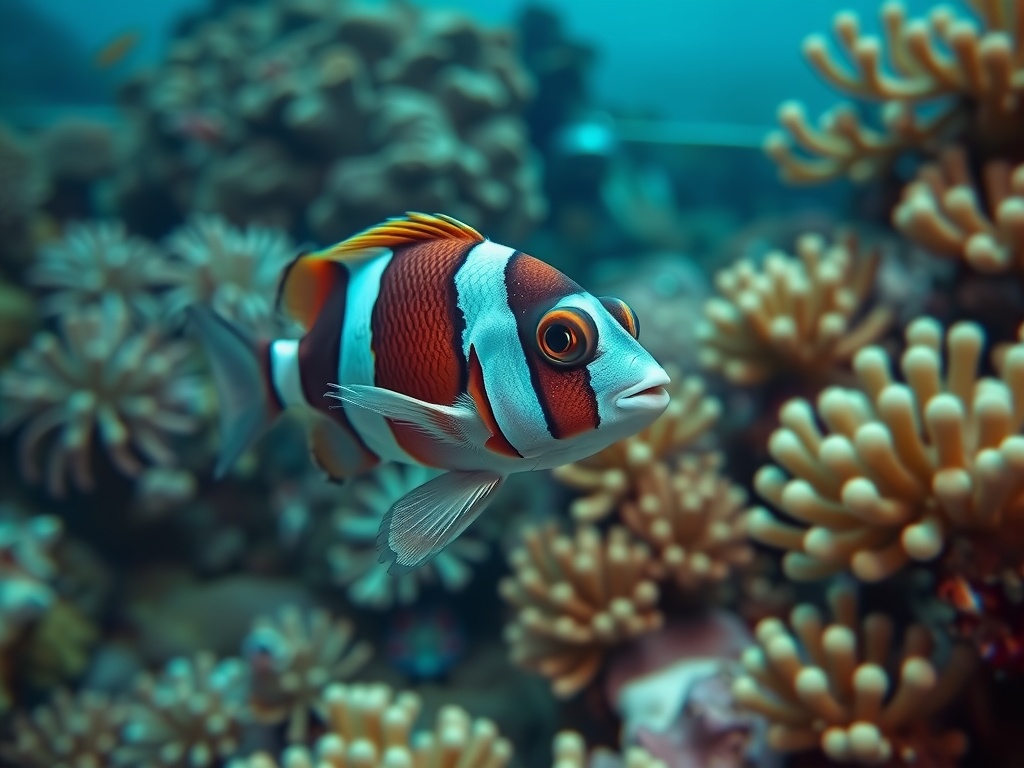
About the Cleaner wrasse
The cleaner wrasse runs a business. It sets up at a fixed location on the reef — a cleaning station — and larger fish queue there voluntarily, holding still, opening their mouths and gill covers, while the wrasse swims inside and picks off parasites, dead skin and debris. Predators that would eat it anywhere else on the reef will not touch it there. The economics are surprisingly subtle: the wrasse would rather eat the client's protective mucus than its parasites, and it cheats when it thinks it can get away with it, biting the client, who jolts and may leave. So the wrasse manages its reputation. It gives better service to clients who have somewhere else to go, offers a tactile massage with its fins to soothe an angry one, and behaves best when other fish are watching and can see how it treats a customer. It has also become famous for something else: in a landmark and hotly argued experiment, cleaner wrasse appeared to pass the mirror mark test, trying to remove a mark they could only see in their reflection.
Fascinating facts
Reef Helpers
Cleaner wrasses play a critical role in maintaining the health of coral reef communities by removing parasites from other fish.
Mutualistic Partners
Their mutualistic relationship benefits both cleaner wrasses, which gain food, and client fish, which enjoy better health.
Imitators Exist
Some fish species, like the sabre-toothed blenny, mimic cleaner wrasses to deceive other fish and take a bite of their scales or flesh.
Detailed description
The cleaner wrasse (Labroides dimidiatus) is a small, elongated marine fish, typically reaching 10–14 cm in length, with a laterally compressed body and a distinctive color pattern: a bold black stripe runs from the snout through the eye to the tail, bordered above and below by electric blue or yellow, depending on geographic variation. Its mouth is small and terminal, equipped with protrusible jaws and specialized teeth adapted for picking parasites and dead tissue from client fish. Cleaner wrasses are diurnal and highly active, spending daylight hours at established 'cleaning stations' on coral reefs, where they perform cleaning services for a wide range of client species, including groupers, parrotfish, and even moray eels. Their social structure is based on harems, typically consisting of a dominant male and several females; the species is protogynous hermaphroditic, meaning females can change sex to become males if the dominant male is lost. Cleaner wrasses communicate with clients using a distinctive 'dance,' involving rapid, undulating body movements that signal their readiness to clean and reduce the risk of predation. Their cleaning behavior is mutualistic, providing nutrition to the wrasse while benefiting client fish by reducing parasite loads and promoting wound healing. The species exhibits remarkable cognitive abilities, including individual recognition and tactical deception, sometimes 'cheating' by feeding on client mucus. Cleaner wrasses are found throughout the Indo-Pacific, from the Red Sea and East Africa to the central Pacific, inhabiting coral-rich lagoons and outer reef slopes at depths of 1–40 meters. Their ecological role is pivotal, as their removal from reefs can lead to increased parasite loads and decreased fish diversity.
Did you know?
Cleaner wrasses are so trusted that even predatory fish allow them to clean inside their mouths without harming them.
Research & sources
Wikipedia summary
The wrasses are a family, Labridae, of marine ray-finned fish, many of which are brightly colored. The family is large and diverse, with over 600 species in 81 genera, which are divided into nine subgroups or tribes.
Behaviour & social structure
Cleaner wrasses exhibit complex and highly ritualized cleaning behavior. They establish and defend cleaning stations, which are visited by a diverse array of reef fish seeking parasite removal. The wrasse initiates cleaning by performing a 'dance,' which reassures clients and invites them to adopt a stationary posture. Cleaning sessions can last from a few seconds to several minutes, during which the wrasse meticulously inspects the client's body, gills, and sometimes inside the mouth. Cleaner wrasses are selective, preferring to feed on certain ectoparasites but occasionally consuming client mucus, which is more nutritious but detrimental to the client. They are known to adjust their behavior based on client species and previous interactions, demonstrating advanced learning and memory. Socially, cleaner wrasses live in harems with a strict dominance hierarchy; the largest female will transition to male if the resident male disappears. Daily routines are tightly linked to daylight, with cleaning activity ceasing at dusk when wrasses retreat to crevices for shelter.
Reproduction & life cycle
Labroides dimidiatus is a protogynous hermaphrodite, with all individuals maturing first as females. In a harem, the dominant individual is male, and if he is removed, the largest female undergoes sex change to become male, a process that can take several days. Spawning occurs year-round in tropical regions but may peak during certain lunar phases or seasons. Courtship involves elaborate displays, with the male and female ascending into the water column to release gametes simultaneously in a broadcast spawning event. There is no parental care; fertilized eggs are pelagic and drift with currents. Larvae are planktonic for several weeks before settling on the reef and adopting juvenile coloration.
Adaptations & survival
Cleaner wrasses possess several unique adaptations for their ecological niche. Their slender, laterally compressed bodies and pointed snouts allow precise maneuvering around client fish. Specialized teeth and a protrusible mouth facilitate the removal of parasites and dead tissue. Their striking coloration and the black lateral stripe serve as a visual signal to potential clients, advertising their cleaning services and reducing predation risk. Behavioral adaptations include the cleaning 'dance' and the ability to recognize individual clients, modulating service quality based on client behavior (e.g., providing better service to 'punishing' clients who chase after cheating). Their cognitive abilities are among the most advanced in fish, supporting complex social interactions and tactical deception.
Cultural significance
Cleaner wrasses are well-known in popular marine biology and are frequently featured in documentaries and educational materials as classic examples of mutualism and animal cooperation. They are popular in the marine aquarium trade, valued for their cleaning behavior, though they are challenging to keep in captivity due to specialized dietary needs. In some Pacific island cultures, their cleaning role is recognized by local fishers, but there is limited direct use in traditional medicine or folklore. Their mutualistic behavior has inspired metaphors for cooperation and service in human society.
Recent research
Recent research has focused on the cognitive abilities of cleaner wrasses, including studies demonstrating self-recognition in mirror tests—a trait previously thought to be limited to mammals and some birds. Ongoing studies investigate the ecological consequences of cleaner wrasse removal from reef systems, revealing their importance in maintaining fish health and diversity. Genetic studies are clarifying population structure and connectivity across the Indo-Pacific. Behavioral ecology research continues to explore the dynamics of cheating, punishment, and cooperation in cleaning interactions, providing insights into the evolution of mutualism.
Videos
Habitat
Coral reefs in the Indo-Pacific region

Conservation
The Cleaner wrasse is currently classified as Least Concern on the IUCN Red List.
Threats & challenges
While currently listed as Least Concern by the IUCN, cleaner wrasses face threats from habitat degradation, particularly coral reef loss due to climate change, ocean acidification, and destructive fishing practices. Over-collection for the aquarium trade can locally deplete populations, potentially disrupting reef health due to their keystone ecological role. Research indicates that reefs lacking cleaner wrasses experience higher parasite loads and reduced fish diversity. Additionally, pollution and sedimentation can degrade their habitat and reduce the availability of cleaning stations.
Taxonomy
Scientific name
Labroides dimidiatus
- Kingdom
- Animalia
- Phylum
- Chordata
- Class
- Actinopterygii
- Order
- Labriformes
- Family
- Labridae
- Genus
- Labroides
- Species
- dimidiatus
Where to see a cleaner wrasse
1 zoo and aquarium in 1 country are recorded as keeping this species.

Community notes
Share your observations about the Cleaner wrasse.
No community notes yet. Be the first!
Discover more wildlife
More fascinating animals from the encyclopedia.