
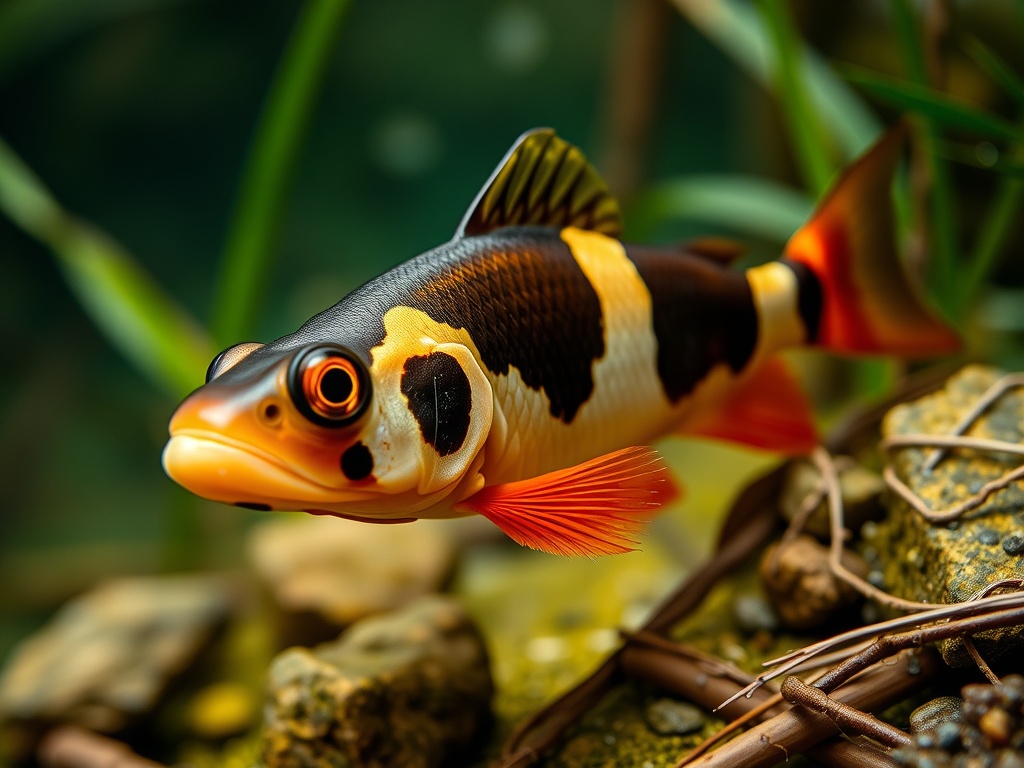
About the Clown Loach
The clown loach conceals a switchblade under its eye. A sub-orbital spine sits in a groove beneath each eye and can be flicked out defensively; it will catch in a net, and it can draw blood from a careless hand. It also clicks audibly when excited, grinding its pharyngeal teeth loudly enough to be heard through the glass. It is one of the most misleadingly sold fish in the aquarium trade: a 4 cm juvenile is a schooling animal that grows to 30 cm, lives 20 years or more, and needs a very large tank and a group of its own kind — kept alone it becomes stressed, hides, and is notoriously the first fish in a tank to break out in white-spot disease. Almost every clown loach in the trade is wild-caught from Sumatra and Borneo, because it has proven extremely difficult to breed in captivity and commercial production required hormone induction. It also alarms new owners by flopping onto its side and lying motionless on the substrate, which is not illness — it is just how a clown loach rests.
Fascinating facts
Unusual Sleeping Habits
Clown loaches often rest on their sides or backs, a behavior that can alarm new aquarium owners but is perfectly normal for the species.
Sound Producers
They create audible clicking noises by grinding their pharyngeal teeth, especially during feeding or social interactions.
Migratory Spawners
Wild clown loaches undertake seasonal migrations upstream to spawn in flooded forest areas during the rainy season.
Detailed description
The clown loach (Chromobotia macracanthus) is a strikingly colored freshwater fish, reaching up to 30 cm (12 in) in length in the wild, though most aquarium specimens remain smaller, typically 15–20 cm (6–8 in). Its laterally compressed body is adorned with a vivid orange to yellow base color, overlaid by three broad, jet-black vertical bands—one through the eye, one at the base of the dorsal fin, and one near the caudal peduncle. The head is pointed, with a subterminal mouth equipped with four pairs of barbels, which aid in foraging among substrate. The dorsal fin is short and high, while the caudal fin is deeply forked, facilitating agile swimming. Notably, clown loaches possess a sharp, retractable subocular spine beneath each eye, used for defense. Their eyes are relatively large, adapted for low-light environments. Social by nature, they form tight shoals in the wild, often displaying complex group behaviors. Clown loaches are crepuscular, being most active at dawn and dusk. Their skin is covered in small, cycloid scales, and they possess a well-developed lateral line system for detecting vibrations in murky waters. Juveniles exhibit brighter coloration, which may fade with age or stress.
Did you know?
Despite their popularity in aquariums, clown loaches rarely breed in captivity and most individuals are wild-caught.
Research & sources
Wikipedia summary
The clown loach, or tiger botia, is a tropical freshwater fish belonging to the botiid loach family. It is the sole member of the genus Chromobotia. It originates in inland waters in Indonesia on the islands of Sumatra and Borneo. The fish is called ulanguli by the locals in Sentarum, West Borneo. It is a popular fish in the freshwater aquarium trade and is sold worldwide.
Behaviour & social structure
Clown loaches are highly social and exhibit pronounced shoaling behavior, often forming groups of five or more individuals. In the wild, these groups forage together, sifting through leaf litter and substrate for invertebrates, worms, crustaceans, and plant matter. They are omnivorous, but show a preference for protein-rich foods, including insect larvae and snails, which they help control in both wild and aquarium settings. Clown loaches are known for their playful antics, such as 'loach dancing'—synchronized swimming and rapid darting movements. They communicate using audible clicking sounds produced by grinding their pharyngeal teeth, especially during feeding or social interactions. During daylight hours, they tend to hide among submerged roots, rocks, or dense vegetation, emerging at twilight to feed. Hierarchies may form within groups, with dominant individuals displaying more intense coloration and leading group movements. They are generally non-aggressive, but may display mild territoriality within their shoal.
Reproduction & life cycle
Reproduction in clown loaches is poorly documented in the wild due to their secretive habits and the inaccessibility of their natural spawning grounds, which are believed to be seasonally flooded forests and river margins. Spawning is thought to coincide with the onset of the rainy season (November to February), when rising water levels trigger migration to inundated areas. Females are batch spawners, releasing thousands of adhesive eggs among submerged vegetation. Males fertilize the eggs externally. There is no parental care; eggs and larvae are left to develop independently. Incubation lasts approximately 24–36 hours at optimal temperatures (26–29°C), after which larvae become free-swimming within 3–5 days. In captivity, successful breeding is rare and typically requires hormonal induction, as natural environmental cues are difficult to replicate. Sexual dimorphism is subtle, with mature females generally being larger and rounder in the abdomen.
Adaptations & survival
Clown loaches possess several adaptations for survival in dynamic floodplain environments. Their subterminal mouth and sensitive barbels allow them to locate food in turbid waters and sift through soft substrates. The retractable subocular spine provides a defense mechanism against predators. Their bright coloration may serve as a warning to potential predators or as a means of social signaling within shoals. The lateral line system is highly developed, enabling detection of water movement and vibrations, crucial for navigation and prey detection in low-visibility habitats. Their ability to produce clicking sounds facilitates social communication and may deter competitors or predators. Physiologically, they are tolerant of fluctuating water parameters, a necessity in habitats subject to seasonal flooding and variable water chemistry.
Cultural significance
The clown loach holds significant value in the global aquarium trade, prized for its vivid coloration, engaging behavior, and ability to control pest snails in tanks. In Indonesia, it is known locally as 'ulanguli' and is occasionally consumed as food, though this is not widespread. The species features in local folklore as a symbol of agility and social harmony. Its popularity has led to the development of aquaculture techniques in Southeast Asia, though most specimens in the trade are still wild-caught. The clown loach's playful demeanor and group dynamics have made it a favorite among aquarists worldwide.
Recent research
Recent research has focused on the development of captive breeding protocols to reduce pressure on wild populations, including the use of hormone-induced spawning and larval rearing techniques. Genetic studies have clarified the species' taxonomic position as the sole member of the genus Chromobotia, distinct from other botiid loaches. Ecological studies are ongoing to assess the impact of habitat alteration and overharvesting on population dynamics. There is growing interest in the species' role as a bioindicator of river health, given its sensitivity to water quality changes. Studies on acoustic communication have revealed complex social interactions mediated by sound production.
Videos
Habitat
Freshwater rivers and floodplains


Conservation
The Clown Loach is currently classified as Least Concern on the IUCN Red List.
Threats & challenges
While currently listed as Least Concern by the IUCN, clown loach populations face several localized threats. Overharvesting for the aquarium trade, particularly of juveniles, has led to population declines in some areas, as the species is slow-growing and late-maturing. Habitat degradation from deforestation, mining, and agricultural runoff threatens the integrity of their riverine and floodplain ecosystems. Dams and water management projects disrupt natural flooding cycles essential for spawning. Climate change poses additional risks by altering rainfall patterns and water temperatures. Despite these challenges, the species remains widespread and locally abundant, but ongoing monitoring and sustainable harvesting practices are recommended to prevent future declines.
Taxonomy
Scientific name
Chromobotia macracanthus
- Kingdom
- Animalia
- Phylum
- Chordata
- Class
- Actinopterygii
- Order
- Cypriniformes
- Family
- Botiidae
- Genus
- Chromobotia
- Species
- macracanthus
Community notes
Share your observations about the Clown Loach.
No community notes yet. Be the first!
Discover more wildlife
More fascinating animals from the encyclopedia.