
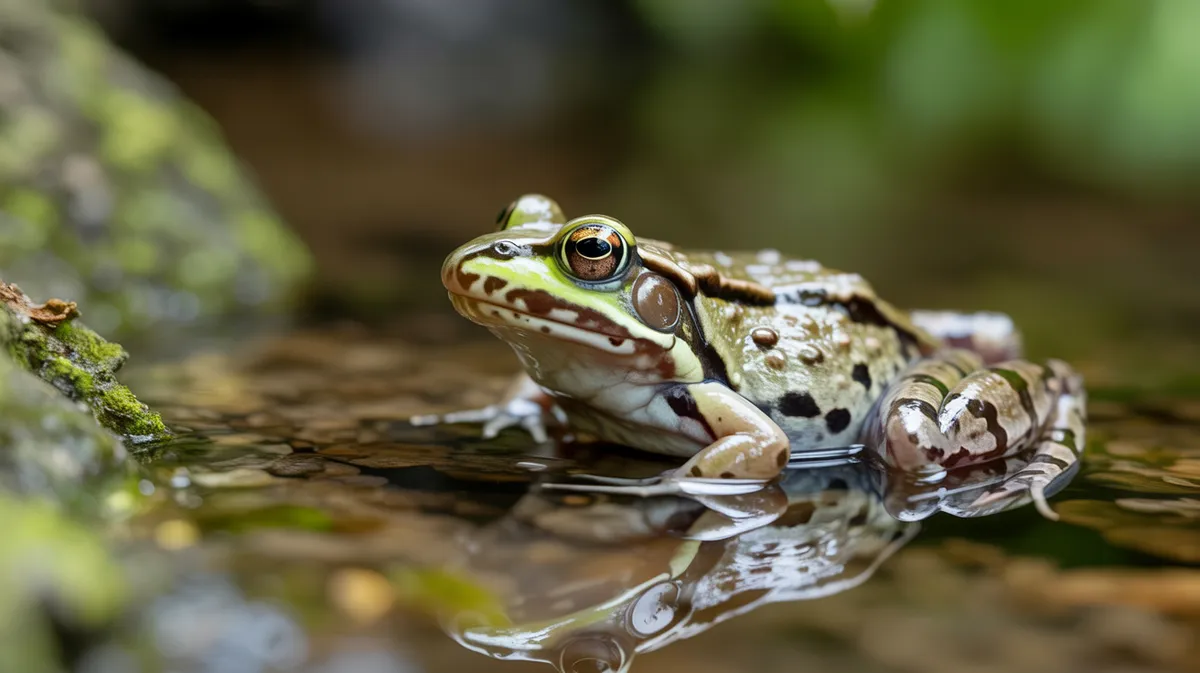
About the Coastal Tailed Frog
The Coastal Tailed Frog is a small, semi-aquatic amphibian native to the cool, fast-flowing streams of the Pacific Northwest in North America. Uniquely adapted to life in turbulent waters, it possesses a streamlined body and large webbed feet, aiding its ability to cling to rocks and navigate currents. Males feature a distinctive tail-like extension, actually a copulatory organ used for internal fertilization, which is extremely rare among frogs. This species is known for its cryptic coloration and nocturnal habits, making it difficult to spot in its natural habitat.
Fascinating facts
Stream Specialist
This frog is uniquely adapted to cold, fast-moving streams, where its eggs and tadpoles develop over several years.
Silent Frog
Unlike most frogs, the Coastal Tailed Frog does not croak or make calls, as it lacks vocal sacs.
Clinging Tadpoles
Tadpoles have specialized suctorial mouthparts that allow them to hold tightly to rocks in rushing water.
Detailed description
The Coastal Tailed Frog (Ascaphus truei) is a small, primitive amphibian, typically measuring 2.5–5 cm in snout-vent length, with a robust, flattened body and a broad, triangular head. Its skin is granular and cryptically colored in shades of brown, olive, or gray, providing camouflage among streambed rocks and leaf litter. The species is characterized by vertical pupils, absence of external eardrums (tympana), and relatively short, muscular limbs with expanded toe tips and extensive webbing on the hind feet, adaptations that facilitate clinging to slippery substrates in turbulent streams. Males possess a unique, tail-like copulatory organ—an extension of the cloaca—used for internal fertilization, a rare trait among anurans. The tongue is broad and attached at the front, but unlike most frogs, it is not used for prey capture; instead, prey is seized directly with the jaws. Tadpoles are highly specialized, featuring large oral suckers and muscular bodies, allowing them to adhere to rocks in swift currents. Adults are mostly nocturnal, emerging at dusk to forage, and are highly secretive, spending daylight hours concealed under rocks or submerged debris. The species exhibits remarkable site fidelity, with individuals often remaining within a small home range for years. Lifespans can exceed 10 years, which is unusually long for frogs of this size.
Did you know?
The Coastal Tailed Frog is one of only two North American frog species that perform internal fertilization.
Research & sources
Wikipedia summary
The tailed frogs are two species of frogs in the genus Ascaphus, the only taxon in the family Ascaphidae. The "tail" in the name is actually an extension of the male cloaca. The tail is one of two distinctive anatomical features adapting the species to life in fast-flowing streams. These are the only North American frog species that reproduce by internal fertilization. They are among the most primitive known families of frogs.
Behaviour & social structure
Coastal Tailed Frogs are primarily nocturnal, with peak activity during humid, cool nights. They are solitary and territorial, rarely interacting outside the breeding season. Foraging occurs along stream margins, where they hunt for aquatic and terrestrial invertebrates such as insect larvae, small crustaceans, and snails. Unlike many frogs, they do not rely on tongue projection but instead use their jaws to grasp prey. Tadpoles graze on diatoms and algae, scraping biofilm from submerged rocks with their specialized mouthparts. Adults are highly sedentary, exhibiting strong site fidelity and limited dispersal, which is likely an adaptation to the fragmented, linear nature of their stream habitats. Escape responses include rapid swimming and seeking refuge under rocks or in crevices. Vocalizations are absent; communication is presumed to be primarily chemical or tactile.
Reproduction & life cycle
Breeding occurs from late spring to early autumn, depending on elevation and latitude. Males establish territories in shallow riffles and attract females through tactile cues rather than vocal calls. Internal fertilization is achieved via the male's tail-like copulatory organ, which transfers sperm directly into the female's cloaca—a unique adaptation among North American frogs. Females lay 20–85 large, yolky eggs in strings attached to the undersides of submerged rocks or logs, where they are guarded by the female for several weeks. Embryonic development is slow, with hatching occurring after 6–8 weeks. Larval development is prolonged, often lasting 1–4 years depending on stream temperature and food availability. Metamorphosis typically occurs in late summer, and sexual maturity is reached at 6–8 years, which is exceptionally late for amphibians of this size.
Adaptations & survival
Ascaphus truei exhibits a suite of adaptations for life in cold, fast-flowing streams. The absence of external tympana reduces drag and prevents damage from debris. The streamlined body, muscular limbs, and expanded toe pads enhance grip and maneuverability in strong currents. The male's copulatory organ ensures successful internal fertilization in turbulent water, preventing sperm loss. Tadpoles possess large oral discs with keratinized mouthparts for suction and grazing, allowing them to resist being swept away. The species' cryptic coloration and nocturnal habits reduce predation risk. Slow metabolism and delayed development are likely adaptations to the cold, nutrient-poor environments they inhabit.
Cultural significance
The Coastal Tailed Frog holds limited direct cultural significance, but it is considered an indicator species for pristine, cold-water stream ecosystems in the Pacific Northwest. Its presence is often used by conservationists and land managers as a measure of stream health. There are no known traditional uses or significant roles in indigenous mythology, but the frog's unique evolutionary status and reproductive biology have made it a subject of scientific interest and public education regarding amphibian diversity and conservation.
Recent research
Recent research has focused on the genetic differentiation between Ascaphus truei and its sister species, A. montanus, revealing cryptic diversity and potential subspecies. Studies on larval development have elucidated the physiological mechanisms underlying their prolonged metamorphosis and adaptation to cold environments. Conservation genetics work has highlighted the impact of habitat fragmentation on gene flow and population viability. Ongoing research is investigating the effects of climate change on stream temperature and hydrology, and how these factors influence tailed frog distribution and reproductive success. The species is also being studied as a model for understanding the evolution of internal fertilization in amphibians.
Videos
Habitat
Cold, fast-flowing forest streams
 Elevated Terrain
Mountain
High-altitude environments with varying climates and specialized wildlife adapted to rugged terrain and thin air.
 Global
Forest
Wooded areas with significant tree cover and diverse plant and animal communities.
 Global
Freshwater
Lakes, rivers, and wetlands with diverse aquatic ecosystems.
Conservation
The Coastal Tailed Frog is currently classified as Least Concern on the IUCN Red List.
Threats & challenges
Although currently listed as Least Concern by the IUCN, Coastal Tailed Frogs face several threats. Habitat fragmentation from logging, road construction, and damming disrupts stream connectivity and microhabitats. Sedimentation and pollution from forestry and agriculture degrade water quality, impacting both adults and larvae. Climate change poses additional risks by altering stream flow regimes and increasing water temperatures, potentially reducing suitable habitat. Their low dispersal ability and site fidelity make populations particularly vulnerable to local extirpation. Disease, such as chytridiomycosis, has been detected but does not currently appear to be a major threat.
Taxonomy
Scientific name
Ascaphus truei
- Kingdom
- Animalia
- Phylum
- Chordata
- Class
- Amphibia
- Order
- Anura
- Family
- Ascaphidae
- Genus
- Ascaphus
- Species
- truei
Community notes
Share your observations about the Coastal Tailed Frog.
No community notes yet. Be the first!
Discover more wildlife
More fascinating animals from the encyclopedia.