
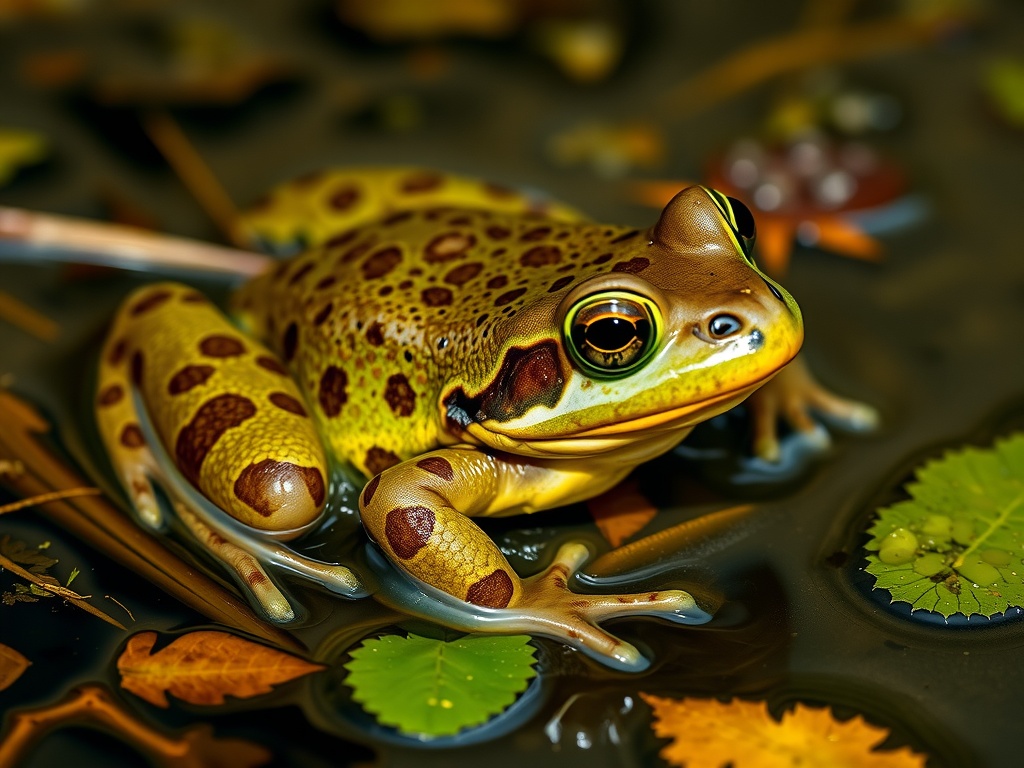
About the Columbia Spotted Frog
The Columbia Spotted Frog is a medium-sized amphibian native to the northwestern United States and parts of southwestern Canada. It is known for its olive green to brown coloration, dark spots scattered across its back, and distinctive upturned eyes. This species prefers slow-moving or still freshwater habitats such as ponds, marshes, and streams with abundant vegetation. The Columbia Spotted Frog is semi-aquatic, spending much of its life in or near water, and is an important indicator species for wetland health. Its populations are stable in some areas but face threats from habitat loss and environmental changes.
Fascinating facts
Distinctive Spots
The back of the Columbia Spotted Frog is covered in dark spots with light borders, making it easy to distinguish from other frog species in its range.
Aquatic Lifestyle
This species spends most of its life in or near water, and rarely ventures far from aquatic habitats, relying on wetlands for breeding, feeding, and shelter.
Cold-Climate Adaptation
Columbia Spotted Frogs can survive harsh winters by hibernating underwater or buried in mud, where they slow their metabolism and absorb oxygen through their skin.
Detailed description
The Columbia Spotted Frog (Rana luteiventris) is a medium-sized ranid amphibian, with adults typically measuring 5.0–10.0 cm (2–4 in) in snout-vent length. Its dorsal coloration ranges from olive green to brown, often with irregular black or dark brown spots bordered by lighter halos. The ventral surface is creamy white to yellow, sometimes with an orange or salmon tinge, especially in breeding males. The skin is moist and finely granular, with prominent dorsolateral folds extending from behind the eye to the groin. The species is characterized by a relatively narrow, pointed snout, upturned eyes, and notably short hind limbs compared to other western North American Rana species. Extensive webbing is present between the toes, an adaptation to its highly aquatic lifestyle. Juveniles resemble adults but are smaller and may lack the full intensity of ventral coloration. The tympanum (external eardrum) is visible and about the same size as the eye. Columbia Spotted Frogs are primarily aquatic, rarely venturing far from water, and are most active during the warmer months. They are ectothermic and rely on environmental temperatures to regulate their body heat, often basking at the water's edge.
Did you know?
Unlike many frogs, Columbia Spotted Frogs are active during the day and can often be seen basking in the sun along the water's edge.
Research & sources
Wikipedia summary
The Columbia spotted frog is a North American species of frog. It is green to brown in color with spots on the dorsal surface. The belly and upper lip are white in color. Individuals can be distinguished from other Rana species by their shorter back legs, narrow snout, and upturned eyes. Since they spend most of their time in the water, they also have more webbing in their hind feet than similar species. Although not threatened, this animal has been studied as a model species for the effects of habitat fragmentation.
Behaviour & social structure
Columbia Spotted Frogs are diurnal and crepuscular, with peak activity during the day and at dusk. They are generally solitary outside the breeding season but may aggregate in large numbers during spawning. These frogs are sit-and-wait predators, feeding on a variety of invertebrates such as insects, spiders, worms, and occasionally small mollusks. Tadpoles graze on algae, detritus, and plant material. Adults exhibit site fidelity, often returning to the same breeding and overwintering sites annually. When threatened, they may dive into water and remain motionless at the bottom or hide among submerged vegetation. Vocalizations are limited outside the breeding season, but males produce a series of low, clucking calls during courtship. Social hierarchies are not well developed, though males may compete for access to females during the breeding period.
Reproduction & life cycle
Breeding occurs in early spring, typically soon after ice melt (March to June, depending on elevation and latitude). Males arrive at breeding sites first and call to attract females. Amplexus (the mating embrace) is axillary, with males grasping females behind the forelimbs. Females lay between 300 and 2,000 eggs in large, gelatinous clusters attached to submerged vegetation or debris in shallow water. Embryonic development is temperature-dependent, with hatching occurring after 2–4 weeks. Tadpoles undergo metamorphosis in 2–4 months, usually emerging as froglets by late summer. There is no parental care post-oviposition. Sexual maturity is reached at 2–4 years of age, with longevity in the wild estimated at up to 10 years.
Adaptations & survival
Columbia Spotted Frogs possess several adaptations for aquatic life, including extensive toe webbing for efficient swimming and upturned eyes that facilitate surface vision while submerged. Their skin is highly permeable, allowing for cutaneous respiration—a critical adaptation for overwintering in oxygen-poor water. The coloration provides camouflage among aquatic vegetation and muddy substrates. During winter, they hibernate underwater, often in mud or under debris, and can tolerate low temperatures and reduced oxygen levels. Rapid larval development is an adaptation to ephemeral breeding habitats, minimizing predation risk and desiccation.
Cultural significance
The Columbia Spotted Frog holds ecological significance as an indicator species for wetland health, but it has limited direct cultural or economic importance. In some Indigenous North American traditions, frogs are symbolic of transformation and renewal, though specific references to this species are rare. The frog is occasionally featured in local environmental education programs highlighting amphibian conservation and wetland ecosystems.
Recent research
Columbia Spotted Frogs are a model organism for studies on habitat fragmentation, population genetics, and amphibian disease dynamics. Recent research has examined the effects of landscape connectivity on gene flow, revealing that isolated populations are at greater risk of decline. Studies on overwintering physiology have provided insights into amphibian cold tolerance and metabolic suppression. Ongoing monitoring programs track population health in response to environmental changes and management interventions. The species has also been used in research on the impacts of agricultural runoff and endocrine-disrupting chemicals on amphibian development.
Videos
Habitat
Freshwater wetlands, ponds, and slow-moving streams


Conservation
The Columbia Spotted Frog is currently classified as Least Concern on the IUCN Red List.
Threats & challenges
While classified as Least Concern by the IUCN, Columbia Spotted Frog populations are declining in some regions due to habitat loss, wetland drainage, water pollution, and fragmentation from roads and agriculture. Introduced predators such as trout and bullfrogs (Lithobates catesbeianus) pose significant threats by preying on eggs, tadpoles, and juveniles. Climate change may alter hydrological regimes, affecting breeding site availability and larval survival. Disease, particularly chytridiomycosis caused by Batrachochytrium dendrobatidis, is an emerging concern. Conservation efforts focus on wetland protection, habitat restoration, and monitoring of population trends.
Taxonomy
Scientific name
Rana luteiventris
- Kingdom
- Animalia
- Phylum
- Chordata
- Class
- Amphibia
- Order
- Anura
- Family
- Ranidae
- Genus
- Rana
- Species
- luteiventris
Community notes
Share your observations about the Columbia Spotted Frog.
No community notes yet. Be the first!
Discover more wildlife
More fascinating animals from the encyclopedia.