
About the Common Collared Snake
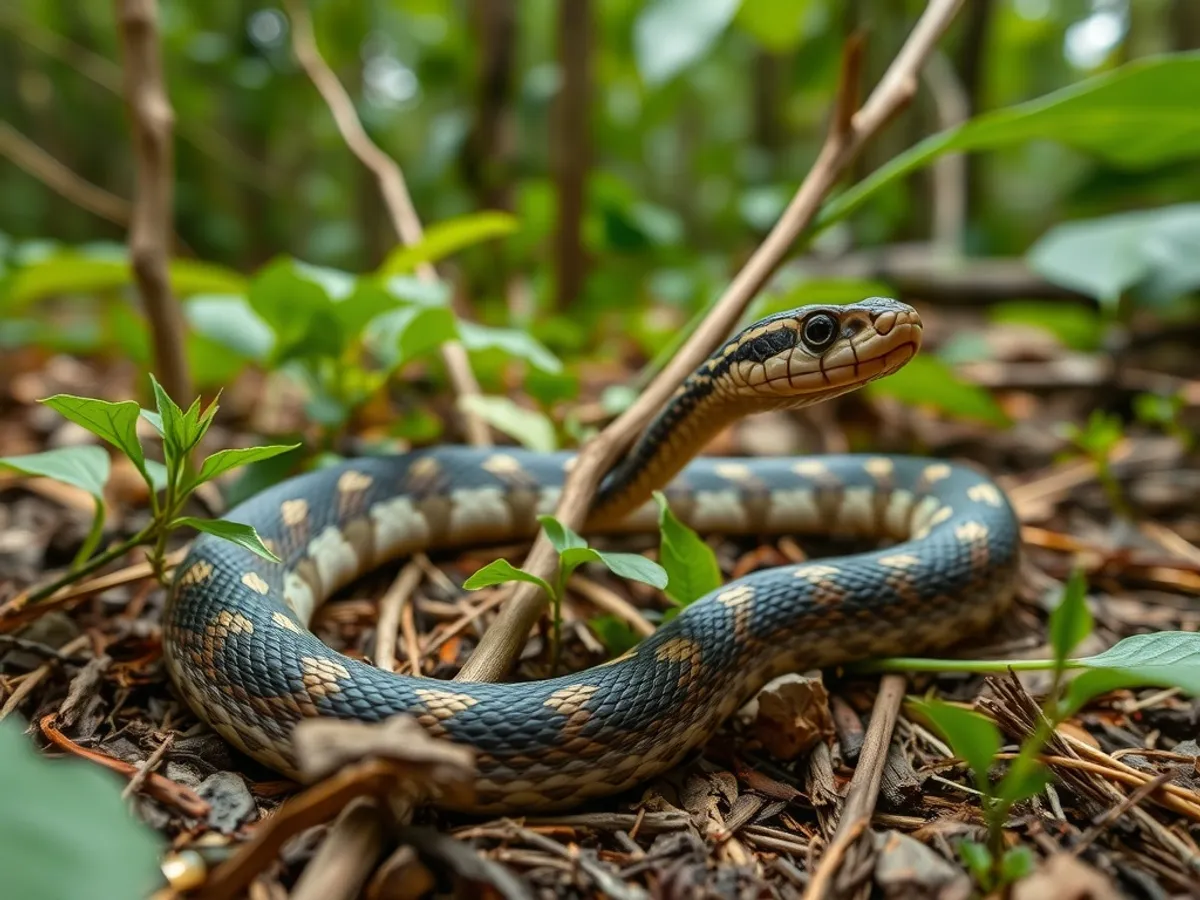
The Common Collared Snake (Sibynophis collaris) is a small, slender, non-venomous snake found across parts of South and Southeast Asia. Recognized by its distinctive yellow or white collar-like marking behind the head, it typically has a brown or olive body with subtle patterning. This elusive reptile is primarily terrestrial and is known for its agility and fast movements when threatened. The Common Collared Snake is harmless to humans and prefers to hide under leaf litter or stones during the day, emerging at dusk or night to hunt.
Fascinating facts
Distinctive Collar
This species is named for the bright yellow or white collar behind its head, making it easily identifiable.
Nocturnal Hunter
The Common Collared Snake is most active at night when it hunts for small lizards, frogs, and insects.
Habitat Flexibility
It adapts well to disturbed habitats and is often found in agricultural fields and gardens near forests.
Detailed description
The Common Collared Snake (Sibynophis collaris) is a slender, medium-sized colubrid, typically reaching a total length of 40–70 cm, with some individuals reported up to 90 cm. Its most distinctive feature is the pale yellow or white collar marking that encircles the nape, bordered posteriorly by a dark band, which contrasts with the olive-brown to reddish-brown dorsal coloration. The ventral surface is usually creamy white or pale yellow, sometimes with faint speckling. Scales are smooth and glossy, arranged in 17 dorsal rows at midbody, aiding in swift, agile movement through leaf litter and low vegetation. The head is slightly flattened and distinct from the neck, with large eyes and round pupils, indicating a primarily diurnal or crepuscular lifestyle. Sibynophis collaris lacks venom glands and is completely harmless to humans. Its body is laterally compressed, facilitating rapid escape through narrow crevices and dense undergrowth. This species is highly secretive, often remaining hidden under stones, logs, or leaf litter during the day. When threatened, it may exhibit rapid, jerky movements or flatten its body to appear larger, but it rarely bites. Its cryptic coloration and elusive habits make it difficult to observe in the wild.
Did you know?
The Common Collared Snake is capable of releasing a foul-smelling musk from its cloacal glands as a defense mechanism when captured.
Research & sources
Behaviour & social structure
Sibynophis collaris is primarily terrestrial and exhibits crepuscular to nocturnal activity, although it may be active during the day in shaded or humid environments. It is a solitary species, with individuals maintaining loosely defined home ranges. The snake is an active forager, using its keen sense of smell and vision to locate prey, which includes small lizards, amphibians, reptile eggs, and occasionally small rodents or invertebrates. It employs a rapid, flicking tongue to sample chemical cues and may probe under debris or within leaf litter. When disturbed, it relies on speed and agility to escape, often employing sudden bursts of movement. Defensive behaviors include body flattening, tail vibration, and mock strikes. Social interactions are minimal outside of the breeding season, and the species does not exhibit territorial aggression.
Reproduction & life cycle
Breeding in Sibynophis collaris typically occurs during the early monsoon season (May to July) in most of its range, coinciding with increased humidity and prey availability. The species is oviparous, with females laying clutches of 3–10 elongated, leathery eggs in concealed, humid locations such as under logs or within rotting vegetation. Incubation lasts approximately 45–60 days, depending on ambient temperature and humidity. Hatchlings measure 12–15 cm in length and are independent from birth, receiving no parental care. Sexual maturity is reached at approximately 18–24 months. There is limited evidence of courtship behavior, but males may engage in brief combat or pursuit of females during the breeding season.
Adaptations & survival
Sibynophis collaris exhibits several adaptations for survival in its diverse habitats. Its cryptic coloration and collar marking provide camouflage among leaf litter and dappled forest light, reducing predation risk. The smooth, glossy scales minimize friction and allow for rapid, silent movement. Its laterally compressed body enables it to navigate through dense vegetation and narrow spaces. The species' agility and speed are key defenses against predators. Its diet flexibility—consuming a range of small vertebrates and eggs—allows it to exploit various ecological niches. The absence of venom is compensated by stealth and rapid escape responses. Additionally, the ability to remain inactive for extended periods helps conserve energy during unfavorable conditions.
Cultural significance
The Common Collared Snake is not widely featured in folklore or mythology, likely due to its secretive nature and lack of medical significance. In some rural communities, it is occasionally misidentified as a venomous species and killed out of fear, but overall, it is not targeted for traditional medicine or ritual use. Its presence in agricultural areas may contribute to natural pest control by preying on small rodents and lizards.
Recent research
Recent research on Sibynophis collaris has focused on its phylogenetic relationships within the subfamily Sibynophiinae, with molecular studies clarifying its evolutionary history and biogeography. Ecological surveys have documented its adaptability to secondary forests and agricultural landscapes, highlighting its resilience to moderate habitat disturbance. Ongoing studies are examining its diet composition and microhabitat preferences using environmental DNA and radio telemetry. There is growing interest in its role as a bioindicator for ecosystem health due to its sensitivity to environmental changes and reliance on diverse prey populations.
Sources
A review of the genus Sibynophis (Serpentes: Colubridae) in South Asia with the description of a new species
Deepak, V., Harikrishnan, S., et al. (2020)
scientificA Review of the Genus Sibynophis in Asia (Serpentes: Colubridae)
Das, I. & Lim, K.K.P. (2003)
scientificSibynophis collaris: The IUCN Red List of Threatened Species 2010
IUCN SSC Amphibian and Reptile Specialist Group
conservationVideos
Habitat
Tropical and subtropical forests, grasslands, and agricultural land
 Various Continental Regions
Grassland
Open areas dominated by grasses rather than trees, supporting numerous herbivores and their predators.
 Elevated Terrain
Mountain
High-altitude environments with varying climates and specialized wildlife adapted to rugged terrain and thin air.
 Global
Forest
Wooded areas with significant tree cover and diverse plant and animal communities.
 Global
Freshwater
Lakes, rivers, and wetlands with diverse aquatic ecosystems.
Conservation
The Common Collared Snake is currently classified as Least Concern on the IUCN Red List.
Threats & challenges
Currently assessed as Least Concern by the IUCN, Sibynophis collaris has a wide distribution and appears tolerant of some habitat modification. However, localized threats include habitat loss due to deforestation, agricultural expansion, and urbanization, particularly in rapidly developing regions of South and Southeast Asia. Pesticide use may reduce prey availability or cause direct mortality. The species is occasionally collected for the pet trade, though not at levels considered threatening. Road mortality and predation by domestic animals are additional, though minor, threats. Population trends are generally stable, but ongoing habitat fragmentation could pose future challenges.
Taxonomy
Scientific name
Sibynophis collaris
- Kingdom
- Animalia
- Phylum
- Chordata
- Class
- Reptilia
- Order
- Squamata
- Family
- Colubridae
- Genus
- Sibynophis
- Species
- collaris
Community notes
Share your observations about the Common Collared Snake.
No community notes yet. Be the first!
Discover more wildlife
More fascinating animals from the encyclopedia.