
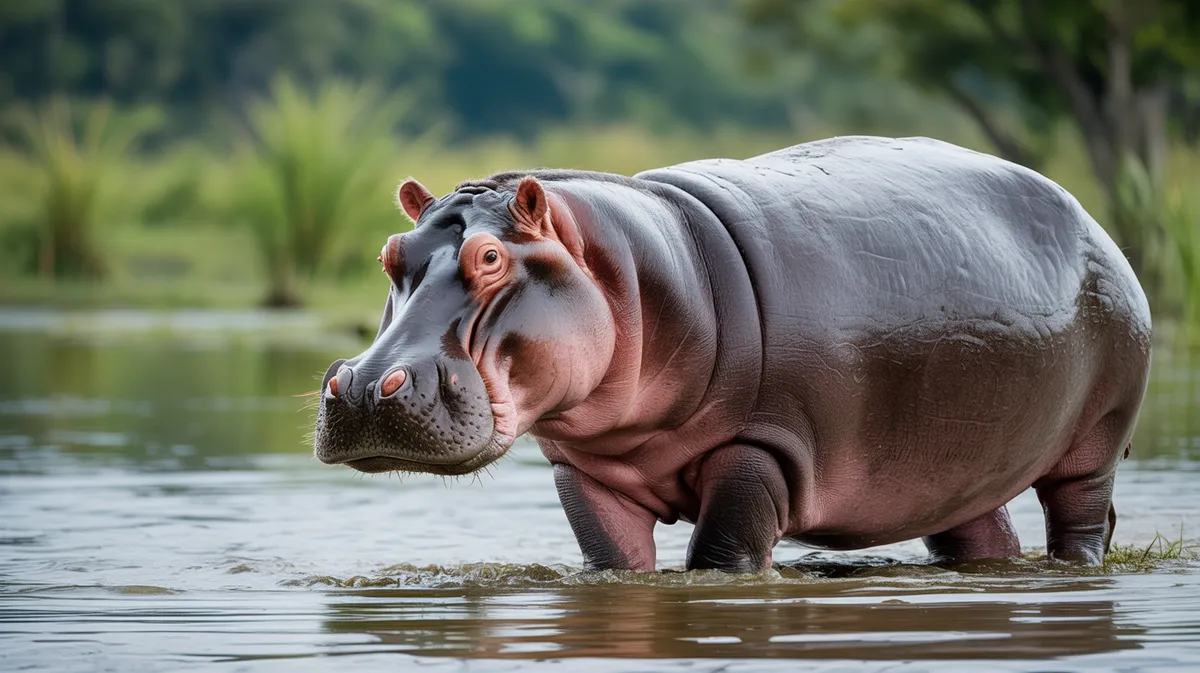
About the Common Hippopotamus
The common hippopotamus (Hippopotamus amphibius) is a large, mostly herbivorous mammal native to sub-Saharan Africa. Weighing between 1,500 and 3,200 kilograms, males are significantly larger than females. This species is uniquely adapted to a semi-aquatic lifestyle, spending much of its day in rivers and lakes to regulate body temperature and prevent dehydration under the harsh African sun. Unlike most mammals, hippos secrete a natural sunscreen, known as 'blood sweat,' which is a reddish fluid that helps protect their skin from UV rays and infection. Their eyes, ears, and nostrils are positioned on top of their heads, allowing them to see and breathe while mostly submerged. Despite their bulky appearance, hippos can run at speeds of up to 30 km/h on land, primarily to defend their territory or escape threats. They have a complex social structure, often forming groups called pods, which can include up to 30 individuals led by a dominant male.
Fascinating facts
Massive Mammals
The hippopotamus is the third-largest land mammal after the elephant and white rhinoceros.
Aquatic Lifestyle
Hippos spend up to 16 hours a day submerged in water to regulate their body temperature and protect their sensitive skin from the sun.
Surprisingly Fast
On land, hippos can run at speeds up to 30 km/h (19 mph) over short distances despite their hefty size.
Detailed description
The common hippopotamus (Hippopotamus amphibius) is a semi-aquatic megafaunal mammal, weighing between 1,400 and 4,500 kg (3,000–9,900 lbs), with males typically larger than females. Its robust, barrel-shaped body is supported by short, pillar-like legs, and it possesses a massive head with a wide mouth capable of opening up to 150 degrees, revealing formidable canine tusks that can reach 50 cm (20 in) in length. The skin is nearly hairless, up to 6 cm (2.4 in) thick, and secretes a natural reddish fluid sometimes called 'blood sweat,' which acts as a sunscreen and antimicrobial agent. Hippos have eyes, ears, and nostrils positioned high on the skull, allowing them to see and breathe while mostly submerged. They are primarily nocturnal grazers, emerging at dusk to travel up to 10 km (6 mi) in search of grasses, their main food source. Socially, hippos are highly gregarious, forming groups called pods or bloats, typically consisting of 10–30 individuals, but sometimes exceeding 100, led by a dominant male. They communicate through a variety of vocalizations, including grunts, bellows, and unique underwater 'wheeze honks.' Reproduction occurs in water, with females giving birth to a single calf after an 8-month gestation. Calves are born underwater and must swim to the surface for their first breath. Despite their aquatic lifestyle, hippos cannot swim in the traditional sense but instead move by walking or bounding along the riverbed. Their unique combination of aquatic and terrestrial adaptations makes them one of Africa’s most ecologically significant large mammals.
Did you know?
A hippopotamus can open its mouth up to 150 degrees, revealing tusks that can grow over 50 cm (20 inches) long.
Research & sources
Behaviour & social structure
Common hippos are primarily nocturnal feeders, spending daylight hours submerged in water to regulate body temperature and avoid sunburn. They leave the water at dusk to graze, consuming up to 40 kg (88 lbs) of grass nightly. Hippos are highly territorial in water, with dominant males defending stretches of river or lake, while on land, they are less territorial and may intermingle. Social interactions are complex, involving vocalizations, body postures, and scent-marking with dung. Aggression is common, particularly among males during the breeding season or when defending territory. Hippos are known for their unpredictable and sometimes aggressive behavior, especially when threatened or with calves present. They play a key ecological role by creating channels and pools in wetlands, which benefit other species. Despite their herbivorous diet, rare instances of scavenging or carnivory have been documented, though these are considered atypical.
Reproduction & life cycle
Breeding in common hippos is not strictly seasonal but peaks during the dry season in some regions. Mating and birthing both occur in water, providing protection from predators. Females reach sexual maturity at 7–9 years, males at about 9–11 years. After an 8-month gestation, a single calf (rarely twins) is born weighing 25–50 kg (55–110 lbs). Calves can suckle underwater, closing their ears and nostrils, and begin grazing at 4–6 months while continuing to nurse for up to a year. Mothers are highly protective, often isolating with their young for several days post-birth before rejoining the pod. Interbirth intervals are typically two years. Parental care is provided solely by the mother; males do not participate in rearing.
Adaptations & survival
The common hippo exhibits several unique adaptations: its thick, nearly hairless skin minimizes water loss but is prone to sunburn, counteracted by the secretion of a natural sunscreen. Eyes, ears, and nostrils are positioned atop the head, allowing near-complete submersion while maintaining environmental awareness. Hippos can close their nostrils and ears underwater and hold their breath for up to 5 minutes. Their large, ever-growing tusks are used for defense and dominance displays. Despite their bulk, hippos are capable of running up to 30 km/h (19 mph) on land over short distances. Their digestive system is adapted for a high-fiber, grass-based diet, with a multi-chambered stomach facilitating fermentation. Socially, their vocal and chemical communication systems are highly developed for maintaining complex group dynamics.
Cultural significance
Hippos have held a prominent place in African mythology and folklore, often symbolizing strength, fertility, and unpredictability. In ancient Egypt, the goddess Taweret, depicted as a hippopotamus, was associated with childbirth and protection. Hippos are featured in traditional art, proverbs, and stories across sub-Saharan Africa. Their ivory-like teeth have been used for carving and trade. In modern times, hippos are iconic symbols of African wildlife, frequently featured in literature, media, and ecotourism, though their dangerous reputation is also well recognized.
Recent research
Recent research has focused on the ecological role of hippos in nutrient cycling, as their dung significantly influences aquatic ecosystems by transferring terrestrial nutrients into rivers and lakes. Studies have also examined the impact of hippo populations on water quality and fish communities. Genetic research has clarified the evolutionary relationships within the Hippopotamidae family, revealing a closer link to cetaceans (whales and dolphins) than to other terrestrial mammals. Ongoing studies are investigating the effects of climate change and human encroachment on hippo behavior, health, and population dynamics. Notably, recent observations of atypical carnivorous behavior have sparked interest in hippo dietary flexibility under environmental stress.
Sources
Hippopotamus amphibius (Common Hippopotamus): Taxonomy, Ecology, and Behavior
Lewison, R. & Pluháček, J. (2017)
scientificThe IUCN Red List of Threatened Species: Hippopotamus amphibius
IUCN SSC Hippo Specialist Subgroup
conservationHippopotamus amphibius (Common Hippopotamus) – Mammalian Species Account
Lewison, R. & Pluháček, J. (2017)
scientificThe IUCN Red List of Threatened Species: Hippopotamus amphibius
IUCN SSC Hippo Specialist Subgroup
conservationVideos
Habitat
Rivers, lakes, and swamps in sub-Saharan Africa
 Africa
Savanna
Grasslands with scattered trees, characterized by seasonal rainfall and home to diverse grazing animals and predators.
 Various Continental Regions
Grassland
Open areas dominated by grasses rather than trees, supporting numerous herbivores and their predators.
 Global
Freshwater
Lakes, rivers, and wetlands with diverse aquatic ecosystems.
Conservation
The Common Hippopotamus is currently classified as Vulnerable on the IUCN Red List.
Threats & challenges
The common hippopotamus faces significant threats from habitat loss, fragmentation, and human-wildlife conflict, particularly as agricultural expansion encroaches on wetland habitats. Illegal hunting for meat and ivory-like canine teeth has contributed to population declines. Water pollution and drought, exacerbated by climate change, further threaten their aquatic habitats. The IUCN estimates the global population at 115,000–130,000 individuals, with a declining trend. Conservation challenges include enforcing anti-poaching laws, managing protected areas, and mitigating conflict with local communities, as hippos can damage crops and pose risks to human safety.
Taxonomy
Scientific name
Hippopotamus amphibius
- Kingdom
- Animalia
- Phylum
- Chordata
- Class
- Mammalia
- Order
- Artiodactyla
- Family
- Hippopotamidae
- Genus
- Hippopotamus
- Species
- amphibius
Where to see a common hippopotamus
17 zoos and aquariums in 5 countries are recorded as keeping this species.
 San Diego Zoo🇺🇸 San Diego, United States
 Warsaw Zoo🇵🇱 Warszawa, Poland
 Calgary Zoo🇨🇦 Calgary, Canada
 Honolulu Zoo🇺🇸 Honolulu, United States
 Kansas City Zoo & Aquarium🇺🇸 Kansas City, United States
Community notes
Share your observations about the Common Hippopotamus.
No community notes yet. Be the first!
Discover more wildlife
More fascinating animals from the encyclopedia.