
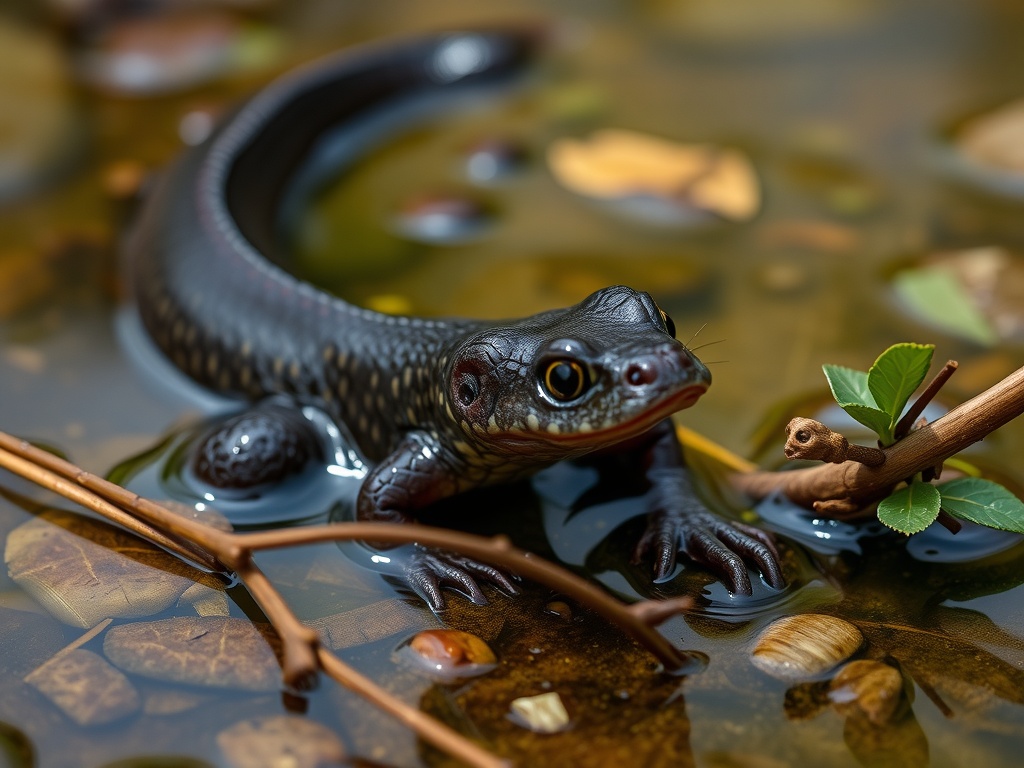
About the Common Mudpuppy
The Common Mudpuppy is a large, fully aquatic salamander native to eastern North America. Recognizable by its bushy, red external gills and mottled gray or brown skin, it spends its entire life underwater in freshwater habitats. Mudpuppies are nocturnal and typically hide under rocks or debris during the day, emerging at night to forage for food. Unlike many amphibians, they do not undergo metamorphosis and retain their larval features, such as external gills, throughout their lives.
Fascinating facts
Fully Aquatic Life
Unlike most salamanders, Common Mudpuppies remain aquatic for their entire lives and never leave the water.
Limb Regeneration
Mudpuppies are capable of regenerating lost limbs, making them valuable for scientific studies on tissue regeneration.
Barking Sounds
They can make vocalizations that resemble a dog's bark, which is where the 'mudpuppy' name originates.
Detailed description
The Common Mudpuppy (Necturus maculosus) is a robust, fully aquatic salamander distinguished by its bushy, reddish external gills, which are highly vascularized and serve as its primary respiratory organs throughout life. Adults typically measure between 20 and 40 cm (8–16 in) in total length, with some individuals reaching up to 48 cm (19 in), making them among the largest North American salamanders. Their skin is smooth and moist, usually gray to brown with dark blue-black spots or blotches, and the ventral side is lighter, often pale gray or whitish. The head is broad and flattened, with small eyes lacking eyelids, reflecting their adaptation to an aquatic lifestyle. Limbs are short but sturdy, each with four toes, and the tail is laterally compressed, aiding in swimming. Unlike most amphibians, mudpuppies exhibit neoteny, retaining larval features such as external gills and a lateral line system into adulthood. They are primarily nocturnal, hiding under rocks, logs, or debris during the day and emerging at night to forage. Mudpuppies are solitary and territorial, with limited social interaction outside of the breeding season. Their diet is opportunistic, including aquatic insects, mollusks, small fish, crustaceans, and even carrion. Reproduction occurs in late autumn or early spring, with females laying eggs in protected underwater sites. The species is long-lived for an amphibian, with wild individuals often reaching 11 years and some captive specimens exceeding 20 years.
Did you know?
Despite being amphibians, Common Mudpuppies never leave the water and breathe almost entirely through their gills.
Research & sources
Wikipedia summary
The common mudpuppy is a species of salamander in the family Proteidae. It lives an entirely aquatic lifestyle in parts of North America in lakes, rivers, and ponds. It goes through paedomorphosis and retains its external gills. Because skin and lung respiration alone is not sufficient for gas exchange, the common mudpuppy must rely on external gills as its primary means of gas exchange. It is usually a rusty brown color and can grow to an average total length of 13 in (330 mm). It is a nocturnal creature, and is active during the day only if the water in which it lives is murky. Its diet consists of almost anything it can get into its mouth, including insects, mollusks, and earthworms. Once a female common mudpuppy reaches sexual maturity at six years of age, she can lay an average of 60 eggs. In the wild, the average lifespan of a common mudpuppy is 11 years.
Behaviour & social structure
Common Mudpuppies are predominantly nocturnal, spending daylight hours concealed beneath submerged objects to avoid predators and desiccation. At night, they actively hunt by slowly crawling along the substrate, using chemosensory cues and their lateral line system to detect prey. They exhibit a sit-and-wait or slow stalking hunting strategy, lunging at prey with a rapid extension of the head and jaws. Feeding is indiscriminate; they consume a wide variety of invertebrates (such as crayfish, snails, aquatic insects, and worms), small fish, amphibian larvae, and detritus. Cannibalism has been observed, particularly among juveniles. Social interactions are minimal, as individuals are generally solitary and may display territorial aggression if space is limited. During winter, mudpuppies remain active under ice, tolerating cold water temperatures by reducing activity levels and metabolic rate.
Reproduction & life cycle
Breeding in Necturus maculosus typically occurs from late autumn to early spring, depending on latitude and water temperature. Courtship involves tactile and chemical cues, with males depositing spermatophores (packets of sperm) on the substrate. Females pick up the spermatophore with their cloaca for internal fertilization. Egg-laying occurs in late spring or early summer; females attach 18–180 eggs (average ~60) singly to the undersides of submerged rocks, logs, or debris in well-oxygenated water. Eggs are large (5–7 mm diameter) and have a gelatinous envelope. Females exhibit parental care by guarding the eggs until hatching, which occurs after 1–2 months depending on temperature. Hatchlings are fully aquatic, resembling miniature adults with external gills, and receive no further parental care. Sexual maturity is reached at 4–6 years, with females maturing slightly later than males.
Adaptations & survival
The Common Mudpuppy displays several adaptations for an aquatic lifestyle. Its persistent external gills maximize oxygen uptake in low-oxygen environments, while cutaneous (skin) and limited pulmonary (lung) respiration supplement gas exchange. The lateral line system, a sensory adaptation, detects water vibrations and movement, aiding in prey detection and predator avoidance. The laterally compressed tail enhances swimming efficiency. Neoteny allows mudpuppies to exploit aquatic habitats year-round, including cold, ice-covered waters. Their cryptic coloration provides camouflage against the substrate. Behavioral adaptations include nocturnality to avoid diurnal predators and reduced activity during winter to conserve energy.
Cultural significance
Mudpuppies have been the subject of local folklore and are sometimes mistaken for juvenile aquatic dragons or mythical creatures due to their unusual appearance. In some regions, they are called 'waterdogs' and have been used as fishing bait. Their presence is considered an indicator of good water quality, making them important in environmental monitoring. They have also featured in educational programs to illustrate amphibian diversity and aquatic ecosystem health.
Recent research
Recent research on Necturus maculosus has focused on its role as a bioindicator species, sensitivity to environmental contaminants, and the evolutionary mechanisms underlying paedomorphosis. Studies have examined the genetic diversity of populations across its range, revealing significant regional variation. Ongoing work investigates the impacts of climate change on distribution and breeding phenology, as well as the effects of endocrine-disrupting chemicals on development and reproduction. Advances in non-invasive monitoring techniques, such as environmental DNA (eDNA), are improving detection and conservation assessments.
Videos
Habitat
Freshwater rivers, lakes, and streams


Conservation
The Common Mudpuppy is currently classified as Least Concern on the IUCN Red List.
Threats & challenges
While the Common Mudpuppy is currently listed as Least Concern, it faces localized threats from habitat degradation, pollution (especially from agricultural runoff and heavy metals), siltation, and dam construction, which alter water flow and reduce suitable breeding sites. Collection for bait or the pet trade, though less common now, has historically impacted some populations. Introduced predatory fish and competition with invasive species may also pose risks. Despite these pressures, the species remains widespread and relatively stable across much of its range, but local declines have been documented, particularly in areas of intensive human activity.
Taxonomy
Scientific name
Necturus maculosus
- Kingdom
- Animalia
- Phylum
- Chordata
- Class
- Amphibia
- Order
- Urodela
- Family
- Proteidae
- Genus
- Necturus
- Species
- maculosus
Where to see a common mudpuppy
1 zoo and aquarium in 1 country are recorded as keeping this species.
Community notes
Share your observations about the Common Mudpuppy.
No community notes yet. Be the first!
Discover more wildlife
More fascinating animals from the encyclopedia.