
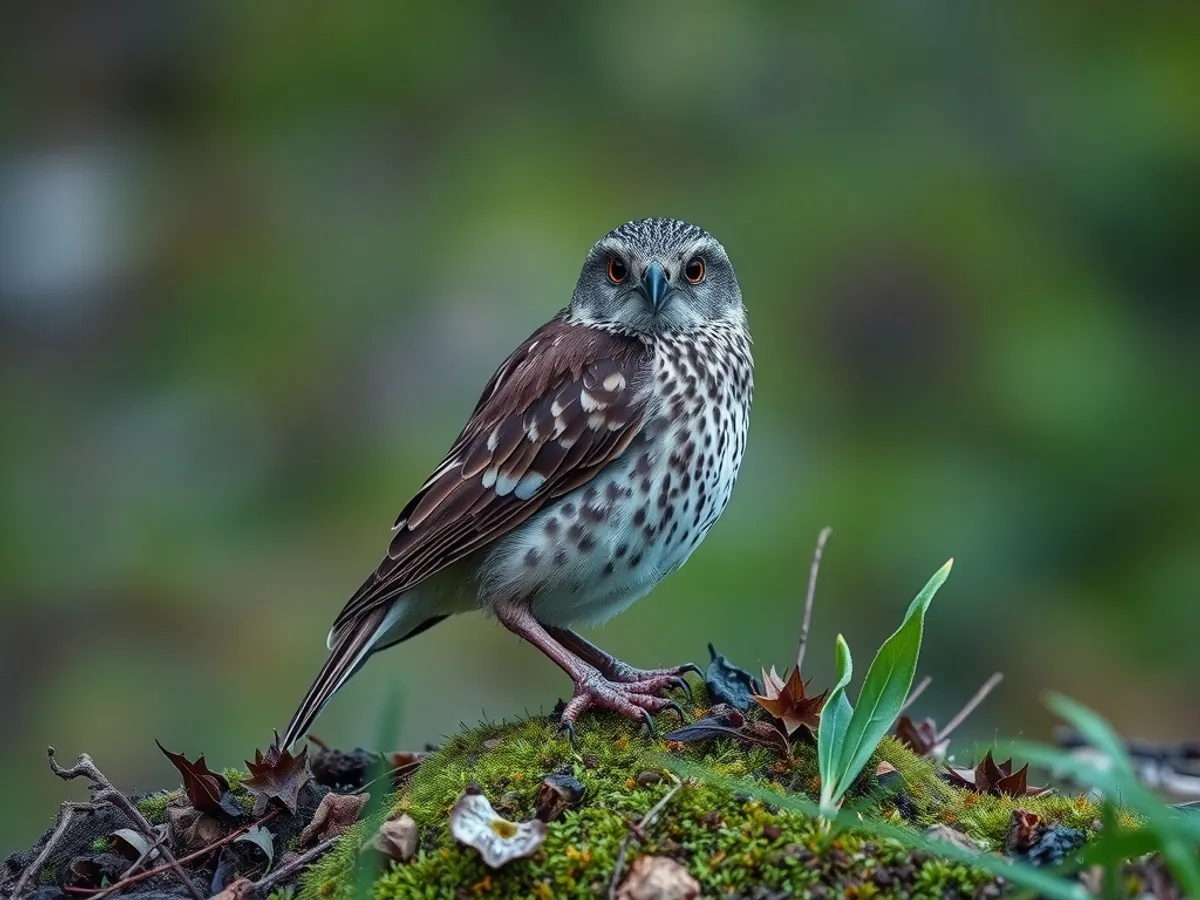
About the Common Nightjar
The Common Nightjar is a medium-sized nocturnal bird renowned for its cryptic plumage and distinctive churring song that echoes through open woodlands and heathlands at dusk and dawn. Its mottled brown, grey, and buff feathers provide exceptional camouflage against leaf litter and fallen branches. During the day, the nightjar rests motionless on the ground, blending perfectly with its surroundings, while at night it becomes active, feeding on flying insects caught in mid-air. This species undertakes long migratory journeys between its breeding grounds in Europe and wintering areas in sub-Saharan Africa.
Fascinating facts
Nocturnal Hunters
Common Nightjars are exclusively active at dusk and night, using their wide mouths and bristle-like feathers to snatch insects in mid-flight.
Exceptional Camouflage
Their intricately patterned plumage allows them to blend seamlessly with leaf litter and bark, providing protection from predators during daylight hours.
Long-distance Migrants
These birds undertake impressive migrations, traveling from Europe to sub-Saharan Africa each year, covering thousands of kilometers.
Detailed description
The Common Nightjar (Caprimulgus europaeus) is a slender, medium-sized nocturnal bird measuring 24–28 cm in length, with a wingspan of 52–59 cm and weighing between 41–101 grams. Its plumage is intricately patterned in shades of grey, brown, and buff, providing superb camouflage against leaf litter and bark. The bird has a flat head, large eyes adapted for low-light vision, and a small, slightly hooked bill surrounded by prominent rictal bristles that help funnel insects into its mouth during flight. Nightjars possess long, pointed wings and a relatively long tail, with males displaying conspicuous white patches on the outer tail feathers and primary wing feathers, which are used in courtship displays and aerial territorial defense. The legs are short and weak, reflecting their predominantly aerial lifestyle. The species is crepuscular and nocturnal, with peak activity at dusk and dawn. During the day, nightjars rest motionless on the ground or along horizontal branches, relying on their cryptic coloration for concealment. Their vocalizations include a distinctive, mechanical 'churring' song produced by males, which can last for several minutes and is often accompanied by wing-clapping displays. Nightjars are solitary outside the breeding season, but may occur in loose aggregations in suitable habitats.
Did you know?
Despite being called 'goatsuckers' in folklore, nightjars do not suck milk from goats; this myth arose from their frequent presence near livestock, where they fed on insects.
Research & sources
Wikipedia summary
The European nightjar, common goatsucker, Eurasian nightjar or just nightjar is a crepuscular and nocturnal bird in the nightjar family that breeds across most of Europe and the Palearctic to Mongolia and Northwestern China. The Latin generic name refers to the old myth that the nocturnal nightjar suckled from goats, causing them to cease to give milk. The six subspecies differ clinally, the birds becoming smaller and paler towards the east of the range. All populations are migratory, wintering in sub-Saharan Africa. Their densely patterned grey and brown plumage makes individuals difficult to see in the daytime when they rest on the ground or perch motionless along a branch, although the male shows white patches in the wings and tail as he flies at night.
Behaviour & social structure
Common Nightjars are highly specialized aerial insectivores, hunting primarily at dusk and dawn (crepuscular) and throughout the night in moonlit conditions. They feed on a variety of flying insects, especially moths, beetles, and mosquitoes, which they capture in flight using their wide gape and bristle-fringed mouths. Foraging is typically conducted in open areas, along woodland edges, clearings, or over heathland, often following regular routes or 'flyways.' Nightjars exhibit a characteristic buoyant, silent flight with occasional glides and sudden twists to pursue prey. Males are territorial during the breeding season, defending their area with persistent churring and display flights. Social interactions are generally limited to courtship and parental care, as the species is otherwise solitary. During the day, nightjars are remarkably sedentary, relying on their camouflage to avoid detection by predators.
Reproduction & life cycle
Breeding occurs from late May to August, varying with latitude and local climate. Nightjars are monogamous within a breeding season, with males performing elaborate display flights and vocalizations to attract females. The female lays two elliptical, cryptically colored eggs directly on bare ground, often among leaf litter or heather, without constructing a nest. Incubation lasts 17–21 days and is performed almost exclusively by the female, who relies on her camouflage for protection. Both parents participate in feeding the chicks, which are semi-precocial and leave the nest scrape within days, though they remain nearby and are brooded by the female at night. The chicks fledge at 16–17 days and become independent soon after. In favorable conditions, a second brood may be attempted. Nightjars exhibit strong site fidelity, often returning to the same breeding territories each year.
Adaptations & survival
The Common Nightjar's cryptic plumage is a primary adaptation for daytime concealment, making it nearly invisible against natural substrates. Its large eyes contain a high density of rod cells, enhancing night vision. The rictal bristles around the mouth aid in prey capture and may also serve a sensory function. The bird's silent, buoyant flight is enabled by soft-edged primary feathers, reducing noise and aiding in stealthy approach to prey. Nightjars have a highly flexible gape and a specialized digestive system for processing chitin-rich insect prey. Their seasonal migration between Eurasia and sub-Saharan Africa is facilitated by strong, pointed wings and efficient fat storage, allowing for long, non-stop flights over inhospitable terrain.
Cultural significance
The Common Nightjar has a rich presence in European folklore and mythology. Its Latin name, Caprimulgus, means 'goat-milker,' stemming from the ancient myth that nightjars suckled milk from goats, causing them to dry up or go blind—a belief now entirely discredited. The bird's eerie, mechanical song and nocturnal habits have inspired numerous superstitions and literary references, often associating it with mystery or omens. In some rural traditions, the nightjar was considered a harbinger of summer. Its distinctive churring has been described in poetry and prose, notably by British naturalists and writers.
Recent research
Recent research on Common Nightjars has focused on their migratory behavior, using geolocators and satellite tracking to reveal precise migration routes and stopover sites between Europe and sub-Saharan Africa. Studies have documented remarkable non-stop flights across the Sahara and the importance of specific African wintering habitats. Acoustic monitoring has improved understanding of population densities and breeding success. Ongoing research addresses the impacts of habitat fragmentation, climate change, and light pollution on nightjar ecology and behavior. There is also interest in the species' role as a bioindicator for healthy open habitats.
Sources
Videos
Habitat
Open woodland, heathland, moorland, and forest clearings
 Various Continental Regions
Grassland
Open areas dominated by grasses rather than trees, supporting numerous herbivores and their predators.
 Elevated Terrain
Mountain
High-altitude environments with varying climates and specialized wildlife adapted to rugged terrain and thin air.
 Global
Forest
Wooded areas with significant tree cover and diverse plant and animal communities.
Conservation
The Common Nightjar is currently classified as Least Concern on the IUCN Red List.
Threats & challenges
While currently classified as Least Concern by the IUCN, Common Nightjar populations are declining in parts of their range due to habitat loss, particularly the reduction of open heathland, woodland clearings, and traditional agricultural landscapes. Afforestation, urbanization, and intensive agriculture reduce suitable breeding and foraging habitats. Disturbance from recreational activities and increased predation by domestic cats and foxes also pose threats. Pesticide use can reduce insect prey availability, impacting breeding success. Climate change may alter migration timing and habitat suitability, presenting additional challenges. Conservation efforts focus on habitat management, preservation of open landscapes, and monitoring population trends.
Taxonomy
Scientific name
Caprimulgus europaeus
- Kingdom
- Animalia
- Phylum
- Chordata
- Class
- Aves
- Order
- Caprimulgiformes
- Family
- Caprimulgidae
- Genus
- Caprimulgus
- Species
- europaeus
Community notes
Share your observations about the Common Nightjar.
No community notes yet. Be the first!
Discover more wildlife
More fascinating animals from the encyclopedia.