
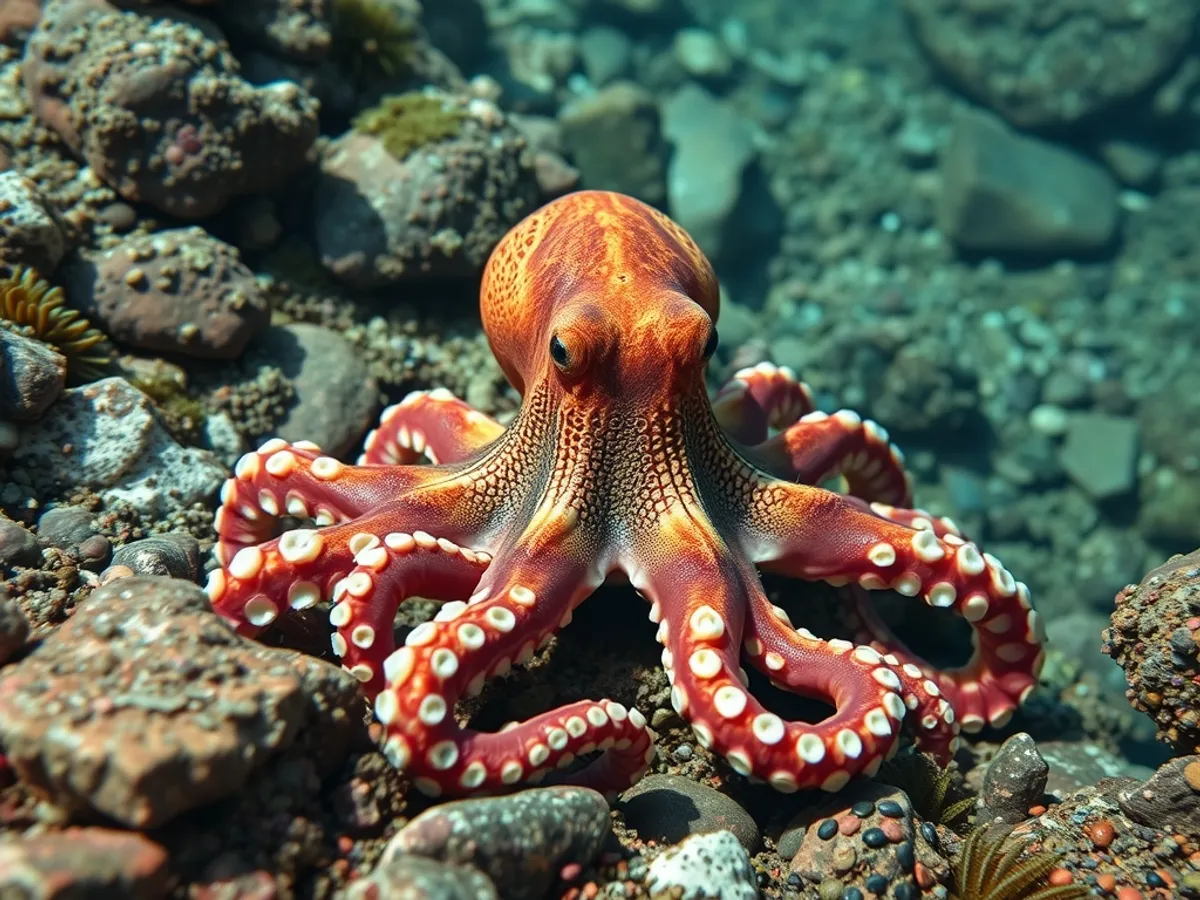
About the Common Octopus
Octopus vulgaris runs on a body plan so unlike ours that almost every organ is a surprise: three hearts, of which two push blood through the gills and one drives it round the body, and blood that is blue because it carries oxygen on copper-based haemocyanin rather than iron. Of its roughly 500 million neurons, about two-thirds sit in the arms rather than the brain, so an arm can find and reject food, or continue exploring a crevice, with a degree of local autonomy. Its skin is a display screen made of three layers — elastic chromatophore sacs pulled open by muscle, reflective iridophores and white leucophores — and it can also raise papillae to change texture, all under direct neural control in under a second. The paradox is that the animal appears to be colourblind, with a single visual pigment; the leading explanation is that it exploits chromatic blur through its odd slit pupil to infer colour from focus. Reproduction is a one-shot affair: the female seals herself in a den, aerates her eggs for weeks or months, does not feed, and dies as they hatch. Removing the optic gland in a classic experiment stopped that death spiral and let females feed and live on, showing the decline is hormonally programmed rather than simple exhaustion. Genetic work has since shown "O. vulgaris" is really a cluster of very similar species.
Fascinating facts
Camouflage Expert
The Common Octopus can rapidly change its skin color and texture, thanks to specialized pigment cells called chromatophores, allowing it to hide from predators and ambush prey.
Intelligent Invertebrate
It is considered one of the most intelligent invertebrates, exhibiting behaviors like problem-solving, using tools, and escaping from enclosures.
Regenerative Abilities
If an arm is lost, the Common Octopus can regenerate it completely, often without lasting harm.
Detailed description
The Common Octopus (Octopus vulgaris) is a medium-sized cephalopod, typically reaching arm spans of up to 1 meter and mantle lengths of 25 cm, though individuals can occasionally exceed these sizes. Its soft, muscular body is highly flexible, allowing it to squeeze through openings as small as its beak—the only rigid part of its anatomy. The skin is covered in chromatophores and specialized cells called iridophores and leucophores, enabling rapid changes in color and texture for camouflage, signaling, and predator deterrence. The large, complex eyes provide acute vision, including polarization sensitivity, which aids in detecting prey and predators. O. vulgaris possesses eight arms lined with two rows of suckers, each arm capable of independent movement and sensory perception. The species is renowned for its intelligence, exhibiting problem-solving, observational learning, and even tool use. It is primarily solitary, spending daylight hours in dens constructed in crevices or under rocks, often barricaded with shells and debris. At night, it emerges to hunt a diverse diet of crustaceans, mollusks, and fish. The common octopus has a short lifespan, typically 1–2 years, with rapid growth and a single reproductive event before death (semelparity). Its unique combination of advanced nervous system, behavioral plasticity, and physical adaptability make it a model organism for neurobiological and behavioral studies.
Did you know?
When threatened, the Common Octopus can eject a cloud of dark ink to confuse predators and escape.
Research & sources
Wikipedia summary
The common octopus is a mollusk belonging to the class Cephalopoda. Octopus vulgaris is one of the most studied of all octopus species, and also one of the most intelligent. It ranges from the eastern Atlantic, extends from the Mediterranean Sea, Black sea and the southern coast of England, to the southern coast of South Africa. It also occurs off the Azores, Canary Islands, and Cape Verde Islands. The species is also common in the Western Atlantic.
Behaviour & social structure
O. vulgaris is a solitary and primarily nocturnal species, exhibiting complex behaviors such as active hunting, ambush predation, and sophisticated problem-solving. It uses its arms and suckers to explore, manipulate, and capture prey, often employing stealth and camouflage to approach targets. The octopus can inject venom through its beak to immobilize prey, particularly crustaceans and bivalves. It is known for constructing and maintaining dens, sometimes decorating or barricading the entrance with stones, shells, and other objects—a behavior termed 'octopus gardening.' Social interactions are rare and typically limited to mating or territorial disputes. The species displays a range of body postures, color changes, and texture modifications for communication and threat displays. Daily routines involve periods of rest in the den, interspersed with foraging excursions, den maintenance, and environmental exploration.
Reproduction & life cycle
Reproduction in O. vulgaris is characterized by internal fertilization, with males using a specialized arm (the hectocotylus) to transfer spermatophores into the female's mantle cavity. Mating can last from several minutes to over an hour, often involving elaborate courtship displays. Females lay between 100,000 and 500,000 small eggs, attaching them in strings to the roof of their den. The incubation period ranges from 25 to 65 days, depending on water temperature. During this time, the female ceases feeding and dedicates herself to aerating and cleaning the eggs, exhibiting intense parental care. After hatching, planktonic paralarvae drift in the water column for several weeks before settling to the benthos. Both males and females are semelparous, dying shortly after reproduction due to programmed senescence.
Adaptations & survival
O. vulgaris exhibits a suite of remarkable adaptations, including advanced chromatophore systems for rapid camouflage and signaling, a decentralized nervous system with over half its neurons located in the arms, and highly sensitive chemoreceptors for detecting prey. Its soft body allows it to access confined spaces, while the beak and radula enable it to penetrate hard shells. The species can autotomize (shed) arms to escape predators, with subsequent regeneration. Jet propulsion, achieved by expelling water through the siphon, provides rapid escape from threats. Behavioral adaptations include tool use (e.g., using coconut shells or rocks for shelter), learning from observation, and memory retention. These evolutionary specializations have enabled the common octopus to thrive in a wide range of coastal habitats.
Cultural significance
The common octopus has held a prominent place in human culture for millennia, appearing in Mediterranean art, mythology, and folklore as a symbol of intelligence, mystery, and adaptability. In ancient Greece and Rome, octopuses were depicted in mosaics and pottery, often associated with the sea god Poseidon. The species is a culinary delicacy in many coastal cultures, particularly in the Mediterranean, Japan, and the Americas, where it is harvested for food. Its remarkable behaviors and intelligence have made it a subject of fascination in literature, film, and popular science, as well as a model organism in neuroscience and behavioral research.
Recent research
Recent research has focused on the neurobiology and cognitive abilities of O. vulgaris, revealing sophisticated learning, memory, and problem-solving skills. Studies have documented observational learning, maze navigation, and even the use of tools, such as coconut shells for shelter. Genetic and phylogeographic analyses have uncovered significant population structure across its range, with evidence of cryptic speciation in some Atlantic and Mediterranean populations. Ongoing research addresses the impacts of climate change on development, behavior, and distribution, as well as the potential for sustainable aquaculture. The species' short life cycle and high fecundity make it an important model for developmental and evolutionary biology.
Sources
Phylogeography of the insular populations of common octopus, Octopus vulgaris Cuvier, 1797, in the Atlantic Macaronesia
Javier Quinteiro, Jorge Rodríguez-Castro, Manuel Rey-Méndez, Nieves González-Henríquez (2020)
scientificVideos
Habitat
Coastal ocean and rocky reefs

Conservation
The Common Octopus is currently classified as Least Concern on the IUCN Red List.
Threats & challenges
While currently listed as Least Concern by the IUCN, O. vulgaris faces localized threats from overfishing, habitat degradation, and pollution, particularly in regions with intensive artisanal and commercial octopus fisheries. Bycatch in trawl and trap fisheries also poses a risk. Ocean warming and acidification may impact reproductive success and prey availability. Population trends are generally stable, but regional declines have been reported in some Mediterranean and Atlantic areas. Conservation challenges include the lack of comprehensive population monitoring and the species' short, boom-bust life cycle, which can mask underlying declines.
Taxonomy
Scientific name
Octopus vulgaris
- Kingdom
- Animalia
- Phylum
- Mollusca
- Class
- Cephalopoda
- Order
- Octopoda
- Family
- Octopodidae
- Genus
- Octopus
- Species
- vulgaris
Community notes
Share your observations about the Common Octopus.
No community notes yet. Be the first!
Discover more wildlife
More fascinating animals from the encyclopedia.