
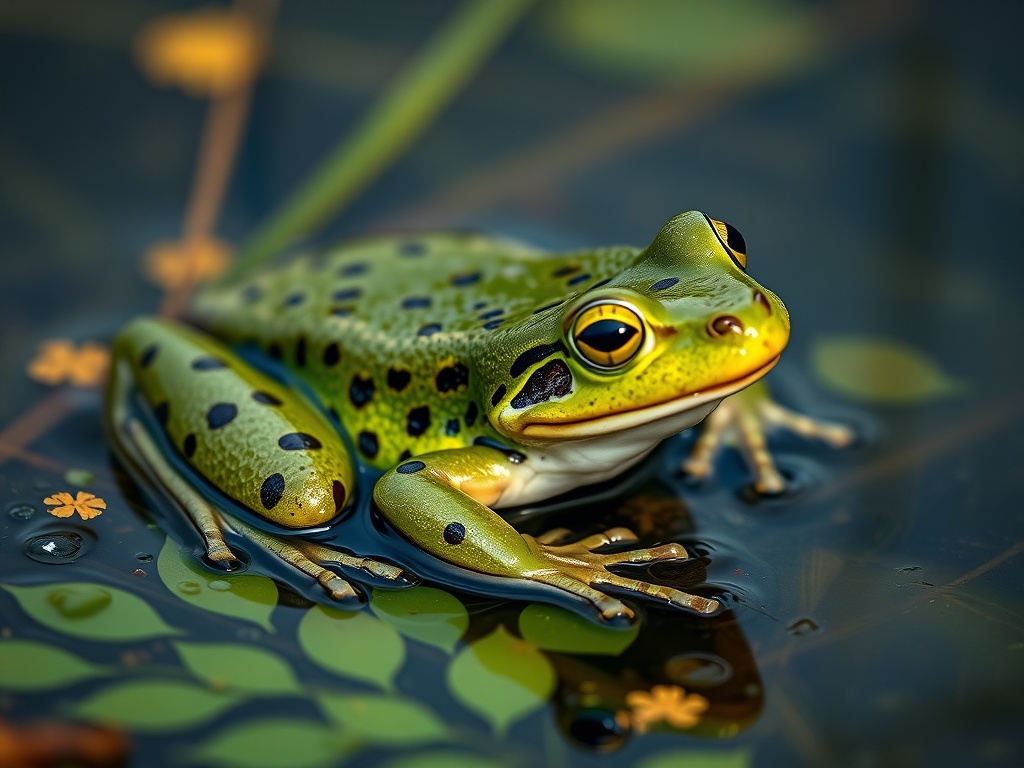
About the Common Parsley Frog
The Common Parsley Frog is a small, slender amphibian found primarily in southwestern Europe. It is easily recognized by its green spots scattered over a grayish or brownish body, often giving it a parsley-like appearance, which inspired its name. This nocturnal frog thrives in temporary freshwater habitats such as ponds, ditches, and marshes, where it breeds during both autumn and spring. Known for its distinctive, high-pitched call, the species is well adapted to fluctuating environments and can be found in a variety of lowland and hilly landscapes.
Fascinating facts
Unique Camouflage
Its green-spotted skin resembles parsley leaves, helping it blend seamlessly into vegetation around its aquatic habitats.
Distinctive Call
The male's call is a high-pitched, repetitive note, often compared to the sound of a squeaky toy and is most active at night.
Double Breeding
This species can breed in both autumn and spring, allowing for two generations per year in favorable conditions.
Detailed description
The Common Parsley Frog (Pelodytes punctatus) is a small, slender amphibian, with adult males typically measuring 3.0–3.5 cm and females reaching up to 3.9–4.5 cm in length. Its body is characterized by a flattened head, protruding eyes with vertical pupils, and long, powerful hind limbs well-suited for jumping. The dorsal skin is granular, covered with elongated warts and irregular green patches on a background that ranges from grayish, brown, to olive, often resembling parsley leaves. The ventral side is smooth and pale, usually white or yellowish. Parsley frogs possess partially webbed toes, aiding in swimming, but their terrestrial agility is also notable. The species is primarily nocturnal, seeking shelter under stones, leaf litter, or in burrows during the day. Their cryptic coloration provides excellent camouflage against predators. Unlike many other anurans, they exhibit a bimodal breeding pattern, with reproductive activity occurring in both autumn and spring. The species is generally solitary outside the breeding season, but congregates in temporary water bodies for reproduction. Their high-pitched, metallic call is distinctive and serves as a key mechanism for mate attraction and territory establishment.
Did you know?
Unlike many frogs, the Common Parsley Frog's breeding season can vary greatly, sometimes occurring in both autumn and spring within the same population.
Research & sources
Wikipedia summary
The common parsley frog is a species of frog in the genus Pelodytes. It lives in the Iberian region of southwestern Europe. Its earliest identification is believed to be from 1802.
Behaviour & social structure
Common Parsley Frogs are primarily nocturnal, emerging at dusk to forage and breed. Their diet consists mainly of small invertebrates such as insects, spiders, and worms, which they capture using a rapid flick of their sticky tongue. They are ambush predators, remaining motionless and relying on their cryptic coloration to avoid detection while waiting for prey. Social interactions are limited outside the breeding season, but during breeding, males form loose choruses and engage in vocal competition. Territorial disputes are rare, but males may physically compete for access to females in crowded breeding sites. During the day, individuals seek refuge in moist microhabitats, including under rocks, logs, or within shallow burrows, to avoid desiccation. Parsley frogs are adept at exploiting ephemeral water bodies, often migrating short distances to suitable breeding sites following rainfall.
Reproduction & life cycle
Pelodytes punctatus exhibits a unique bimodal breeding strategy, with spawning occurring in both autumn (September–November) and spring (February–April), an adaptation to the unpredictable Mediterranean climate. Males arrive at breeding sites first and produce a series of high-pitched, metallic calls to attract females. Amplexus is axillary, and females lay elongated strings of 200–1,000 eggs, typically attached to submerged vegetation or debris in shallow water. Embryonic development is rapid, with hatching occurring within 7–14 days, depending on temperature. Larval development is also variable; autumn-laid tadpoles may overwinter and metamorphose in spring, while spring-laid tadpoles complete metamorphosis in 6–10 weeks. There is no parental care post-oviposition. This dual breeding season increases reproductive success in variable environments, as some cohorts can survive even if one breeding season fails due to pond desiccation.
Adaptations & survival
The Common Parsley Frog displays several adaptations to its Mediterranean environment. Its cryptic coloration and warty skin provide camouflage and deter predators. The species’ bimodal breeding strategy is a key adaptation to the unpredictability of temporary ponds, allowing for reproductive flexibility. Tadpoles exhibit rapid growth and development, enabling them to complete metamorphosis before water bodies dry up. Adults are tolerant of moderate habitat disturbance and can exploit a range of breeding sites, including artificial ponds and ditches. Their partially webbed feet facilitate both swimming and terrestrial movement. Additionally, the ability to aestivate in burrows or under debris during hot, dry periods helps reduce water loss and survive drought.
Cultural significance
The Common Parsley Frog has limited direct cultural significance, but its distinctive appearance and call have made it a subject of local folklore in parts of France and the Iberian Peninsula. Its presence is often associated with healthy, unpolluted wetlands, making it an indicator species for environmental quality. Occasionally, it appears in educational materials and conservation campaigns highlighting the importance of amphibian diversity and wetland preservation. There are no known traditional uses or significant roles in mythology.
Recent research
Recent research on Pelodytes punctatus has focused on its reproductive ecology, particularly the adaptive significance of bimodal breeding and the effects of climate variability on breeding success. Genetic studies have revealed significant population structure across its range, with evidence of local adaptation to different microhabitats. Ongoing research is investigating the species’ response to habitat fragmentation and the impact of agrochemicals on larval development. Studies on acoustic communication have provided insights into mate choice and species recognition mechanisms. The parsley frog is also used as a model for studying amphibian responses to environmental unpredictability and the evolution of bet-hedging reproductive strategies.
Sources
Videos
Habitat
Temporary freshwater ponds and marshes
 Various Continental Regions
Grassland
Open areas dominated by grasses rather than trees, supporting numerous herbivores and their predators.
 Global
Forest
Wooded areas with significant tree cover and diverse plant and animal communities.
 Global
Freshwater
Lakes, rivers, and wetlands with diverse aquatic ecosystems.
Conservation
The Common Parsley Frog is currently classified as Least Concern on the IUCN Red List.
Threats & challenges
While currently listed as Least Concern by the IUCN, the Common Parsley Frog faces several localized threats. Habitat loss due to agricultural expansion, urbanization, and drainage of wetlands reduces available breeding sites. Pollution from pesticides and fertilizers can negatively impact larval development. The introduction of predatory fish and invasive amphibians poses a risk to eggs and tadpoles. Climate change, resulting in altered precipitation patterns and increased frequency of droughts, threatens the availability of suitable temporary water bodies. Despite these challenges, the species’ adaptability and broad distribution contribute to its overall population stability, though some local declines have been reported.
Taxonomy
Scientific name
Pelodytes punctatus
- Kingdom
- Animalia
- Phylum
- Chordata
- Class
- Amphibia
- Order
- Anura
- Family
- Pelodytidae
- Genus
- Pelodytes
- Species
- punctatus
Community notes
Share your observations about the Common Parsley Frog.
No community notes yet. Be the first!
Discover more wildlife
More fascinating animals from the encyclopedia.