
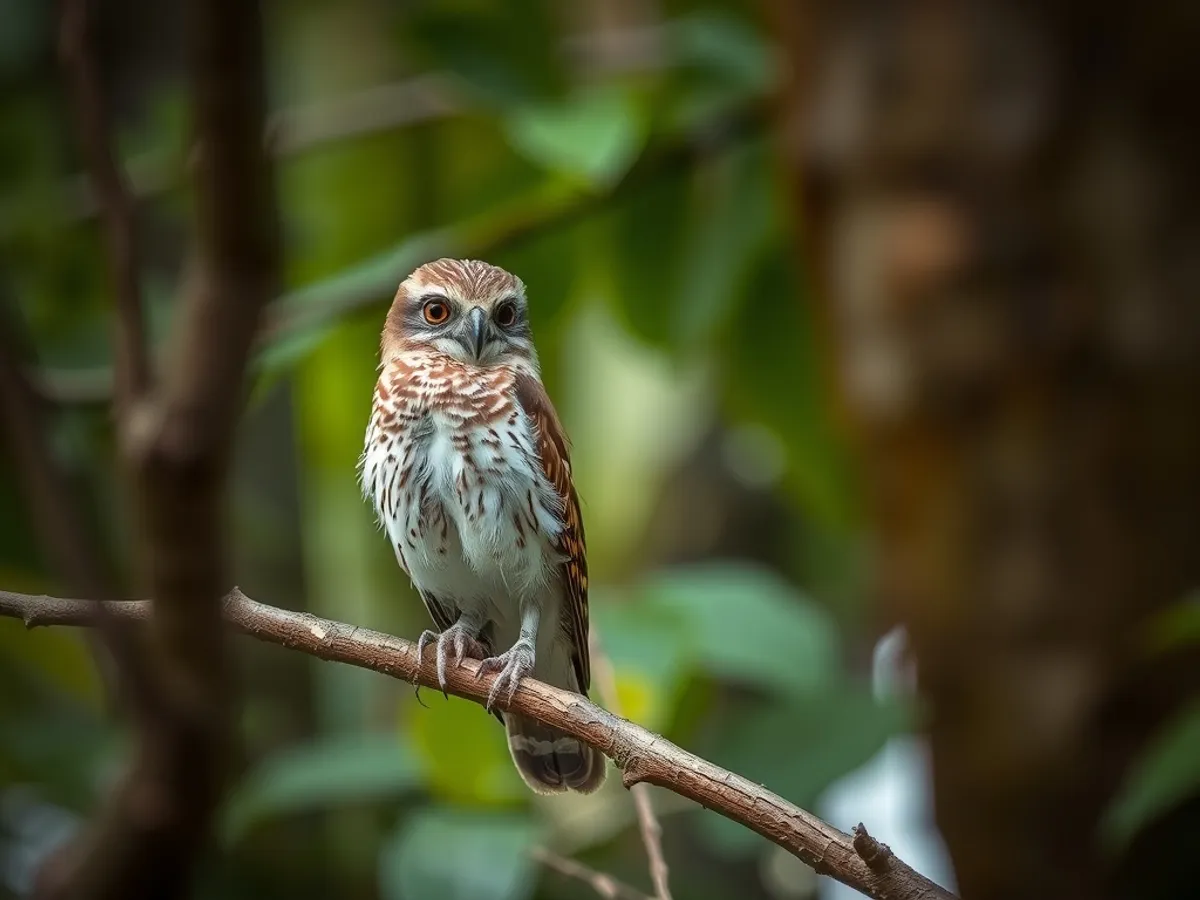
About the Common Potoo
Nyctibius griseus is a nocturnal bird of Central and South America that has committed entirely to a single defensive strategy: it becomes a broken branch. At dawn it settles on the top of a snapped-off stump, points its bill skyward, freezes with its eyes shut and its plumage compressed, and holds that pose all day, and the grey-brown mottling and the way the head merges into the body make it effectively vanish. To watch its surroundings without breaking the pose, its upper eyelid carries two or three small slits, so the bird can keep the eye closed and still detect a moving shape through the gaps. It is not a nightjar or an owl; potoos have their own family and lack the bristles around the gape that nightjars use. Hunting is done from a perch: it sallies out after a passing moth or beetle with an enormous gape — the mouth is far wider than the small bill suggests — and returns to the same lookout. It builds no nest at all, laying a single egg directly into a depression or knot on a bare branch, and the chick is a ball of white down that adopts the same freeze posture almost as soon as it can stand. Its song is an unmistakable descending series of mournful whistles, a sound anyone who has camped in the Neotropics remembers.
Fascinating facts
Nocturnal Hunter
The Common Potoo hunts mainly at night, catching moths, beetles, and other flying insects in mid-air.
Master of Disguise
Its plumage mimics the texture and color of tree bark, helping it blend in perfectly with its surroundings.
Special Eyes
It has slits in its eyelids that allow it to sense movement even when its eyes are almost completely closed.
Detailed description
The Common Potoo (Nyctibius griseus) is a medium-sized nocturnal bird, typically measuring 33–38 cm (13–15 in) in length and weighing between 145–180 grams. Its cryptic plumage, a complex pattern of gray, brown, and black streaks and mottling, allows it to mimic broken branches or tree stumps with remarkable precision, rendering it nearly invisible during daylight hours. The bird's large, yellow eyes are highly adapted for nocturnal vision, featuring a unique slit in the upper eyelid that enables it to detect movement even when apparently at rest. The Common Potoo has a proportionally large, gaping mouth bordered by fine rictal bristles, which aid in catching flying insects, although these bristles are less developed than in true nightjars. Its body is slender, with a relatively short tail and rounded wings, and its legs are short and weak, reflecting its predominantly arboreal lifestyle. During the day, the potoo perches motionless, often adopting a vertical posture to enhance its camouflage. At night, it becomes active, sallying from exposed perches to capture prey in flight. The species is solitary and highly territorial, with individuals maintaining exclusive feeding and roosting areas. Its haunting, melancholy vocalizations—often described as wailing or moaning—are most frequently heard on moonlit nights and serve both to advertise territory and attract mates. The Common Potoo is found across a wide range in Central and South America, from Nicaragua and Trinidad south to northern Argentina and Uruguay, inhabiting open woodlands, forest edges, savannas, and occasionally plantations.
Did you know?
Despite appearing motionless and invisible during the day, Common Potoos can rotate their heads up to 180 degrees to keep watch for predators.
Research & sources
Wikipedia summary
The common potoo, or kakuy, or urutau is one of seven species of birds within the genus Nyctibius. It is notable for its large, yellow eyes and a wide mouth. Potoos are nocturnal and are related to nightjars and frogmouths. They lack the characteristic bristles around the mouths of true nightjars.
Behaviour & social structure
Common Potoos are strictly nocturnal, remaining completely motionless and silent during the day to avoid detection. Their primary hunting technique is 'sallying,' in which the bird launches from a perch to snatch flying insects—primarily moths, beetles, and other large nocturnal arthropods—before returning to the same or a nearby perch. They rely heavily on visual cues to detect prey, aided by their large, sensitive eyes. Socially, Common Potoos are solitary outside of the breeding season, with little evidence of flocking or cooperative behavior. They are highly site-faithful, often returning to the same perch or roosting spot for extended periods. Territorial disputes are rare but may be signaled by vocalizations or postural displays. Their daily routine is dominated by inactivity during daylight, followed by active foraging and singing at night, especially during the breeding season.
Reproduction & life cycle
Breeding occurs during the local wet season, varying geographically but generally from March to August in much of their range. The Common Potoo is monogamous, with pairs forming stable bonds for at least the duration of the breeding season. The female lays a single, elliptical white egg directly on a natural depression or broken stub atop a tree branch, without constructing a nest. Both parents participate in incubation, which lasts approximately 30 days. The chick is semi-precocial, covered in down and camouflaged, and remains motionless during the day, mimicking the appearance of the parent or the tree branch. Parental care is extensive, with adults feeding the chick by regurgitation and providing protection through vigilant camouflage. Fledging occurs about 40–50 days after hatching, with juveniles remaining near the nest site for several weeks before dispersing.
Adaptations & survival
The Common Potoo's most remarkable adaptation is its cryptic plumage, which provides exceptional camouflage against tree bark and branches. Its vertical resting posture, combined with the ability to remain motionless for hours, further enhances this disguise. The bird's large eyes maximize light capture for nocturnal vision, while the slit in the eyelid allows it to monitor its surroundings with minimal movement. Its wide gape and fine rictal bristles facilitate the capture of erratic flying insects. Behaviorally, its solitary and territorial nature reduces competition for food and nesting sites. The lack of a constructed nest and reliance on natural tree stubs minimizes exposure to predators and parasites.
Cultural significance
In many South American cultures, the Common Potoo is associated with mystery and the supernatural, owing to its haunting vocalizations and ghostly nocturnal presence. Its calls are often interpreted as omens or messages from the spirit world in indigenous folklore. In Brazil, the bird is known as 'urutau,' and its mournful song is said to be the lament of a woman transformed into a bird by sorrow. The potoo's remarkable camouflage and elusive habits have also made it a symbol of invisibility and stealth in local storytelling.
Recent research
Recent studies have focused on the Common Potoo's visual adaptations for nocturnality, revealing specialized retinal structures and unique eyelid morphology. Acoustic research has documented significant regional variation in vocalizations, suggesting the potential for cryptic species or subspecies within the Nyctibius griseus complex. Ongoing ecological research is examining the species' resilience to habitat fragmentation and its role in controlling nocturnal insect populations. Advances in bioacoustic monitoring are improving population assessments and revealing previously unknown aspects of potoo behavior and distribution.
Videos
Habitat
Tropical and subtropical forests, woodland edges, and savannas
 Africa
Savanna
Grasslands with scattered trees, characterized by seasonal rainfall and home to diverse grazing animals and predators.
 Tropical Regions
Rainforest
Dense, wet forests with the highest biodiversity on Earth, containing more than half of the world's plant and animal species.
 Global
Forest
Wooded areas with significant tree cover and diverse plant and animal communities.
Conservation
The Common Potoo is currently classified as Least Concern on the IUCN Red List.
Threats & challenges
Currently, the Common Potoo is classified as Least Concern by the IUCN, with a stable and widespread population. However, localized threats include habitat loss due to deforestation, agricultural expansion, and urbanization, particularly in regions of rapid land-use change. The species is sensitive to the removal of mature trees, which provide essential perching and nesting sites. Light pollution may also disrupt nocturnal foraging and breeding behaviors. Despite these challenges, the Common Potoo's adaptability to secondary habitats and its cryptic lifestyle have enabled it to persist in moderately disturbed landscapes.
Taxonomy
Scientific name
Nyctibius griseus
- Kingdom
- Animalia
- Phylum
- Chordata
- Class
- Aves
- Order
- Nyctibiiformes
- Family
- Nyctibiidae
- Genus
- Nyctibius
- Species
- griseus
Community notes
Share your observations about the Common Potoo.
No community notes yet. Be the first!
Discover more wildlife
More fascinating animals from the encyclopedia.