
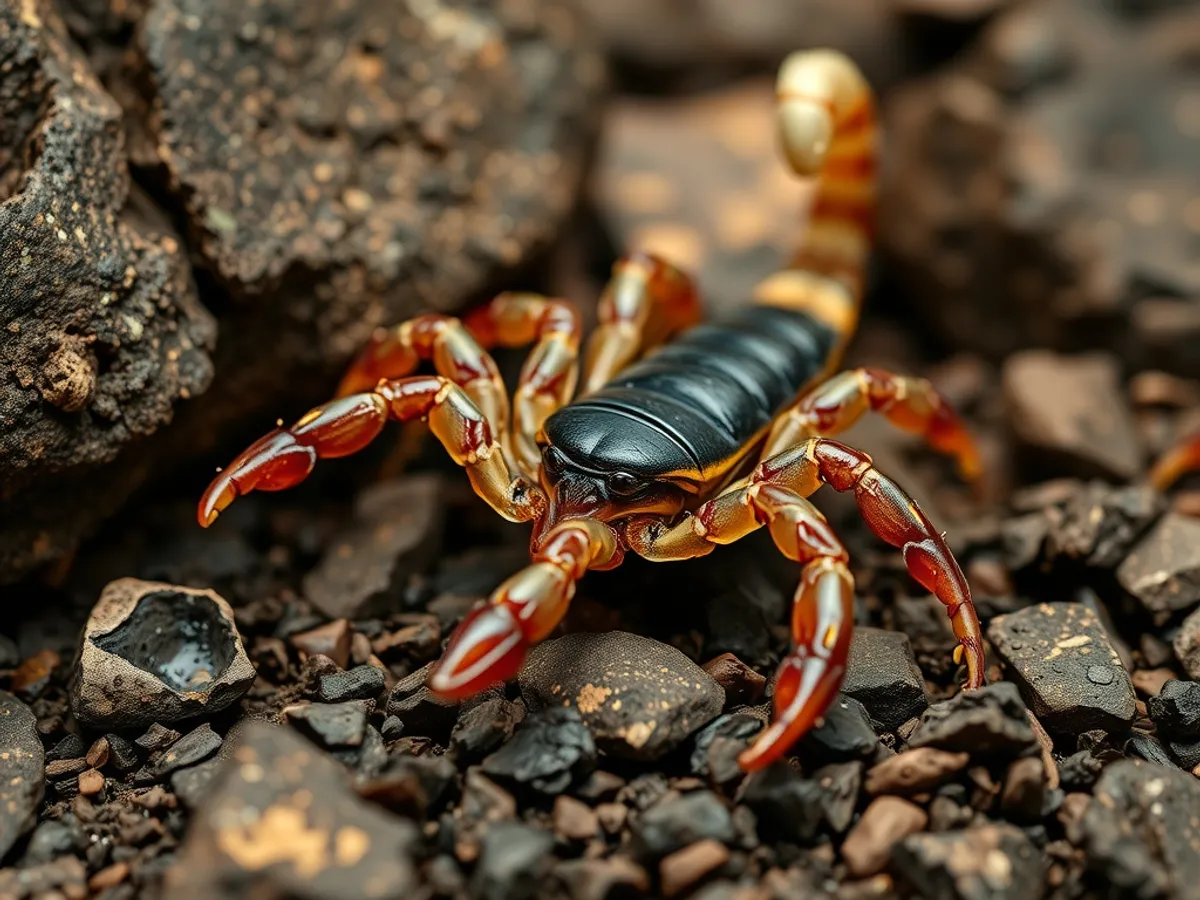
About the Common scorpion
The common scorpion, known scientifically as Euscorpius carpathicus, is a small to medium-sized arachnid native to parts of Southern Europe. It is easily recognized by its segmented tail, which ends in a venomous stinger, and its robust pincers used for hunting and defense. These scorpions are primarily nocturnal, hiding under rocks, logs, or leaf litter during the day and emerging at night to hunt small invertebrates. While their sting can be painful to humans, it is generally not dangerous and is milder compared to other scorpion species.
Fascinating facts
Glows in UV Light
The exoskeleton of the common scorpion fluoresces a bright blue-green color under ultraviolet light.
Live Birth
Female common scorpions give birth to live young, which climb onto her back immediately after being born and stay there for several days.
Nocturnal Hunter
Common scorpions are most active at night, using their keen senses to locate and capture prey such as insects, spiders, and other small arthropods.
Detailed description
Euscorpius carpathicus, commonly known as the common scorpion or Carpathian scorpion, is a small to medium-sized arachnid, typically measuring 30–50 mm in length. Its body is divided into the prosoma (cephalothorax) and opisthosoma (abdomen), with the latter ending in a five-segmented metasoma (tail) tipped by a telson containing the venom gland and stinger. The coloration ranges from pale brown to dark reddish-brown, often with subtle patterning that aids in camouflage among leaf litter and rocks. Its robust pedipalps (pincers) are adapted for grasping and subduing prey, while the legs are relatively short and adapted for maneuvering in confined spaces. Euscorpius carpathicus is primarily nocturnal, emerging at dusk to hunt, and spends daylight hours hidden under stones, bark, or within crevices. It is a solitary species, with individuals maintaining distinct territories except during the breeding season. The species exhibits a relatively mild venom, primarily used for subduing small arthropods rather than for defense against larger predators. Reproduction involves a complex courtship dance, and females give birth to live young, which are carried on the mother’s back until their first molt. This scorpion is well-adapted to temperate environments, tolerating a range of humidity and temperature fluctuations, and is often found in microhabitats with stable moisture levels. Its ecological role as both predator and prey contributes to the regulation of invertebrate populations and supports local food webs.
Did you know?
The venom of the common scorpion is not dangerous to humans and is comparable to a bee sting in terms of pain and risk.
Research & sources
Behaviour & social structure
Euscorpius carpathicus is predominantly nocturnal, becoming active shortly after sunset. It relies on tactile and chemical cues to locate prey, which includes insects, spiders, and other small arthropods. The scorpion uses its sensitive pectines (comb-like sensory organs on the underside) to detect vibrations and chemical trails. Hunting is typically ambush-based: the scorpion remains motionless until prey approaches, then quickly seizes it with its pedipalps and delivers a mild venomous sting if necessary. Feeding occurs in a secluded spot, and the scorpion uses external digestion, secreting enzymes to liquefy prey tissues. Social interactions are limited, with individuals showing territoriality and occasional aggressive encounters, especially between males. During the day, individuals retreat to shelters that maintain stable humidity and temperature, reducing desiccation risk. Seasonal activity peaks in spring and autumn, with reduced activity during extreme summer heat or winter cold.
Reproduction & life cycle
Mating in Euscorpius carpathicus involves a ritualized courtship, where the male grasps the female’s pedipalps and performs a 'promenade à deux'—a coordinated dance to find a suitable substrate for spermatophore deposition. The male deposits a spermatophore on the ground, which the female picks up with her genital opening. Gestation lasts between 8 and 12 months, depending on environmental conditions. Females are viviparous, giving birth to 10–30 live young, which immediately climb onto the mother’s back. The young remain there for 7–10 days, molting once before dispersing. Parental care is limited to this brooding period; after dispersal, juveniles are independent. Breeding typically occurs in late spring to early summer, with females capable of reproducing annually or biennially.
Adaptations & survival
Euscorpius carpathicus exhibits several adaptations for survival in temperate environments. Its cryptic coloration provides camouflage against predators and prey. The exoskeleton is thick and waxy, reducing water loss and allowing survival in microhabitats with variable humidity. The pectines are highly sensitive, enabling detection of prey and conspecifics through substrate vibrations and chemical cues. Behavioral adaptations include nocturnality to avoid diurnal predators and desiccation, and the use of microhabitats such as rock crevices and leaf litter for shelter. The mild venom is specialized for invertebrate prey, minimizing metabolic cost while still effective for hunting. Euscorpius carpathicus can tolerate a wide range of temperatures, entering periods of reduced activity (torpor) during unfavorable conditions.
Cultural significance
Scorpions, including Euscorpius carpathicus, have held symbolic significance in various European cultures, often representing protection, danger, or resilience. In some regions, scorpions are featured in folklore as omens or protective symbols. However, E. carpathicus is not commonly used in traditional medicine or as a food source, unlike some larger scorpion species in other parts of the world. Its mild venom and secretive habits have generally led to a neutral or slightly negative perception among local populations, with occasional fear or misunderstanding regarding its sting.
Recent research
Recent molecular studies have revealed that Euscorpius carpathicus is part of a complex of closely related cryptic species, leading to taxonomic revisions and the description of new species within the Euscorpius genus. Ongoing research focuses on population genetics, biogeography, and the impact of habitat fragmentation. Studies on venom composition have shown it to be relatively simple, with low toxicity to mammals, but effective against arthropod prey. Ecological research highlights the species’ role in controlling pest populations and its sensitivity to environmental changes, making it a potential bioindicator for habitat quality. There is also interest in the species’ reproductive biology and the evolution of parental care behaviors among scorpions.
Sources
Revision of the Euscorpius carpathicus complex (Scorpiones: Euscorpiidae) in Europe
Gantenbein, B., Fet, V., Largiadèr, C.R., and Scholl, A. (2000)
scientificEuscorpius carpathicus: The IUCN Red List of Threatened Species 2023
IUCN SSC Arachnid Specialist Group
conservationSystematics and biogeography of the Euscorpius carpathicus complex (Scorpiones: Euscorpiidae)
G. Fet, V. E. Fet, M. E. Soleglad (2014)
scientificEuscorpius carpathicus: The IUCN Red List of Threatened Species 2020
IUCN SSC Arachnid Specialist Group
conservationVideos
Habitat
Temperate forests and rocky areas


Conservation
The Common scorpion is currently classified as Least Concern on the IUCN Red List.
Threats & challenges
While currently listed as Least Concern, Euscorpius carpathicus faces localized threats from habitat loss due to urbanization, agriculture, and deforestation. Microhabitat destruction, such as removal of rocks and dead wood, can significantly impact populations. Pesticide use in agricultural areas may reduce prey availability and directly harm scorpions. Climate change poses a long-term threat by altering temperature and humidity regimes, potentially affecting reproductive success and survival. Despite these challenges, the species remains widespread and locally abundant, with stable population trends in most areas. Conservation efforts focus on habitat preservation and monitoring of population dynamics.
Taxonomy
Scientific name
Euscorpius carpathicus
- Kingdom
- Animalia
- Phylum
- Arthropoda
- Class
- Arachnida
- Order
- Scorpiones
- Family
- Euscorpiidae
- Genus
- Euscorpius
- Species
- carpathicus
Community notes
Share your observations about the Common scorpion.
No community notes yet. Be the first!
Discover more wildlife
More fascinating animals from the encyclopedia.