
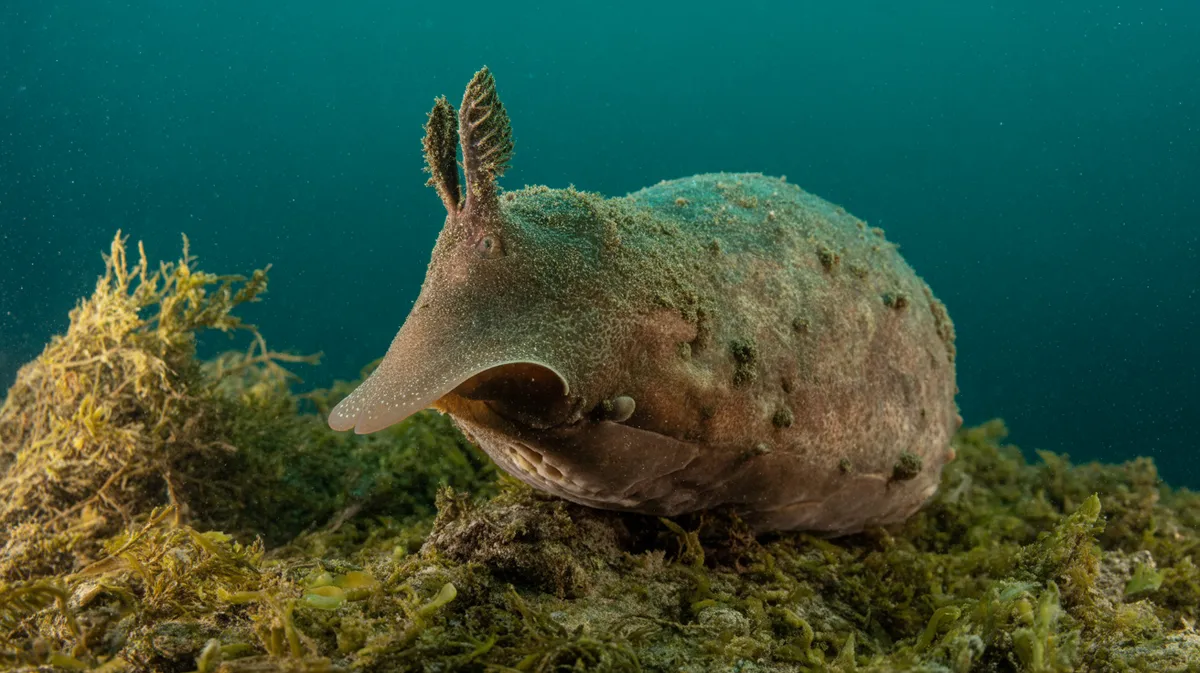
About the Common sea hare
The common sea hare is a medium-sized, soft-bodied marine mollusk belonging to the group of opisthobranch gastropods. Their bodies are elongated and somewhat flattened, with a pair of long, ear-like rhinophores on their heads that resemble rabbit ears, giving them their common name. Sea hares are known for their ability to release a purple ink when threatened, which helps deter predators. They are found in shallow coastal waters, especially among seaweed beds where they graze on algae.
Fascinating facts
Unique Defense
When threatened, common sea hares release a cloud of purple ink that confuses predators and can even block their sense of smell.
Algae Diet
Sea hares feed exclusively on algae, often leaving distinctive bite marks on seaweed where they graze.
Scientific Importance
Their large neurons make sea hares a favored model organism in neurological and behavioral studies.
Detailed description
The common sea hare (Aplysia punctata) is a medium-sized marine gastropod mollusk, typically reaching lengths of 7–20 cm, though some individuals may grow larger in optimal conditions. Its body is soft, elongated, and somewhat flattened, with a thin, internal shell that provides minimal protection. The mantle is often mottled brown, green, or reddish, allowing for effective camouflage among seaweed and algae. Two prominent, ear-like rhinophores on the head function as chemosensory organs, detecting chemical cues in the water. The parapodia—large, wing-like flaps along the sides—are used for swimming and can be folded over the back to protect the gills. The foot is broad and muscular, enabling the animal to crawl over rocky and algal substrates. Aplysia punctata is notable for its ability to secrete a purple ink and milky opaline fluid from specialized glands when disturbed, which can confuse or deter predators. Internally, it possesses a highly developed nervous system for an invertebrate, making it a valuable model organism in neurobiological research. Its radula, a ribbon-like structure lined with tiny teeth, is adapted for scraping algae from surfaces.
Did you know?
Despite their unassuming appearance, common sea hares play a crucial role in scientific research, especially in neurobiology due to their large, easily studied neurons.
Research & sources
Behaviour & social structure
Aplysia punctata is primarily a solitary grazer, spending much of its time slowly moving across rocks and seaweed beds in search of food. It feeds mostly during daylight hours, using its sensitive rhinophores to locate patches of algae, particularly red and green seaweeds such as Ulva and Enteromorpha. When threatened, it may release a cloud of ink and opaline to obscure itself and chemically deter predators, such as fish and crustaceans. While generally solitary, sea hares may aggregate in large numbers during breeding seasons, sometimes forming dense clusters. They exhibit limited territoriality and do not defend feeding grounds. Locomotion is achieved by crawling with the muscular foot or, less commonly, by swimming through undulating movements of the parapodia. Their daily routine is largely dictated by food availability and environmental conditions, with increased activity in warmer months.
Reproduction & life cycle
Aplysia punctata is a simultaneous hermaphrodite, possessing both male and female reproductive organs. During the breeding season, which typically occurs from late spring to early autumn in temperate regions, individuals form mating chains, where each animal acts as both male and female, fertilizing and being fertilized in turn. Copulation involves the transfer of sperm via a penis located on the right side of the head. After mating, the animal lays long, gelatinous strings of yellowish eggs, which may contain thousands of embryos. These egg masses are attached to seaweed or rocks in sheltered areas. Embryonic development lasts from 10 to 20 days, depending on water temperature, after which planktonic veliger larvae hatch and drift with the currents before settling and metamorphosing into juvenile sea hares. There is no parental care beyond egg deposition.
Adaptations & survival
Aplysia punctata exhibits several notable adaptations for survival in its coastal habitat. Its cryptic coloration and soft, flexible body allow it to blend seamlessly with seaweed, reducing predation risk. The secretion of purple ink and opaline fluid is a unique chemical defense, containing compounds that can disrupt predator sensory systems. The parapodia not only facilitate swimming but also protect the delicate gills. As a simultaneous hermaphrodite, it maximizes reproductive opportunities in sparse populations. Its radula is specialized for efficiently scraping a variety of algal species, allowing dietary flexibility. The large, well-organized nervous system is an evolutionary specialization that supports complex behaviors and learning, rare among mollusks.
Cultural significance
While Aplysia punctata does not have a prominent role in traditional human culture or mythology, it is of considerable scientific significance. The species, along with related Aplysia, has been a key model organism in neurobiology, particularly in studies of learning and memory, due to its relatively simple and accessible nervous system. The work of Nobel laureate Eric Kandel on Aplysia californica has provided fundamental insights into the molecular basis of memory, with A. punctata serving as a European counterpart in similar research. Occasionally, sea hares are mentioned in natural history literature and marine education programs.
Recent research
Recent research on Aplysia punctata has focused on its neurophysiology, chemical defenses, and ecological interactions. Studies have elucidated the composition and function of its ink and opaline secretions, revealing complex mixtures of amino acids, pigments, and deterrent compounds. Ongoing research investigates the effects of environmental stressors, such as ocean acidification and temperature rise, on its development and behavior. Genomic and transcriptomic studies are expanding understanding of its nervous system and adaptive responses. Additionally, A. punctata is being used in biomonitoring programs to assess coastal pollution impacts, given its sensitivity to water quality changes.
Sources
Aplysia punctata (Cuvier, 1803): Biology and Ecology
J. Z. Young, Journal of Molluscan Studies (1970)
scientificAplysia punctata (Cuvier, 1803): Taxonomy, Biology and Ecology
Bouchet, P. & Gofas, S. (MolluscaBase) (2023)
scientificVideos
Habitat
Shallow coastal waters with abundant seaweed

Conservation
The Common sea hare is currently classified as Least Concern on the IUCN Red List.
Threats & challenges
Currently, Aplysia punctata faces relatively few direct threats and is classified as Least Concern by the IUCN. However, localized population declines may occur due to habitat degradation, pollution (especially eutrophication and heavy metals), and climate change, which can alter algal communities and water temperature. Collection for scientific research and the aquarium trade is generally not at a scale to threaten populations. Natural predators include fish, crabs, and sea stars, though the sea hare's chemical defenses provide some protection. Long-term monitoring is needed to assess the impacts of changing coastal ecosystems and human activities.
Taxonomy
Scientific name
Aplysia punctata
- Kingdom
- Animalia
- Phylum
- Mollusca
- Class
- Gastropoda
- Order
- Anaspidea
- Family
- Aplysiidae
- Genus
- Aplysia
- Species
- punctata
Community notes
Share your observations about the Common sea hare.
No community notes yet. Be the first!
Discover more wildlife
More fascinating animals from the encyclopedia.