
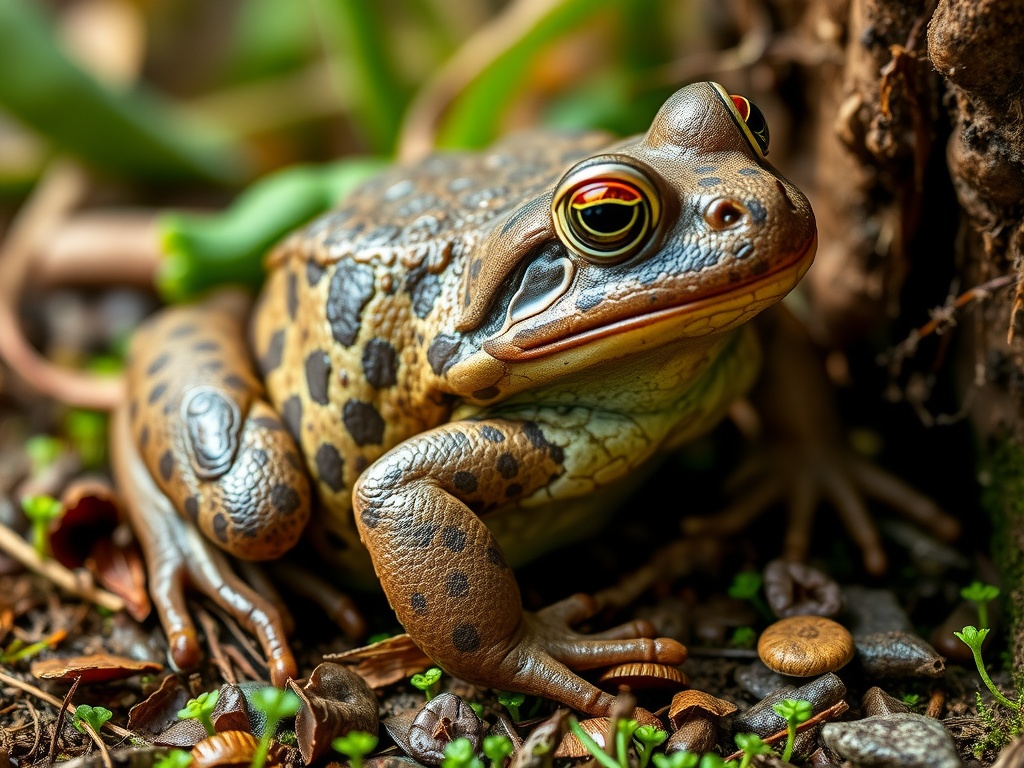
About the Common Toad
The Common Toad is a widespread amphibian native to much of Europe and parts of western Asia. Recognizable by its warty, brownish skin and robust body, it is well adapted to a variety of habitats, including gardens, woodlands, and grasslands. Common Toads are primarily nocturnal and spend much of their time hidden under logs, stones, or leaf litter. During the breeding season, they migrate to ponds and slow-moving waters to spawn, often returning to the same site each year.
Fascinating facts
Toxic Defense
The Common Toad secretes a mild toxin from glands behind its eyes, making it distasteful and sometimes poisonous to predators such as cats and foxes.
Nocturnal Habits
This species is mostly active at night, spending daytime hours hidden in damp, sheltered spots to avoid dehydration.
Great Travelers
Common Toads have strong homing instincts and can travel several kilometers to return to their ancestral breeding ponds each spring.
Detailed description
The Common Toad (Bufo bufo) is a robust, medium-to-large amphibian, typically measuring 6–13 cm in length, with females generally larger than males. Its skin is dry, thick, and covered with prominent warty glands, which secrete a mild toxin (bufotoxin) as a defense against predators. The coloration varies from greyish-brown to olive or reddish-brown, often providing excellent camouflage among leaf litter and soil. The head is broad with conspicuous parotoid glands behind the eyes, and the eyes themselves are coppery-gold with horizontal pupils. Limbs are relatively short, resulting in a characteristic slow, lumbering gait rather than long leaps. The Common Toad is primarily nocturnal, emerging at dusk to forage, and spends daylight hours concealed under logs, stones, or in burrows. It is a solitary species outside the breeding season, exhibiting strong site fidelity and homing behavior, often returning to the same breeding pond annually. During the breeding season, large aggregations form at aquatic sites, where males outnumber females and compete for mates. This species is long-lived for an amphibian, with individuals in the wild living up to 10–12 years, and occasionally longer in captivity.
Did you know?
Common Toads can live for over 40 years in captivity, much longer than in the wild.
Research & sources
Wikipedia summary
The common toad, European toad, or in Anglophone parts of Europe, simply the toad, is a toad found throughout most of Europe, in the western part of North Asia, and in a small portion of Northwest Africa. It is one of a group of closely related animals that are descended from a common ancestral line of toads and which form a species complex. The toad is an inconspicuous animal as it usually lies hidden during the day. It becomes active at dusk and spends the night hunting for the invertebrates on which it feeds. It moves with a slow, ungainly walk or short jumps, and has greyish-brown skin covered with wart-like lumps.
Behaviour & social structure
Common Toads are largely terrestrial and exhibit crepuscular to nocturnal activity patterns, becoming active shortly after sunset. Their movement is characterized by a slow, deliberate walk interspersed with short hops. They are opportunistic carnivores, feeding on a wide variety of invertebrates such as earthworms, beetles, slugs, spiders, and ants, which they catch with a rapid flick of their sticky tongue. Toads rely on chemical cues and movement to locate prey, and their diet can shift seasonally based on availability. Outside the breeding season, individuals are solitary and exhibit territoriality, often returning to the same daytime refuges. When threatened, they adopt a defensive posture by inflating their bodies and exuding toxins from their skin glands. Vocalizations are generally limited to males during the breeding season, producing a soft, trilling call to attract females and deter rival males. Social interactions are mostly restricted to breeding congregations, where intense competition among males can lead to 'mating balls' around a single female.
Reproduction & life cycle
Breeding occurs in early spring (March–April), triggered by rising temperatures and rainfall. Adults migrate en masse to traditional breeding ponds, sometimes traveling several kilometers from their terrestrial habitats. Males arrive first and await females, often engaging in amplexus (the male grasps the female around the waist) for extended periods. Fertilization is external: as the female lays long double strings of 3,000–6,000 eggs, the male releases sperm over them. Eggs hatch in 2–3 weeks, depending on water temperature, producing black tadpoles that undergo metamorphosis over 8–12 weeks. Juvenile toadlets leave the water en masse, often after heavy rain. There is no parental care after egg-laying. Sexual maturity is reached at 3–5 years, with males maturing slightly earlier than females. High site fidelity means adults often return to their natal ponds to breed.
Adaptations & survival
The Common Toad exhibits several adaptations for terrestrial life, including a tough, warty skin that reduces water loss and provides protection from predators via toxic secretions. The parotoid glands produce bufotoxins, which deter most vertebrate predators. Their cryptic coloration and nocturnal habits minimize predation risk. Toads are capable diggers, using their hind limbs to excavate burrows for shelter and hibernation. They can tolerate a wide range of habitats and are resilient to moderate habitat disturbance. Their strong homing instinct allows them to navigate complex landscapes to return to breeding sites. Physiologically, they can survive periods of drought by burrowing and reducing metabolic activity. Their reproductive strategy of producing large numbers of eggs increases the likelihood of offspring survival despite high predation rates on eggs and tadpoles.
Cultural significance
The Common Toad holds a prominent place in European folklore and mythology, often associated with witchcraft, transformation, and medicinal lore. In medieval Europe, toads were believed to possess magical properties, both feared and revered for their supposed connection to witches and alchemists. Toads appear in literature and art as symbols of transformation and resilience, and their image is sometimes used in heraldry. In some rural traditions, toads were kept in gardens as natural pest controllers. Modern conservation campaigns in Europe have used the toad as a flagship species to promote wetland and pond preservation.
Recent research
Recent research has focused on the Common Toad's navigation abilities, revealing the use of magnetic and olfactory cues for homing to breeding sites. Studies on population genetics have shown significant regional variation, suggesting historical fragmentation and adaptation to local environments. Ongoing research investigates the impact of road mortality and the effectiveness of mitigation measures such as amphibian tunnels. There is also interest in the species' resistance to chytrid fungus compared to other amphibians, and the ecological role of bufotoxins in predator-prey interactions. Climate change studies are examining shifts in breeding phenology and potential range changes.
Videos
Habitat
Woodlands, gardens, grasslands, and wetlands
 Various Continental Regions
Grassland
Open areas dominated by grasses rather than trees, supporting numerous herbivores and their predators.
 Global
Forest
Wooded areas with significant tree cover and diverse plant and animal communities.
 Global
Freshwater
Lakes, rivers, and wetlands with diverse aquatic ecosystems.
Conservation
The Common Toad is currently classified as Least Concern on the IUCN Red List.
Threats & challenges
While the Common Toad remains widespread and is classified as Least Concern by the IUCN, local populations face significant threats. Habitat loss and fragmentation, particularly the destruction of breeding ponds and terrestrial refuges due to urbanization and agriculture, are major concerns. Road mortality during breeding migrations can cause substantial local declines. Pollution, especially from pesticides and fertilizers, negatively impacts both adults and larvae. Emerging infectious diseases such as chytridiomycosis and ranavirus pose additional risks. Climate change may alter breeding phenology and reduce suitable aquatic habitats. Despite these challenges, the species' adaptability and broad range have so far prevented large-scale declines, but ongoing monitoring and mitigation (e.g., toad tunnels under roads) are important for local conservation.
Taxonomy
Scientific name
Bufo bufo
- Kingdom
- Animalia
- Phylum
- Chordata
- Class
- Amphibia
- Order
- Anura
- Family
- Bufonidae
- Genus
- Bufo
- Species
- bufo
Community notes
Share your observations about the Common Toad.
No community notes yet. Be the first!
Discover more wildlife
More fascinating animals from the encyclopedia.