
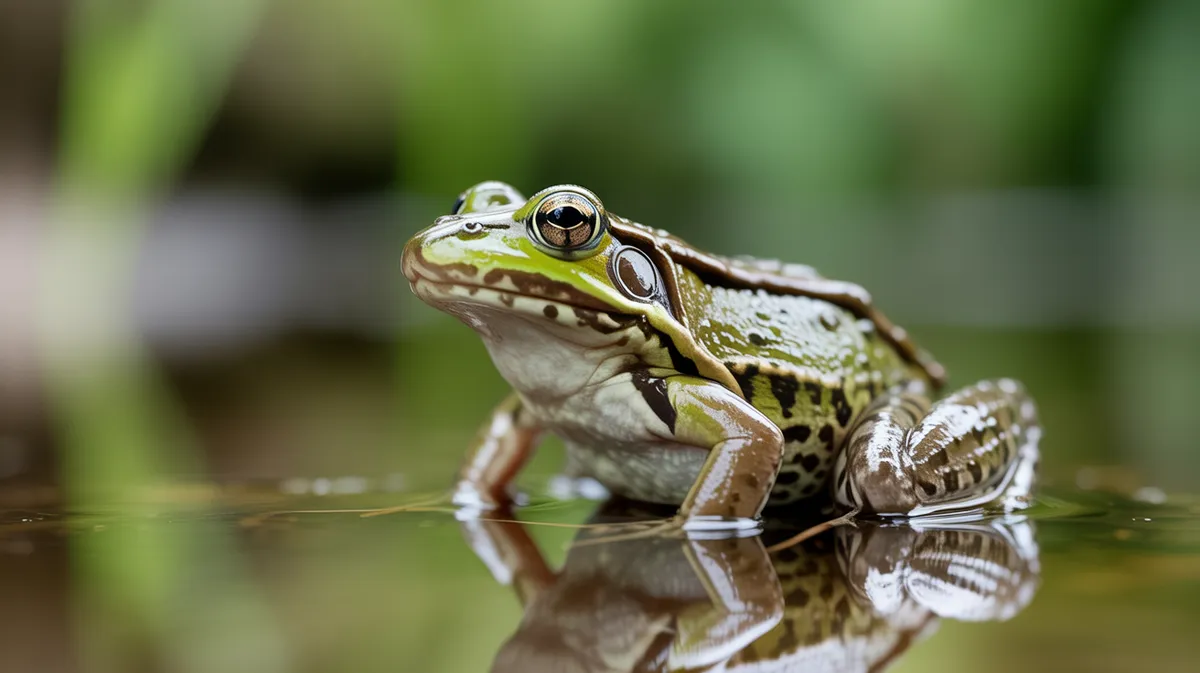
About the Common Tusked Frog
The Common Tusked Frog is a medium-sized amphibian native to eastern Australia, recognized for the prominent 'tusks'—enlarged lower jaw teeth—found especially in males. Its robust body is typically olive green or brown with a pale underbelly, providing camouflage among leaf litter and muddy waters. These frogs are primarily nocturnal and are often found in slow-moving or still freshwater environments, such as ponds, creeks, and swamps. They are known for their unique breeding behavior, where males use their tusks in combat for mates and territory.
Fascinating facts
Tusked Males
Male Common Tusked Frogs have bony tusks in their lower jaws, which they use to engage in aggressive fights for territory and mates.
Diet
Their diet consists mainly of invertebrates such as insects, worms, and other small terrestrial and aquatic creatures.
Breeding Season
Breeding occurs in the rainy season, and males call from concealed positions near water to attract females.
Detailed description
The Common Tusked Frog (Adelotus brevis) is a robust, medium-sized amphibian, with adult males typically reaching 35–45 mm in snout–vent length, and females slightly larger at 40–55 mm. Its most distinctive feature is the presence of prominent, protruding odontoid processes or 'tusks' on the lower jaw, which are especially well-developed in males and used during intraspecific combat. The dorsal coloration varies from olive green to dark brown, often mottled with darker patches, while the ventral side is pale cream to white, sometimes with faint marbling. The skin is granular, providing additional camouflage among leaf litter and muddy substrates. Eyes are large and positioned laterally, aiding in nocturnal foraging. The limbs are relatively short and strong, adapted for digging and moving through dense vegetation. This species is primarily terrestrial, spending much of its life hidden under logs, rocks, or debris near water bodies, but returns to aquatic environments for breeding. The Common Tusked Frog is largely solitary outside the breeding season, exhibiting strong site fidelity to favored microhabitats. Its vocalizations are low-pitched, guttural grunts, produced by males to attract females and deter rivals during the breeding season.
Did you know?
The Common Tusked Frog is one of the few frog species in Australia where males possess prominent, tooth-like tusks used for combat.
Research & sources
Behaviour & social structure
Adelotus brevis is predominantly nocturnal, emerging at dusk to forage for invertebrates such as beetles, ants, spiders, and small crustaceans. It employs a sit-and-wait predatory strategy, remaining motionless and relying on its cryptic coloration to ambush passing prey. Males are highly territorial during the breeding season, engaging in aggressive combat using their tusks to wrestle and bite rivals, a rare behavior among Australian frogs. Outside of breeding, individuals are largely solitary and secretive, minimizing exposure to predators. During the day, they seek shelter in moist microhabitats to avoid desiccation. Social interactions are minimal except during the breeding period, when males may aggregate in loose choruses near suitable water bodies.
Reproduction & life cycle
Breeding occurs primarily from late winter to early summer (August to January), triggered by rainfall and rising temperatures. Males establish territories along the edges of slow-moving streams, ponds, or ephemeral pools, where they call to attract females. Amplexus is inguinal, and females lay clutches of 200–500 eggs in foamy nests constructed by the male, often anchored to submerged vegetation or debris. The foam provides protection from desiccation and predation. Embryonic development is rapid, with hatching occurring within 3–7 days depending on temperature. Tadpoles are benthic, feeding on detritus and algae, and undergo metamorphosis after 6–10 weeks. Parental care is limited to nest construction and initial protection; adults do not guard the eggs or larvae after deposition.
Adaptations & survival
The most notable adaptation of Adelotus brevis is the development of tusk-like odontoid processes in males, used for combat and mate competition—an unusual trait among anurans. Their cryptic coloration and granular skin texture provide effective camouflage in leaf litter and muddy environments, reducing predation risk. The ability to construct foam nests is an adaptation to fluctuating water levels, ensuring egg survival in ephemeral aquatic habitats. Their robust, muscular limbs facilitate digging and rapid movement through dense ground cover. Behavioral adaptations include nocturnality and site fidelity, which help minimize predation and competition.
Cultural significance
There is limited direct cultural significance attributed to the Common Tusked Frog in Indigenous Australian or colonial folklore, likely due to its secretive habits and restricted range. However, frogs in general hold ecological importance in Australian culture as indicators of environmental health, and their presence is often associated with the onset of rain and seasonal change. The unique tusks of this species have attracted scientific interest and are occasionally referenced in educational materials to illustrate evolutionary adaptations.
Recent research
Recent research has focused on the evolutionary significance of tusk development in male Adelotus brevis, with studies suggesting sexual selection as a primary driver. Ongoing genetic analyses are investigating population structure and connectivity across fragmented habitats in eastern Australia. Studies on foam nest composition have revealed antimicrobial properties, which may protect eggs from pathogens. Monitoring programs are assessing the impact of chytrid fungus and environmental pollutants on population health. The species is also used as a model for understanding the evolution of male-male combat in amphibians.
Sources
Adelotus brevis (Common Tusked Frog): Natural History and Reproductive Behavior
Anstis, M. (2017)
scientificAdelotus brevis: The IUCN Red List of Threatened Species 2022
IUCN SSC Amphibian Specialist Group
conservationSystematics and reproductive biology of the tusked frog Adelotus brevis (Anura: Limnodynastidae)
Anstis, M. et al. (2010)
scientificAdelotus brevis: The IUCN Red List of Threatened Species 2022
IUCN SSC Amphibian Specialist Group
conservationVideos
Habitat
Freshwater streams, ponds, and swampy forested areas


Conservation
The Common Tusked Frog is currently classified as Least Concern on the IUCN Red List.
Threats & challenges
While currently listed as Least Concern, the Common Tusked Frog faces localized threats from habitat loss due to land clearing, urbanization, and drainage of wetlands. Pollution, particularly from agricultural runoff and pesticides, can degrade breeding sites and impact larval development. The species is also susceptible to chytridiomycosis, a fungal disease affecting amphibians worldwide. Climate change, with its associated alterations in rainfall patterns and increased frequency of droughts, poses a long-term threat to suitable breeding habitats. Despite these challenges, the species remains relatively common within its range, but ongoing monitoring is recommended.
Taxonomy
Scientific name
Adelotus brevis
- Kingdom
- Animalia
- Phylum
- Chordata
- Class
- Amphibia
- Order
- Anura
- Family
- Limnodynastidae
- Genus
- Adelotus
- Species
- brevis
Community notes
Share your observations about the Common Tusked Frog.
No community notes yet. Be the first!
Discover more wildlife
More fascinating animals from the encyclopedia.