
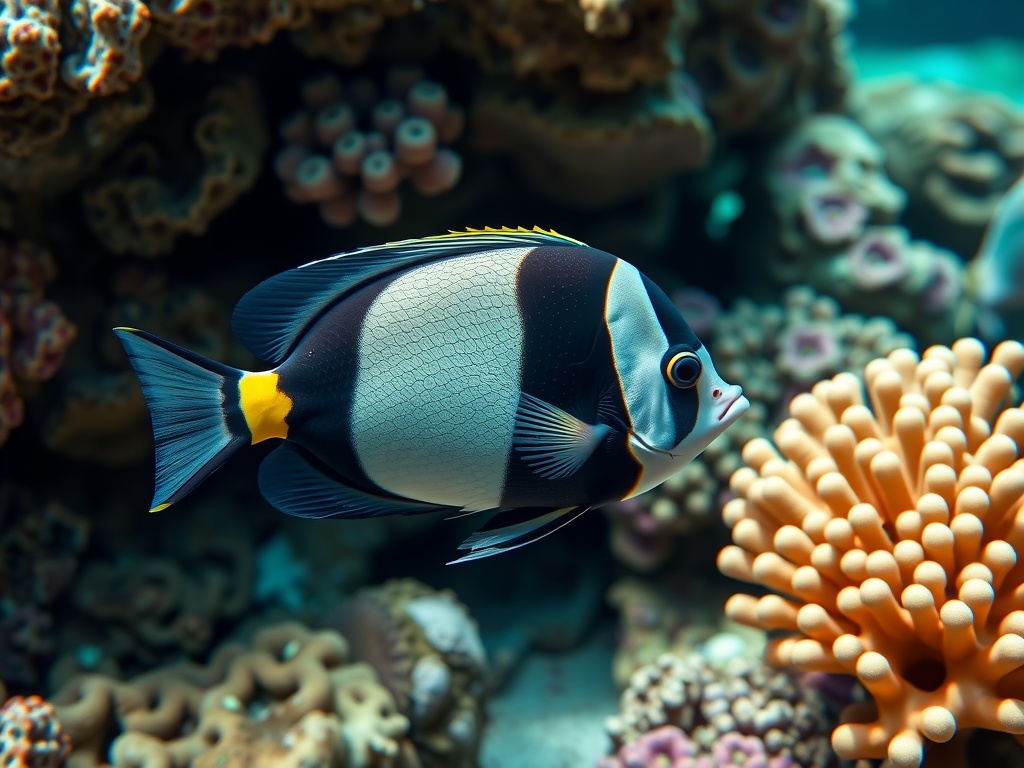
About the Convict tang
The convict tang, also known as the convict surgeonfish, is a strikingly patterned marine fish easily recognized by its white to pale yellow body adorned with six bold vertical black stripes. Native to tropical Indo-Pacific coral reefs, this species is highly social and often forms large, active schools while grazing. Convict tangs play a vital role in reef ecosystems by consuming algae, helping to maintain the balance of coral health. Their streamlined bodies and small mouths are perfectly adapted for picking algae from rocks and coral surfaces.
Fascinating facts
Schooling Experts
Convict tangs regularly form schools of hundreds or even thousands of individuals, which helps deter predators and enhances their foraging efficiency.
Algae Eaters
Their primary diet consists of filamentous algae, making them essential contributors to the health and balance of coral reef ecosystems.
Widespread Range
Convict tangs are found throughout the Indo-Pacific, from the coast of East Africa and the Red Sea to Hawaii, the Marquesas, and the southern Great Barrier Reef.
Detailed description
The convict tang (Acanthurus triostegus) is a medium-sized marine fish, typically reaching lengths of 15–27 cm, with a maximum recorded length of about 27 cm. Its laterally compressed, oval-shaped body is predominantly white to pale yellow, marked by six distinct, evenly spaced vertical black bars—five across the body and one through the eye—giving rise to its 'convict' moniker. The small, protrusible mouth is equipped with a single row of spatulate teeth, specialized for scraping filamentous algae from hard substrates. The dorsal fin is continuous and elongated, supported by 8 dorsal spines and 27–30 soft rays, while the anal fin has 3 spines and 23–26 soft rays. Acanthurus triostegus is highly gregarious, forming large, fast-moving schools of dozens to hundreds of individuals, especially in shallow reef flats and lagoons. These schools are often observed grazing synchronously, which may deter predators and increase foraging efficiency. The species is diurnal, spending daylight hours actively feeding and retreating to shelter among rocks or coral crevices at night. Juveniles tend to form smaller groups or remain solitary in tide pools and protected areas before joining adult schools. Convict tangs play a crucial ecological role as primary herbivores, controlling algal growth and facilitating coral recruitment. Their streamlined bodies and swift swimming abilities allow them to navigate turbulent shallow waters, while their scalpel-like caudal spines (a characteristic of surgeonfishes) serve as defensive weapons against predators and rivals.
Did you know?
Despite being called 'surgeonfish,' convict tangs have less pronounced scalpel-like spines on their tails compared to other members of their family.
Research & sources
Wikipedia summary
Acanthurus triostegus, commonly known as convict tang, manini, convict surgeonfish, convict surgeon, or fiveband surgeonfish, is a species of marine ray-finned fish belonging to the family Acanthuridae which includes the surgeonfishes, unicornfishes and tangs. This species has a wide Indo-Pacific distribution.
Behaviour & social structure
Convict tangs are primarily herbivorous, feeding almost exclusively on turf algae and filamentous algae growing on rocks, coral rubble, and reef flats. They exhibit a highly coordinated schooling behavior, with individuals often aligning their movements and feeding in unison. This schooling not only provides safety in numbers but also allows them to overwhelm territorial damselfish and access prime feeding grounds. Foraging typically occurs during daylight, with peak activity in the morning and late afternoon. At night, the fish disperse to seek shelter in crevices or beneath ledges. Aggressive interactions are rare within schools, but individuals may display territoriality when feeding in smaller groups or as juveniles. The species is known for its rapid, darting swimming style, which aids in both foraging and predator evasion. Social hierarchies are not strongly developed, and school membership is fluid, with individuals frequently joining or leaving groups.
Reproduction & life cycle
Acanthurus triostegus exhibits broadcast spawning, a reproductive strategy where males and females release gametes into the water column simultaneously, usually at dusk or during high tide. Spawning events are often synchronized within large schools, increasing the likelihood of fertilization and reducing predation risk on eggs and larvae. There is little to no parental care; fertilized eggs are pelagic and hatch within 24–48 hours. Larvae are planktonic, drifting with ocean currents for several weeks before settling onto suitable reef habitats as juveniles. Breeding occurs year-round in equatorial regions, but may be more seasonal in subtropical areas, often peaking during warmer months. Sexual maturity is typically reached at 1–2 years of age, depending on local environmental conditions.
Adaptations & survival
Convict tangs possess several adaptations for their herbivorous lifestyle and reef environment. Their small, sharp teeth are ideal for scraping algae from hard surfaces, and their elongated intestines efficiently process plant material. The laterally compressed body allows for agile maneuvering among rocks and corals, while the scalpel-like spine on each side of the caudal peduncle provides effective defense against predators. The bold vertical stripes serve as disruptive coloration, confusing predators and aiding in school cohesion. Their schooling behavior not only enhances foraging success but also reduces individual predation risk. Physiologically, they are tolerant of a wide range of salinities and temperatures, enabling them to inhabit diverse reef and lagoon environments throughout the Indo-Pacific.
Cultural significance
In Hawaii, the convict tang is known as 'manini' and holds cultural significance as a traditional food fish, often caught using nets or traps. It features in local folklore and is sometimes used in ceremonial feasts. The species is also popular in public aquaria due to its striking appearance and active schooling behavior. In some Pacific Island communities, the presence and abundance of manini are considered indicators of reef health and are integrated into traditional ecological knowledge.
Recent research
Recent research has focused on the ecological role of Acanthurus triostegus in controlling algal growth and facilitating coral recruitment, highlighting its importance in maintaining reef resilience. Studies have also examined the effects of marine protected areas on population structure and foraging behavior, revealing that protected populations exhibit larger school sizes and reduced wariness. Genetic analyses indicate high connectivity among populations across the Indo-Pacific, suggesting widespread larval dispersal. Ongoing research is investigating the impacts of climate change on feeding behavior, reproductive timing, and larval settlement patterns.
Videos
Habitat
Coral reefs and shallow lagoons

Conservation
The Convict tang is currently classified as Least Concern on the IUCN Red List.
Threats & challenges
Currently assessed as Least Concern by the IUCN, Acanthurus triostegus faces localized threats from overfishing, particularly in regions where it is harvested for food or the aquarium trade. Habitat degradation due to coral reef destruction, pollution, and climate change (e.g., coral bleaching, ocean acidification) poses long-term risks to populations. In some areas, heavy fishing pressure has led to observable declines, but the species' wide distribution and high reproductive output confer resilience. Continued monitoring is necessary, especially in areas experiencing rapid reef decline or increased fishing activity.
Taxonomy
Scientific name
Acanthurus triostegus
- Kingdom
- Animalia
- Phylum
- Chordata
- Class
- Actinopterygii
- Order
- Acanthuriformes
- Family
- Acanthuridae
- Genus
- Acanthurus
- Species
- triostegus
Community notes
Share your observations about the Convict tang.
No community notes yet. Be the first!
Discover more wildlife
More fascinating animals from the encyclopedia.