
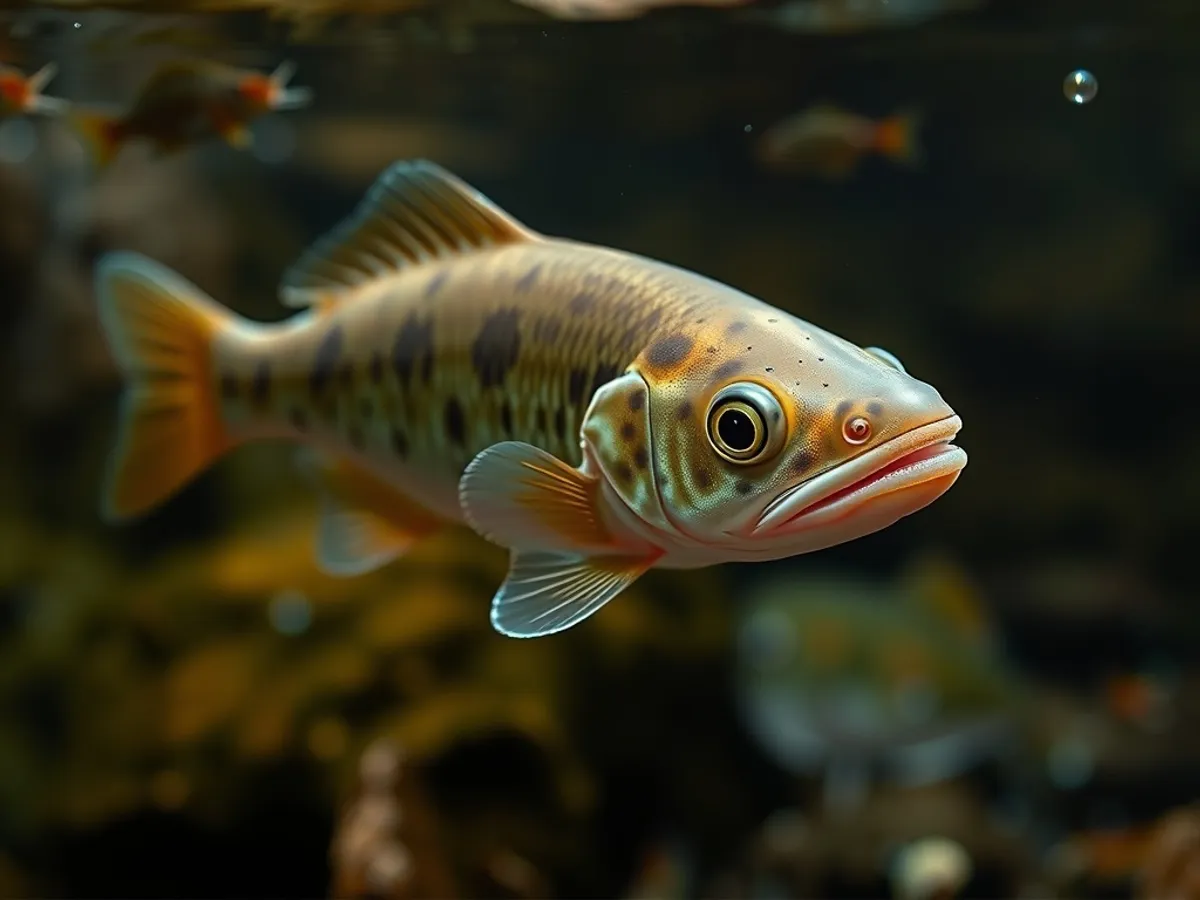
About the Corydoras Catfish
The Corydoras catfish is a small, peaceful freshwater fish native to South America, known for its armored plates and distinctive whisker-like barbels around its mouth. These bottom-dwelling fish are highly social, often found in groups, and play an important ecological role as scavengers, helping to keep waterways clean. Corydoras catfish are popular in the aquarium trade due to their hardy nature and gentle temperament, making them ideal for community tanks. They display fascinating behaviors, such as 'gulping' air at the water's surface, which supplements their oxygen intake.
Fascinating facts
Air Breathers
Corydoras catfish regularly swim to the surface to gulp air, absorbing oxygen through their intestines.
Armored Bodies
Instead of scales, Corydoras have overlapping bony plates called scutes that protect them from predators and rough substrates.
Squeaky Defense
When stressed or captured, Corydoras catfish can emit squeaking sounds by rubbing their pectoral fins against their sockets.
Detailed description
The Corydoras catfish (Corydoras aeneus), commonly known as the bronze corydoras, is a small, armored freshwater fish native to the slow-moving rivers, streams, and floodplains of South America, particularly in Argentina, Colombia, Venezuela, and Brazil. Adults typically reach 5–7 cm (2–2.8 in) in length, with females generally larger and more robust than males. Their bodies are protected by overlapping bony scutes, or plates, which provide defense against predators and abrasive substrates. The species is characterized by a short, rounded snout and a pair of prominent barbels around the mouth, which serve as tactile organs for detecting food in murky or sediment-rich environments. Corydoras aeneus are diurnal and highly gregarious, forming shoals of 6–20 or more individuals in the wild, which enhances their foraging efficiency and provides safety in numbers. They exhibit a unique adaptation among catfish: the ability to breathe atmospheric air by gulping at the surface, utilizing a modified intestine for oxygen absorption, which allows survival in hypoxic waters. Their coloration is typically metallic bronze to olive-green, with a pale underside and sometimes a faint lateral stripe. In addition to their ecological role as detritivores and scavengers, they are known for their peaceful temperament and complex social interactions, including synchronized swimming and tactile communication. Their reproductive strategy involves elaborate courtship rituals and the deposition of adhesive eggs on submerged surfaces, with no subsequent parental care.
Did you know?
Despite being fish, Corydoras catfish can survive in waters with low oxygen levels thanks to their unique ability to breathe atmospheric air.
Research & sources
Behaviour & social structure
Corydoras aeneus are bottom-dwelling fish that spend much of their time actively foraging for food by sifting through substrate with their sensitive barbels. Their omnivorous diet includes insect larvae, small crustaceans, detritus, and plant matter. They display a distinctive 'shoaling' behavior, maintaining close proximity to conspecifics, which reduces predation risk and facilitates social learning. Corydoras are crepuscular, being most active during dawn and dusk. They are known for their startle response, a rapid darting movement when threatened. Feeding is typically communal, with individuals often following each other and mimicking foraging behaviors. They also exhibit 'surface gulping,' a behavior where individuals rise to the water surface to ingest air, supplementing oxygen intake, especially in low-oxygen environments. Social hierarchies are subtle, with little evidence of aggression, and tactile interactions such as nudging are common during both foraging and courtship.
Reproduction & life cycle
Breeding in Corydoras aeneus is triggered by environmental cues such as temperature drops and increased water flow, simulating rainy season conditions. Courtship involves the 'T-position,' where the male positions himself perpendicular to the female, who then collects sperm in her mouth and fertilizes the eggs as she deposits them. Females lay between 100–300 adhesive eggs in small batches, attaching them to plant leaves, rocks, or aquarium glass. There is no parental care after egg deposition; adults may even consume unguarded eggs. Incubation lasts 3–5 days at 24–26°C (75–79°F), after which fry are free-swimming and begin feeding on microfauna. Sexual maturity is typically reached at 8–12 months. Spawning can occur multiple times per year in favorable conditions, contributing to their resilience and stable population numbers.
Adaptations & survival
Corydoras aeneus possess several notable adaptations: their bony scutes provide armor against predators and abrasive substrates, while their ventral mouth and barbels are specialized for benthic foraging in turbid waters. The species' ability to utilize atmospheric oxygen via intestinal respiration is a remarkable adaptation to hypoxic environments, allowing survival in stagnant or oxygen-poor waters. Their cryptic coloration provides camouflage among leaf litter and detritus. Social shoaling reduces predation risk and enhances foraging efficiency. Additionally, Corydoras can secrete a mild toxin from their skin and fin spines when stressed, deterring some predators.
Cultural significance
Corydoras catfish have significant value in the global aquarium trade, prized for their hardiness, peaceful nature, and role as 'clean-up crew' in community tanks. They have been bred in captivity since the early 20th century and are among the most popular beginner fish. While they do not feature prominently in indigenous folklore, their presence in home aquaria has contributed to public interest in freshwater biodiversity and responsible fishkeeping. Educational programs often use Corydoras to teach about aquatic ecosystems and animal behavior.
Recent research
Recent research has focused on the physiological mechanisms underlying Corydoras' air-breathing ability, revealing specialized vascularization in the intestinal wall that facilitates gas exchange. Studies have also examined their social behavior, demonstrating that group size influences stress levels and foraging success. Genetic analyses have clarified relationships within the Corydoradinae subfamily, aiding in species identification and conservation planning. Ongoing research explores their sensitivity to environmental pollutants, making them potential bioindicators for freshwater ecosystem health.
Sources
A review of the genus Corydoras (Callichthyidae) from South America
Reis, R.E. et al. (2003)
scientificCorydoras aeneus: The IUCN Red List of Threatened Species 2020
IUCN SSC Freshwater Fish Specialist Group
conservationA review of the genus Corydoras (Teleostei: Siluriformes: Callichthyidae), with descriptions of new species
Reis, R.E. (2003)
scientificVideos
Habitat
Freshwater rivers and streams


Conservation
The Corydoras Catfish is currently classified as Least Concern on the IUCN Red List.
Threats & challenges
Currently listed as Least Concern by the IUCN, Corydoras aeneus populations are stable across their native range. However, localized threats include habitat degradation from deforestation, agricultural runoff, and pollution, which can reduce water quality and disrupt breeding habitats. Over-collection for the aquarium trade is not considered a major threat due to the species' widespread distribution and prolific breeding, both in the wild and captivity. Climate change and hydrological alterations pose potential long-term risks by affecting floodplain dynamics and water oxygenation. Conservation efforts focus on habitat protection and sustainable trade practices.
Taxonomy
Scientific name
Corydoras aeneus
- Kingdom
- Animalia
- Phylum
- Chordata
- Class
- Actinopterygii
- Order
- Siluriformes
- Family
- Callichthyidae
- Genus
- Corydoras
- Species
- aeneus
Community notes
Share your observations about the Corydoras Catfish.
No community notes yet. Be the first!
Discover more wildlife
More fascinating animals from the encyclopedia.