
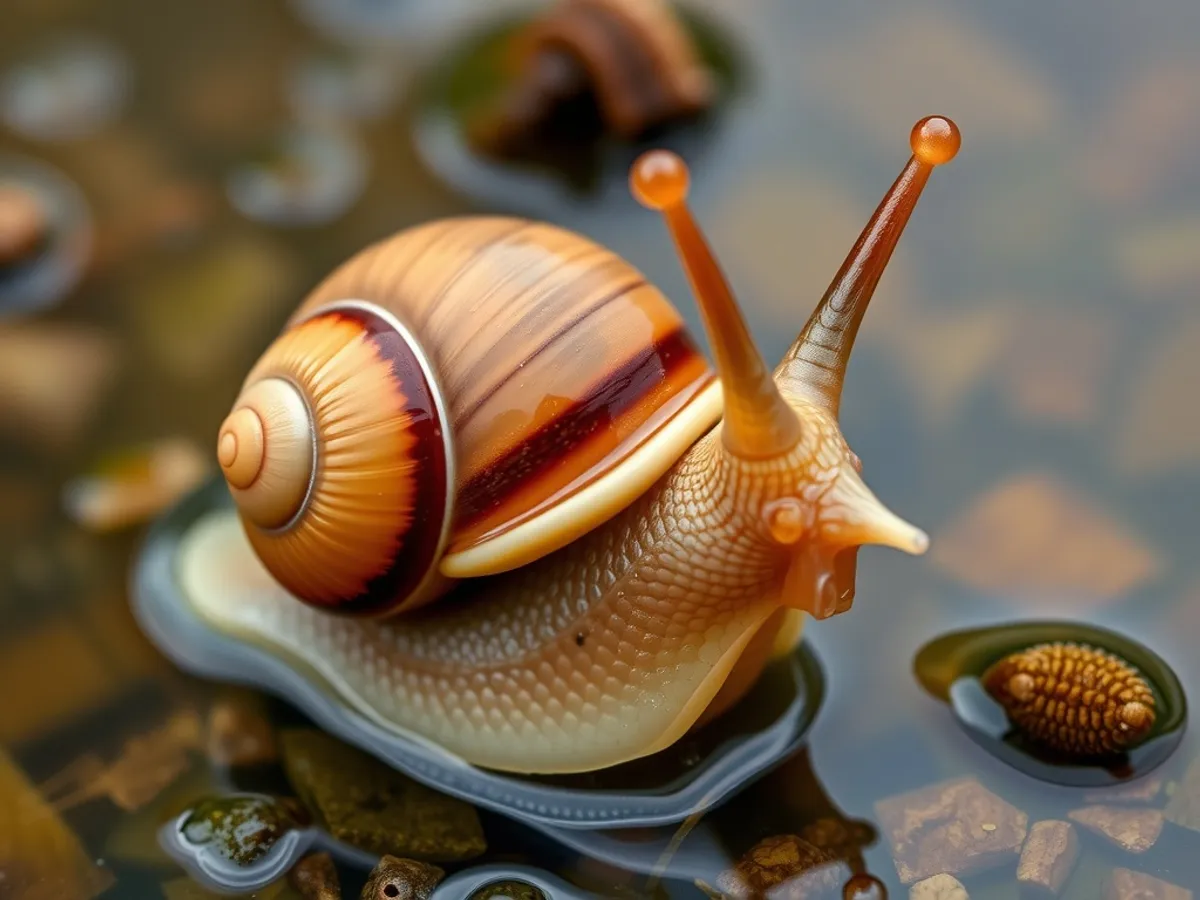
About the Crown Snail
The Crown Snail is a small, freshwater gastropod mollusk known for its distinctive, crown-like shell adorned with spiny projections. These snails are often found in clean, slow-moving streams, ponds, and marshes where aquatic vegetation is abundant. Their shells provide both camouflage and protection from predators, while their slow movements and cryptic coloration help them blend into their environment. Crown Snails play an important ecological role in their habitat by consuming algae and decaying plant material, thereby contributing to nutrient cycling. Though not commonly encountered, their unique appearance makes them a favorite among mollusk enthusiasts.
Fascinating facts
Crown-like Shell
The shell of the Crown Snail is rimmed with spiky projections, giving it a unique crown-like appearance that offers added defense from predators.
Aquatic Bioindicator
Crown Snails are extremely sensitive to pollutants, making their presence an indicator of good water quality in freshwater habitats.
Algae Controller
By feeding on algae and decaying plant matter, Crown Snails help maintain the ecological balance and cleanliness of aquatic environments.
Detailed description
The Crown Snail (Stephanosphaera coronata) is a diminutive freshwater gastropod, typically measuring between 8 and 14 mm in shell diameter. Its most distinctive feature is the shell, which is globular with a series of pronounced, crown-like spines or tubercles encircling the whorls, providing both structural defense and camouflage among aquatic vegetation. The shell coloration ranges from pale olive to brownish, often mottled to further blend with submerged plant matter. The soft body is translucent gray with a muscular foot adapted for slow crawling across submerged surfaces. Crown Snails possess a pair of short tentacles with eyes at the base, used for environmental sensing. They are primarily nocturnal, emerging at dusk to graze on biofilms, algae, and detritus. Their radula—a specialized rasping tongue—enables efficient scraping of food from rocks and plant surfaces. Stephanosphaera coronata is solitary, rarely forming aggregations except during breeding periods. Reproduction is hermaphroditic, with individuals exchanging sperm to fertilize internally. Egg clusters are laid on submerged leaves or stems, and juveniles hatch as miniature adults, bypassing a free-swimming larval stage. The species is highly sensitive to water quality, making it an indicator of healthy freshwater ecosystems.
Did you know?
Despite their delicate appearance, Crown Snails can seal themselves tightly inside their shells and survive short periods of drought by entering a state of dormancy.
Research & sources
Behaviour & social structure
Crown Snails are slow-moving and largely sedentary, spending much of their time attached to the undersides of leaves or stones to avoid predation. They exhibit crepuscular to nocturnal activity patterns, likely as an adaptation to reduce exposure to visual predators such as fish and aquatic insects. Feeding occurs primarily at night, with individuals using their radula to graze on periphyton, algae, and decomposing plant matter. They are non-aggressive and show little intraspecific interaction outside of mating. When threatened, they retract rapidly into their shells, relying on the spiny projections for added protection. Crown Snails are sensitive to changes in water chemistry and will migrate short distances to seek optimal microhabitats if disturbed.
Reproduction & life cycle
Stephanosphaera coronata is a simultaneous hermaphrodite, meaning each individual possesses both male and female reproductive organs. Mating typically occurs in late spring to early summer, coinciding with increased water temperatures and plant growth. During copulation, two snails align ventrally to exchange sperm, after which both may lay eggs. Egg masses, containing 10–30 eggs, are attached to submerged vegetation or detritus. Embryonic development lasts 2–3 weeks, depending on water temperature, and juveniles hatch as fully formed miniatures of adults. There is no parental care post-oviposition; juveniles are independent from hatching. Under optimal conditions, Crown Snails can produce multiple clutches per season, contributing to stable local populations.
Adaptations & survival
The most notable adaptation of the Crown Snail is its shell morphology: the crown-like spines deter predation by making the snail difficult to swallow and providing camouflage among spiky aquatic plants. The shell’s robust structure also helps resist crushing by fish or invertebrate predators. The radula is finely serrated, allowing efficient grazing on tough algal films. Behaviorally, their nocturnal activity reduces predation risk and competition for food. Their ability to tolerate slight fluctuations in water chemistry, though limited, allows them to persist in moderately variable habitats. The species’ hermaphroditism increases reproductive flexibility, ensuring that even sparse populations can reproduce successfully.
Cultural significance
The Crown Snail has limited direct cultural significance but is occasionally featured in educational materials and natural history collections due to its unique shell morphology. Its distinctive appearance makes it a favorite among amateur malacologists and shell collectors. In some regions, it serves as a bioindicator species, symbolizing the health of freshwater ecosystems. There are no known traditional uses or mythological associations.
Recent research
Recent research has focused on the Crown Snail’s role as a bioindicator for freshwater ecosystem health, with studies demonstrating its sensitivity to pollutants such as heavy metals and pesticides. Genetic studies are ongoing to clarify its phylogenetic relationships within the Planorbidae family. Ecological research has highlighted its importance in nutrient cycling and as a food source for certain fish and invertebrates. There is growing interest in using Stephanosphaera coronata as a model organism for studying the impacts of microplastic pollution in freshwater systems. No significant range expansions or contractions have been documented in recent years, but continued habitat monitoring is recommended.
Videos
Habitat
Freshwater streams and ponds

Conservation
The Crown Snail is currently classified as Least Concern on the IUCN Red List.
Threats & challenges
While currently listed as Least Concern, Crown Snails face localized threats from water pollution, habitat destruction, and the introduction of invasive species such as predatory fish and crayfish. Agricultural runoff and eutrophication can lead to algal blooms and oxygen depletion, degrading their habitat. Physical alterations to streams and ponds, such as dredging or the removal of aquatic vegetation, reduce available microhabitats. Climate change may alter hydrological regimes, impacting breeding and feeding cycles. Despite these challenges, populations remain stable in protected or pristine environments, but ongoing monitoring is recommended due to their sensitivity to environmental changes.
Taxonomy
Scientific name
Stephanosphaera coronata
- Kingdom
- Animalia
- Phylum
- Mollusca
- Class
- Gastropoda
- Order
- Littorinimorpha
- Family
- Planorbidae
- Genus
- Stephanosphaera
- Species
- coronata
Community notes
Share your observations about the Crown Snail.
No community notes yet. Be the first!
Discover more wildlife
More fascinating animals from the encyclopedia.