
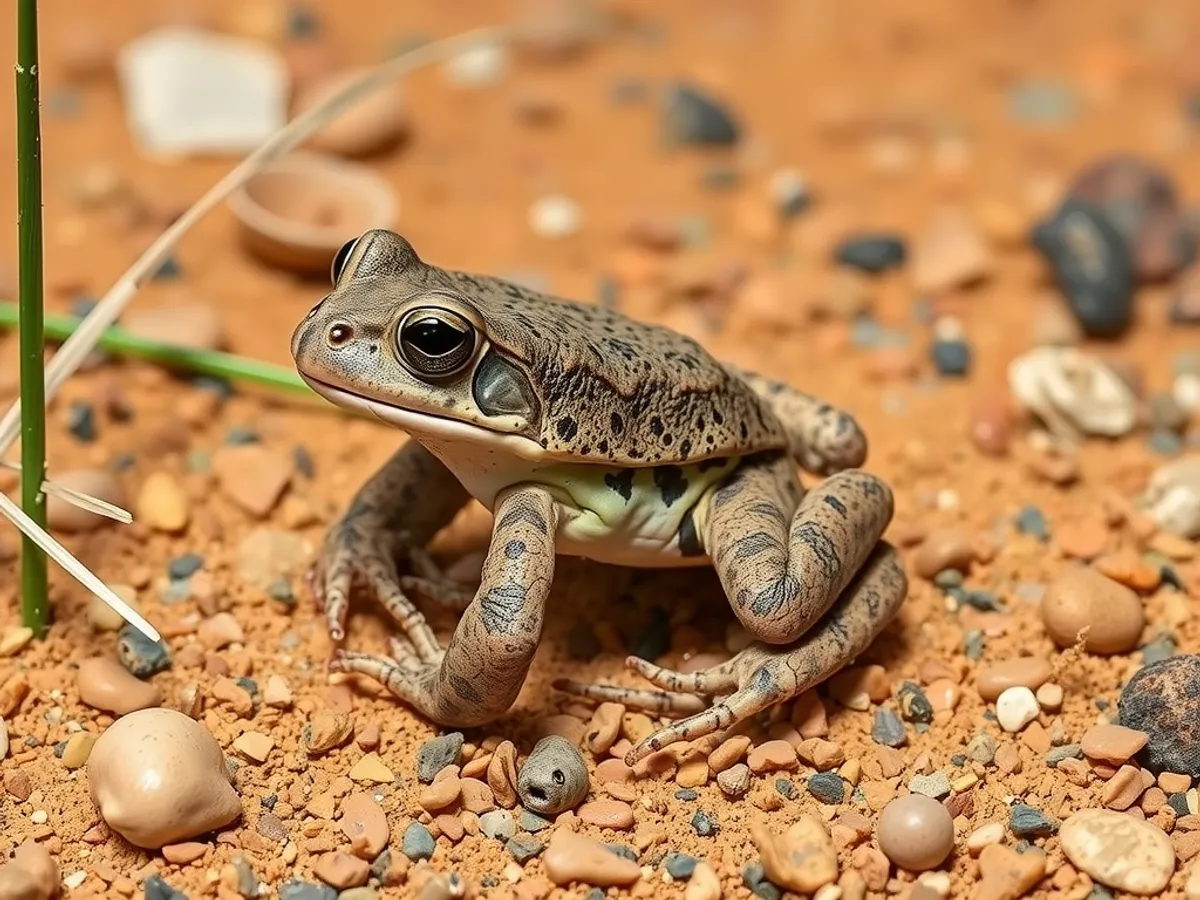
About the Crucifix Toad
The Crucifix Toad, also known as the Holy Cross Frog, is a striking amphibian native to arid regions of eastern Australia. Its vivid yellow coloration with a distinctive cross-shaped pattern of green and red on its back makes it easily recognizable. This species spends much of its life underground, emerging mainly after heavy rains to breed. It secretes a sticky, glue-like substance from its skin as a defense mechanism and to trap insects.
Fascinating facts
Colorful Warning
The Crucifix Toad's bright yellow and cross-shaped patterns serve as aposematic coloration, warning predators of its toxic skin secretions.
Natural Glue
When threatened, it excretes a sticky glue from its skin that deters predators and can even trap insects for food.
Rain Emerge
This species spends most of its life underground and only emerges after heavy rains to breed in temporary pools.
Detailed description
The Crucifix Toad (Notaden bennettii) is a small, robust amphibian, typically measuring 4–6 cm in length, with females generally larger than males. Its dorsal surface is vividly colored, featuring a bright yellow background adorned with a distinctive cross-shaped pattern of green and red spots, a form of aposematism that warns predators of its toxicity. The skin is smooth and glandular, capable of secreting a sticky, glue-like substance. The body is rounded and squat, with short limbs adapted for digging rather than leaping. Eyes are small and positioned dorsally, aiding in its fossorial lifestyle. The ventral surface is pale and unmarked. This species spends the majority of its life underground, encased in a cocoon of shed skin to retain moisture during prolonged dry periods. It is primarily nocturnal, emerging only after heavy rainfall to feed and breed. The Crucifix Toad is solitary outside of the breeding season, and its vocalizations—low, drawn-out calls—are used to attract mates during ephemeral rain events.
Did you know?
Despite its name, the Crucifix Toad is actually a frog, not a true toad.
Research & sources
Wikipedia summary
The crucifix toad, holy cross frog or Catholic frog is a species of frog in the family Limnodynastidae. It is a fossorial frog. It is one of the few Australian frogs to display aposematism. It is native to western New South Wales and south-western Queensland.
Behaviour & social structure
Crucifix Toads are fossorial and exhibit remarkable burrowing behavior, using their strong hind limbs to dig backwards into soft clay or sandy soils. They remain dormant underground for most of the year, entering a state of aestivation to survive arid conditions. When surface conditions become favorable after heavy rains, they emerge en masse to exploit abundant food resources, primarily feeding on ants, termites, and other small invertebrates. Their feeding strategy is sit-and-wait, relying on their sticky skin secretions to trap prey that comes into contact with their bodies. Social interactions are minimal outside the breeding season, with individuals displaying territoriality around breeding sites. Activity is largely nocturnal, reducing water loss and predation risk.
Reproduction & life cycle
Breeding is highly opportunistic and closely tied to unpredictable rainfall events, typically occurring from late spring to early autumn. Males congregate at temporary pools and call to attract females, producing a distinctive, deep, resonant 'woop' sound. Amplexus is axillary, and females lay large clutches of up to 1,000–2,000 eggs in shallow water. Eggs are deposited in gelatinous strings or masses that float on the water's surface. Embryonic development is rapid, with tadpoles hatching within 2–4 days and metamorphosis completed in as little as 3–6 weeks, an adaptation to the ephemeral nature of their breeding habitats. There is no parental care; both adults and larvae are vulnerable to predation and desiccation if water bodies dry prematurely.
Adaptations & survival
Notaden bennettii exhibits numerous adaptations to arid environments. Its ability to aestivate underground in a self-made cocoon minimizes water loss during droughts. The bright aposematic coloration deters predators by signaling toxicity; the skin secretions contain peptides and proteins that are both adhesive and unpalatable. The glue-like secretion is unique among Australian frogs and serves both as a defense mechanism and a means of trapping prey. Rapid reproductive cycles and accelerated larval development enable the species to exploit temporary water bodies before they evaporate. The toad's squat, rounded body reduces surface area and water loss, while its powerful hind limbs facilitate efficient burrowing.
Cultural significance
The Crucifix Toad's striking appearance and unusual behaviors have made it a subject of fascination in Australian natural history. Its common names—Holy Cross Frog and Catholic Frog—reflect the cross-shaped pattern on its back, which has inspired local folklore and curiosity. While not widely featured in Indigenous mythology, its emergence after rain is sometimes seen as a harbinger of good fortune. The species is occasionally kept in educational displays to illustrate desert amphibian adaptations, but it is not commonly used in traditional medicine or cuisine.
Recent research
Recent research has focused on the biochemical properties of the Crucifix Toad's skin secretions, revealing novel adhesive proteins with potential biomedical applications. Studies have also examined its rapid developmental biology, providing insights into amphibian responses to environmental unpredictability. Genetic analyses are ongoing to clarify phylogenetic relationships within the Limnodynastidae family. Ecological monitoring projects are assessing the impacts of climate variability on breeding success and population dynamics. Notably, the species' resilience to aridification is of interest in the context of global amphibian declines.
Videos
Habitat
Arid grasslands and claypans


Conservation
The Crucifix Toad is currently classified as Least Concern on the IUCN Red List.
Threats & challenges
Currently listed as Least Concern by the IUCN, the Crucifix Toad faces localized threats from habitat loss due to agricultural expansion, land clearing, and soil compaction. Climate change poses a long-term risk by altering rainfall patterns and reducing the frequency of suitable breeding events. Pesticide use and water pollution may also impact populations, particularly during the vulnerable aquatic larval stage. However, the species' wide distribution and adaptability to ephemeral habitats have so far buffered it from significant declines. Ongoing monitoring is necessary to detect population trends and emerging threats.
Taxonomy
Scientific name
Notaden bennettii
- Kingdom
- Animalia
- Phylum
- Chordata
- Class
- Amphibia
- Order
- Anura
- Family
- Limnodynastidae
- Genus
- Notaden
- Species
- bennettii
Community notes
Share your observations about the Crucifix Toad.
No community notes yet. Be the first!
Discover more wildlife
More fascinating animals from the encyclopedia.