
About the Devil's coach horse beetle
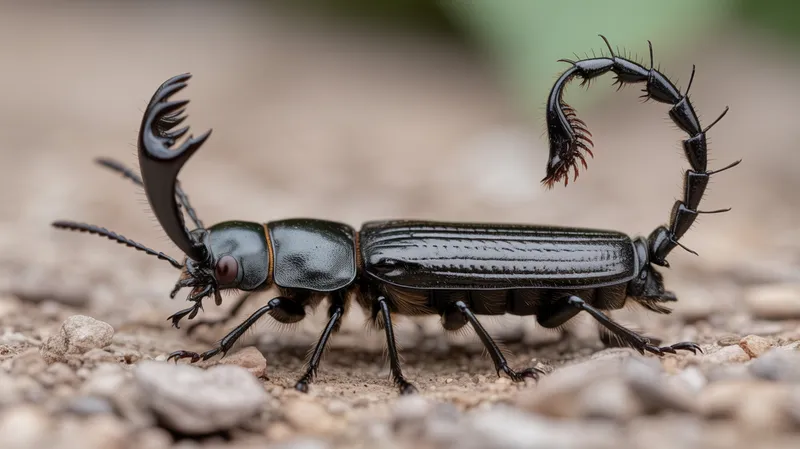
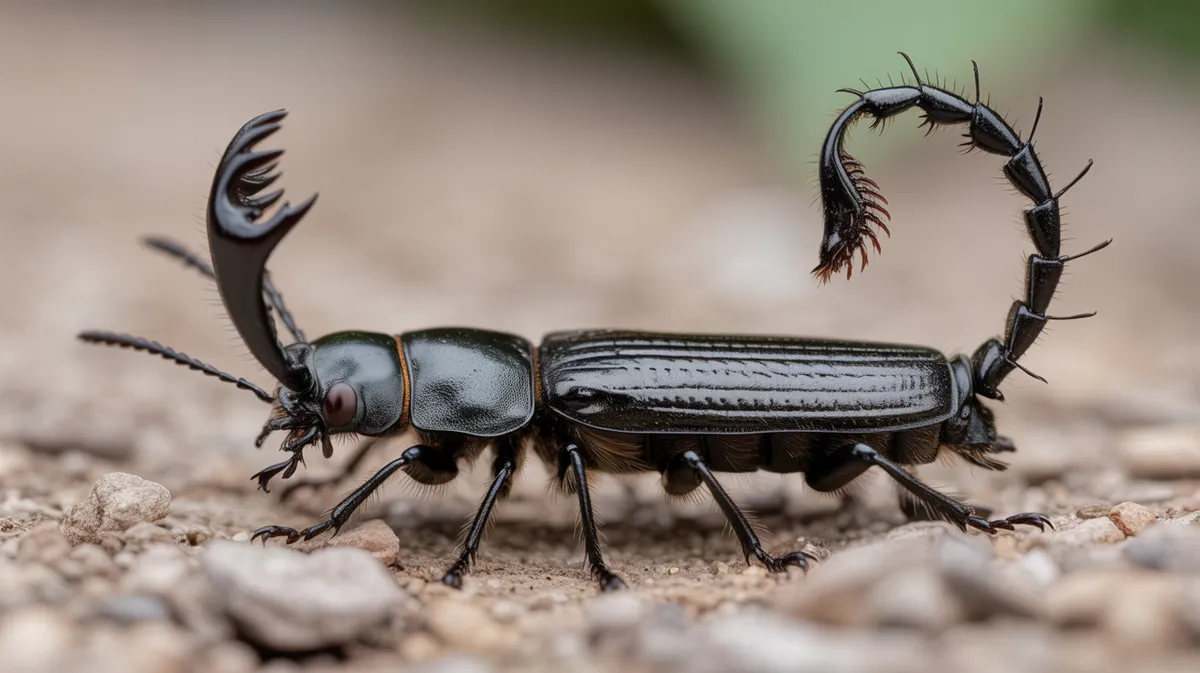
The Devil's coach horse beetle is a large, black rove beetle well known for its intimidating appearance and defensive behavior. When threatened, it raises its abdomen and opens its powerful jaws, mimicking a scorpion, though it is harmless to humans. This nocturnal predator is highly effective at hunting other invertebrates, playing a crucial role in controlling garden pests. Its ability to emit a foul-smelling odor when disturbed adds to its fearsome reputation in folklore and among gardeners.
Fascinating facts
Scorpion mimic
When threatened, the Devil's coach horse beetle raises its abdomen like a scorpion, though it cannot sting.
Odor defense
It can secrete a foul-smelling chemical from its abdomen to deter predators.
Nocturnal hunter
This beetle is most active at night, hunting for small invertebrates such as worms and slugs.
Detailed description
The Devil's coach-horse beetle (Ocypus olens) is one of the largest rove beetles in Europe, typically measuring 20–32 mm in length. Its robust, elongated body is entirely black with a slightly iridescent sheen, and it is covered in fine setae (hairs) that aid in sensory perception. The head is broad and equipped with powerful, sickle-shaped mandibles used for subduing prey and defense. The elytra (wing covers) are short, exposing several abdominal segments, a hallmark of the Staphylinidae family. Despite possessing wings, O. olens rarely flies, preferring to run swiftly across the ground. When threatened, it raises its abdomen in a scorpion-like posture and opens its jaws, often releasing a pungent, defensive secretion from abdominal glands. This beetle is primarily nocturnal, emerging at dusk to hunt. Its keen sense of smell and touch compensate for relatively poor eyesight. The species is solitary, highly territorial, and spends daylight hours concealed under logs, stones, or leaf litter.
Did you know?
Despite its menacing look and name, the Devil's coach horse beetle is not venomous and poses no real threat to humans.
Research & sources
Wikipedia summary
The devil's coach-horse beetle is a species of beetle belonging to the large family of the rove beetles (Staphylinidae). It was originally included in the genus Staphylinus in 1764, and some authors and biologists still use this classification.
Behaviour & social structure
Ocypus olens is an aggressive, solitary predator that actively hunts at night. It preys on a wide range of invertebrates, including earthworms, slugs, snails, and insect larvae, using its strong mandibles to seize and dismember prey. The beetle employs both ambush and active pursuit strategies, relying on chemoreceptors in its antennae to locate food. When disturbed, it exhibits a characteristic threat display: raising its abdomen, opening its mandibles, and sometimes releasing a foul-smelling fluid from pygidial glands to deter predators. Social interactions are minimal, limited mainly to antagonistic encounters during the breeding season. The beetle is primarily ground-dwelling and rarely climbs vegetation. It is most active during humid nights and retreats to moist microhabitats during the day to avoid desiccation.
Reproduction & life cycle
Breeding occurs mainly in autumn, although mating can also take place in spring. Males locate females by following pheromone trails. Courtship involves tactile and chemical cues, with the male mounting the female for copulation. Females lay eggs singly in moist soil or leaf litter, often in concealed locations. The incubation period lasts approximately 2–3 weeks, depending on temperature and humidity. Larvae are elongate, predatory, and resemble miniature adults but lack fully developed wings and reproductive organs. The larval stage lasts 4–6 weeks, during which they undergo several molts. Pupation occurs in an earthen cell, and the pupal stage lasts 2–3 weeks. There is typically one generation per year. Parental care is absent; larvae are independent from hatching.
Adaptations & survival
Ocypus olens exhibits several notable adaptations for survival. Its short elytra and flexible abdomen allow rapid movement and maneuverability in dense ground cover. The enlarged mandibles are specialized for grasping and tearing prey. The ability to secrete a noxious, quinone-based fluid from abdominal glands is a key chemical defense, deterring predators such as birds, mammals, and amphibians. The beetle's dark coloration provides camouflage in leaf litter and soil. Nocturnality reduces predation risk and competition for food. Sensory adaptations include highly developed antennae for detecting chemical cues and vibrations. The species can tolerate a wide range of habitats, from woodlands to urban gardens, due to its generalist diet and adaptability to microclimatic conditions.
Cultural significance
Ocypus olens has a rich presence in European folklore, often associated with superstition and fear due to its menacing appearance and defensive posture. In medieval England, it was believed to be an omen of death or to possess supernatural powers, earning names such as 'Devil's coach-horse' and 'Devil's steed.' The beetle's habit of raising its abdomen was thought to be a gesture of cursing or defiance. Despite these myths, it has also been valued by gardeners for its role in controlling pest populations. There are no known traditional medicinal or culinary uses.
Recent research
Recent research has focused on the chemical composition of the beetle's defensive secretions, which include benzoquinones and other irritants effective against a range of predators. Studies have also examined its ecological role as a top invertebrate predator in temperate ecosystems, highlighting its contribution to regulating soil invertebrate communities. Genetic analyses have clarified its taxonomic status and relationships within the Staphylinidae. Ongoing research investigates the impact of urbanization and climate change on its distribution and life history traits. The species is also used as a model organism for studying predator-prey interactions and chemical defense mechanisms in beetles.
Videos
Habitat
Woodlands, grasslands, gardens, hedgerows, and meadows


Conservation
The Devil's coach horse beetle is currently classified as Least Concern on the IUCN Red List.
Threats & challenges
Currently, the Devil's coach-horse beetle is classified as Least Concern and is widespread across Europe and parts of North Africa and western Asia. It faces few significant threats due to its adaptability and broad habitat tolerance. However, local populations may be affected by habitat loss from intensive agriculture, pesticide use, and urbanization, which reduce prey availability and suitable microhabitats. Road mortality and predation by domestic animals are minor threats. Climate change could alter the beetle's distribution by affecting soil moisture and prey populations. Despite these challenges, the species remains common and is not considered at risk.
Taxonomy
Scientific name
Ocypus olens
- Kingdom
- Animalia
- Phylum
- Arthropoda
- Class
- Insecta
- Order
- Coleoptera
- Family
- Staphylinidae
- Genus
- Ocypus
- Species
- olens
Community notes
Share your observations about the Devil's coach horse beetle.
No community notes yet. Be the first!
Discover more wildlife
More fascinating animals from the encyclopedia.