
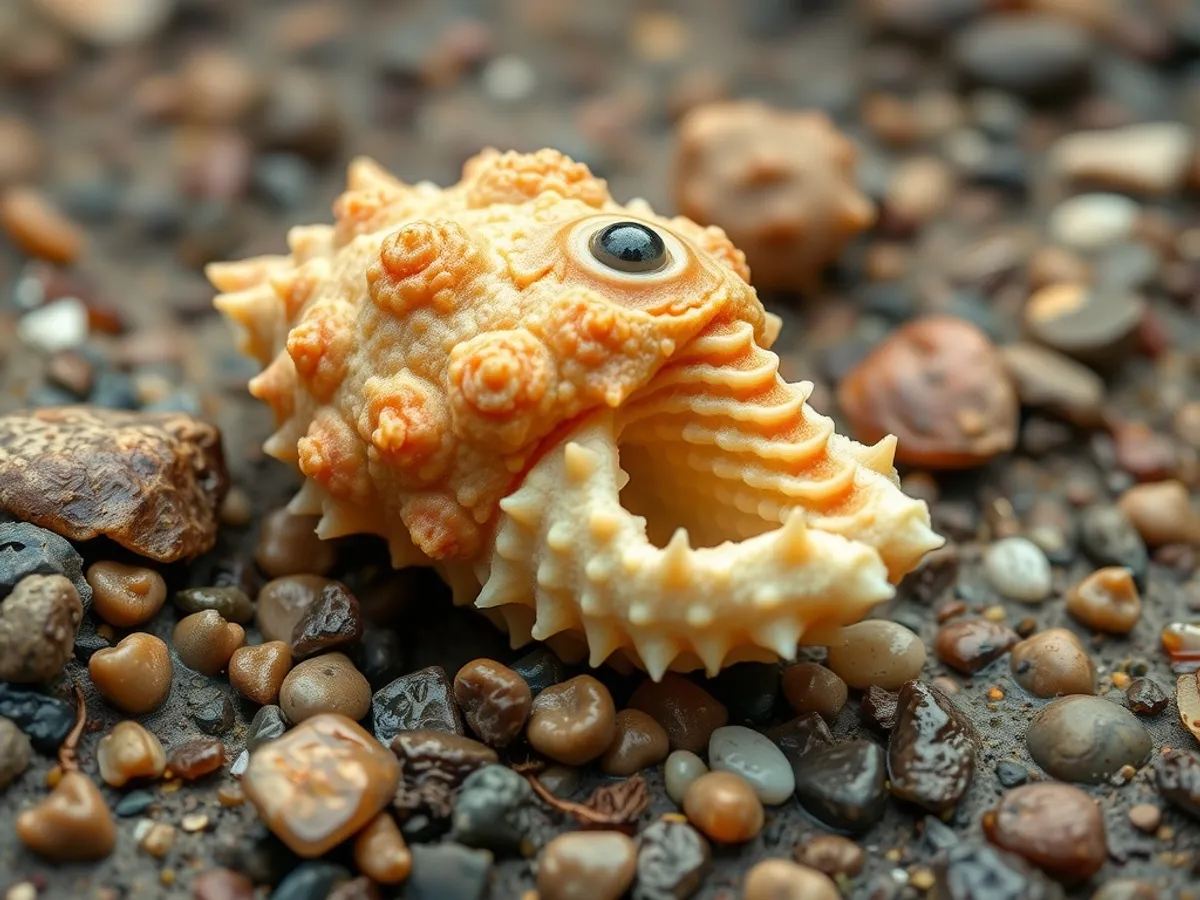
About the Dog Whelk
The Dog Whelk is a marine gastropod mollusk commonly found along rocky shores in the North Atlantic. It boasts a sturdy, spiral shell that varies in color from white and grey to brown and purple, and typically grows up to 4 cm long. This predatory snail is best known for drilling holes into the shells of barnacles and mussels to feed on their soft tissues. Dog Whelks play a significant role in controlling the population of other intertidal invertebrates and are considered an indicator species for monitoring marine pollution.
Fascinating facts
Shell Driller
Dog Whelks use a combination of acid secretion and a toothed tongue called a radula to drill holes into the shells of barnacles and mussels.
Wave Resistant
Their strong, tight-closing operculum and muscular foot allow them to withstand the pounding surf of wave-battered shores.
Source of Purple Dye
The secretions of Dog Whelks were historically used to make Tyrian purple dye, a rare and valuable pigment in the ancient world.
Detailed description
The Dog Whelk (Nucella lapillus) is a robust marine gastropod mollusk, typically reaching 2.5–4 cm in length, though individuals up to 5 cm have been recorded in optimal conditions. Its shell is thick, ovate, and spirally ridged, with a short, pointed spire and a large, oval aperture; coloration is highly variable, ranging from white and pale grey to shades of brown, pink, purple, or orange, often influenced by local environmental factors and genetics. The shell’s outer layer, or periostracum, is sometimes eroded in exposed habitats, revealing the underlying calcareous structure. The Dog Whelk possesses a muscular foot for locomotion and a well-developed siphon for detecting chemical cues in the water. Its radula—a toothed, ribbon-like organ—is specialized for boring through the calcareous shells of prey. Nucella lapillus is solitary and territorial, often occupying crevices or undersides of rocks during low tide to avoid desiccation. It is a slow-moving predator, primarily feeding on barnacles and mussels, but may also consume limpets and other mollusks. The species exhibits sexual dimorphism, with females generally larger than males. Reproduction involves internal fertilization, and females deposit distinctive, yellowish egg capsules in clusters on hard substrates. The Dog Whelk is highly sensitive to environmental pollutants, such as tributyltin (TBT), which can cause imposex—a condition where females develop male sexual characteristics—making it a key bioindicator for marine pollution monitoring.
Did you know?
Dog Whelks were historically harvested for their purple dye, valued in ancient times and used to color royal garments.
Research & sources
Wikipedia summary
The dog whelk, dogwhelk, or Atlantic dogwinkle is a species of predatory sea snail, a carnivorous marine gastropod in the family Muricidae, the rock snails.
Behaviour & social structure
Dog Whelks are primarily nocturnal or crepuscular, foraging during periods of low light to reduce predation risk and desiccation. Their hunting strategy involves locating prey using chemoreception, then attaching to the prey’s shell with their muscular foot. Using their radula and secreted acidic enzymes, they bore a neat hole through the shell, a process that can take several days, after which they insert their proboscis to consume the soft tissues. They exhibit site fidelity, often returning to favored feeding or resting spots. Social interactions are minimal, with individuals maintaining solitary territories except during the breeding season. Aggressive encounters are rare but may occur over limited food resources or prime egg-laying sites. Dog Whelks are capable of detecting and avoiding areas with high predator or competitor presence, and may alter their behavior in response to environmental stressors such as wave exposure or pollution.
Reproduction & life cycle
Breeding occurs mainly from late spring to early summer, though timing can vary with latitude and local conditions. Males locate females by following mucous trails, and copulation involves the transfer of spermatophores via a specialized penis. Females lay clusters of 10–100 egg capsules, each containing up to several dozen eggs, attached to rocks or crevices in the mid to lower intertidal zone. Embryonic development is direct: juveniles hatch as miniature adults after 3–8 weeks, depending on temperature, bypassing a free-swimming larval stage. There is no parental care post-oviposition, but the tough, leathery egg capsules provide protection from desiccation and predation. Fecundity and reproductive output are influenced by environmental factors, including temperature, food availability, and pollution levels.
Adaptations & survival
Dog Whelks are highly adapted to the dynamic intertidal environment. Their thick, sculptured shells offer protection against wave action, desiccation, and predators such as crabs and birds. The ability to tightly seal their aperture with the operculum helps minimize water loss during low tide. Chemoreceptive organs enable them to detect prey and avoid toxins or predators. Their radula and acid-secreting glands are evolutionary specializations for drilling through hard shells. Behavioral plasticity, such as altering foraging times and microhabitat selection, allows them to cope with environmental variability. Populations in exposed sites often develop thicker shells and lower spires, a form of phenotypic plasticity in response to increased wave action and predation pressure.
Cultural significance
Dog Whelks have limited direct significance in human culture, as they are not a traditional food source due to their small size and unpalatable taste. However, their shells have occasionally been used for decorative purposes or in jewelry. In scientific and environmental circles, Nucella lapillus is renowned for its role in ecological studies of predator-prey dynamics, intertidal zonation, and as a classic example of bioindicator species for marine pollution. The species has also contributed to our understanding of evolutionary adaptation and phenotypic plasticity in response to environmental gradients.
Recent research
Recent research has focused on the recovery of Dog Whelk populations following the ban on TBT, with studies documenting reductions in imposex prevalence and gradual population rebounds in affected areas. Ongoing investigations examine the genetic basis of shell morphology variation, responses to climate change (such as increased temperature and ocean acidification), and the ecological impacts of Dog Whelk predation on intertidal community structure. Molecular studies are shedding light on population connectivity and dispersal, given the species’ direct development and limited larval dispersal. The Dog Whelk remains a model organism in marine ecology, evolutionary biology, and ecotoxicology.
Videos
Habitat
Rocky intertidal zones

Conservation
The Dog Whelk is currently classified as Least Concern on the IUCN Red List.
Threats & challenges
While Dog Whelk populations are currently stable and classified as Least Concern, they face several threats. The most significant historical threat was tributyltin (TBT) pollution from antifouling paints, which caused widespread imposex and population declines in the late 20th century. Although TBT use has been largely banned, legacy effects persist in some regions. Other threats include habitat disturbance from coastal development, climate change (affecting intertidal temperature and desiccation stress), and competition with invasive species. Localized over-collection for scientific study or shell trade may also impact some populations. Monitoring continues to be important, as Dog Whelks serve as sensitive indicators of marine ecosystem health.
Taxonomy
Scientific name
Nucella lapillus
- Kingdom
- Animalia
- Phylum
- Mollusca
- Class
- Gastropoda
- Order
- Neogastropoda
- Family
- Muricidae
- Genus
- Nucella
- Species
- lapillus
Community notes
Share your observations about the Dog Whelk.
No community notes yet. Be the first!
Discover more wildlife
More fascinating animals from the encyclopedia.