
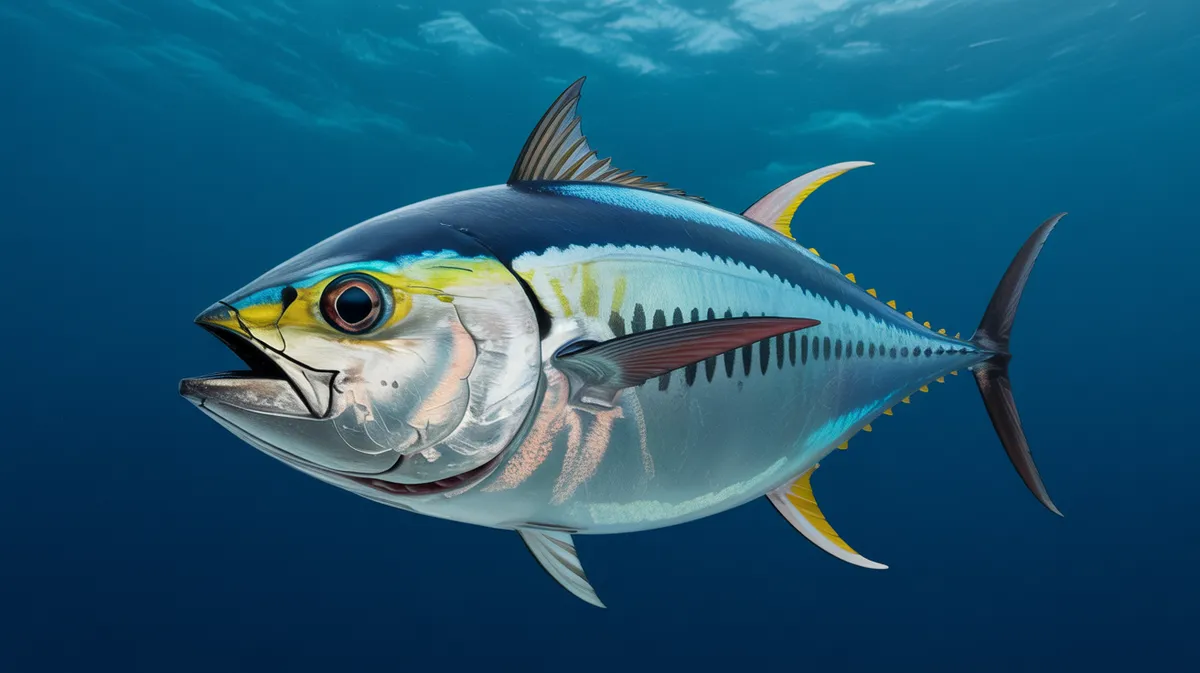
About the Dogtooth Tuna
The Dogtooth Tuna is a large, predatory fish inhabiting tropical and subtropical reefs in the Indo-Pacific region. Recognized for its streamlined body, large canine-like teeth, and metallic blue-green coloration, it is a powerful swimmer and a formidable hunter. Dogtooth Tunas can reach impressive speeds and are highly sought after by sport fishermen due to their strength and challenging behavior. They play a crucial role in reef ecosystems by controlling populations of smaller fish and cephalopods. Despite their popularity, they remain relatively elusive due to their deep-water habits and migratory nature.
Fascinating facts
Powerful Predator
Dogtooth Tuna are apex predators on coral reefs, often preying on smaller fish, squid, and crustaceans.
Unique Teeth
They possess prominent, canine-like teeth which set them apart from other tuna species and aid in catching slippery prey.
Deep Divers
Dogtooth Tuna frequently dive to depths exceeding 300 meters, making them a challenging catch for anglers.
Detailed description
The Dogtooth Tuna (Gymnosarda unicolor) is a robust, torpedo-shaped pelagic fish, typically reaching lengths of 100–150 cm, though exceptional specimens can exceed 200 cm and weigh up to 130 kg. Its body is streamlined for high-speed pursuits, with a metallic blue-green dorsal surface fading to silvery-white ventrally, providing camouflage in open water. The species is named for its prominent, conical canine teeth, which are unusually large for a member of the Scombridae family and are visible even when the mouth is closed. Unlike true tunas, the dogtooth tuna lacks finlets between the dorsal and caudal fins, and its first dorsal fin is notably long and sickle-shaped. The caudal peduncle is narrow and muscular, ending in a deeply forked tail that enables rapid acceleration. Dogtooth tunas are apex predators in their reef-associated habitats, preying on a wide range of fish and cephalopods. They are generally solitary or form small, loose groups, especially around steep drop-offs and seamounts. Their large eyes and lateral line system are highly developed, allowing them to detect prey and navigate complex reef environments. The species is known for its powerful, sustained swimming ability and is capable of making rapid, explosive bursts of speed when ambushing prey or evading predators.
Did you know?
Despite being called 'tuna,' Dogtooth Tuna are not considered true tunas in the genus Thunnus and belong instead to the genus Gymnosarda.
Research & sources
Wikipedia summary
The dogtooth tuna, also known as white tuna, is a species of pelagic marine fish which belongs to the family Scombridae. Despite the name “tuna”, it is not actually a tuna. Instead, it is a bonito.
Behaviour & social structure
Dogtooth tuna are primarily crepuscular hunters, with peak activity at dawn and dusk when their preferred prey—such as fusiliers, mackerel, squid, and flying fish—are most abundant. They use stealth and speed to ambush prey, often attacking from below or from behind. Their hunting strategy involves both solitary stalking and, less commonly, cooperative hunting in small groups to herd and corral schools of baitfish. Dogtooth tuna are known to patrol the edges of reefs, drop-offs, and underwater pinnacles, using the complex topography to their advantage. They are highly migratory within their home ranges, covering large distances in search of food. Social structure is generally loose, with individuals aggregating temporarily in areas of high prey density or during spawning events. They exhibit strong site fidelity to productive hunting grounds but may shift locations seasonally.
Reproduction & life cycle
Reproductive biology of the dogtooth tuna is not fully understood, but spawning is believed to occur in offshore waters during warmer months, typically between late spring and early autumn, depending on the region. Like many pelagic scombrids, they are broadcast spawners: males and females release gametes into the open water column, where fertilization occurs externally. Females are highly fecund, producing hundreds of thousands to millions of buoyant eggs per spawning event. There is no parental care; eggs and larvae are planktonic and drift with ocean currents, making them vulnerable to predation and environmental fluctuations. Juveniles settle in deeper reef slopes as they grow, gradually moving to adult habitats as they mature. Sexual maturity is reached at approximately 70–90 cm fork length, which may correspond to 3–5 years of age.
Adaptations & survival
Dogtooth tuna possess several key adaptations for their predatory lifestyle. Their large, canine-like teeth are specialized for grasping and tearing large, slippery prey, distinguishing them from other scombrids. The streamlined body and powerful musculature allow for sustained high-speed swimming and rapid acceleration, essential for both chasing prey and avoiding predators such as sharks. Their coloration provides countershading camouflage, while large eyes enhance vision in dimly lit reef environments. The lateral line system is highly sensitive, detecting vibrations and movements in the water, aiding in prey detection and navigation. Physiologically, they exhibit partial regional endothermy, allowing them to maintain elevated muscle temperatures for improved performance during bursts of activity.
Cultural significance
Dogtooth tuna are highly prized in sport fishing communities throughout the Indo-Pacific, renowned for their strength and challenging fight, which has led to their status as a 'trophy' species. In some Pacific island cultures, they are valued as a food source, though their flesh is not as highly regarded as that of true tunas. There is limited traditional mythology associated with the species, but their presence in local fisheries and markets contributes to regional economies. In recent years, catch-and-release practices have been promoted among sport anglers to help conserve populations.
Recent research
Recent research on dogtooth tuna has focused on their movement ecology, using acoustic and satellite tagging to better understand home range, migratory patterns, and habitat use. Genetic studies have clarified their phylogenetic placement within the Scombridae, confirming their closer relationship to bonitos than to true tunas. Ongoing studies are investigating their role as apex predators in reef ecosystems and their potential vulnerability to changing oceanic conditions. There is also interest in their reproductive biology and larval dispersal, which remains poorly documented. Advances in underwater video and remote sensing are providing new insights into their natural behaviors and population structure.
Videos
Habitat
Coral reefs and offshore drop-offs in tropical and subtropical ocean waters

Conservation
The Dogtooth Tuna is currently classified as Least Concern on the IUCN Red List.
Threats & challenges
Currently assessed as Least Concern by the IUCN, dogtooth tuna face localized threats from overfishing, particularly by artisanal and recreational fisheries targeting them for their size and fighting ability. They are often caught as bycatch in longline and handline fisheries. Habitat degradation, especially of coral reefs, poses an indirect threat by reducing prey availability and suitable hunting grounds. There is limited data on global population trends due to their elusive nature and lack of targeted commercial fisheries, but anecdotal evidence suggests localized declines in heavily fished regions. Climate change and ocean warming may also impact their distribution and reproductive success over time.
Taxonomy
Scientific name
Gymnosarda unicolor
- Kingdom
- Animalia
- Phylum
- Chordata
- Class
- Actinopterygii
- Order
- Scombriformes
- Family
- Scombridae
- Genus
- Gymnosarda
- Species
- unicolor
Community notes
Share your observations about the Dogtooth Tuna.
No community notes yet. Be the first!
Discover more wildlife
More fascinating animals from the encyclopedia.