
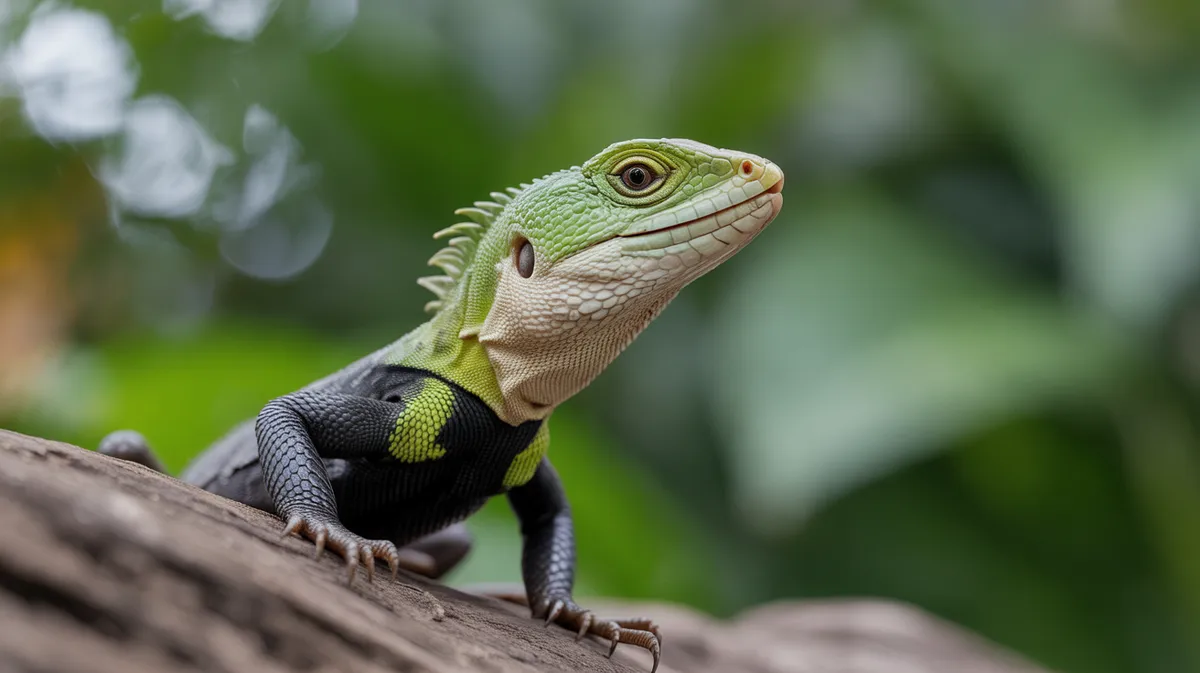
About the Draco Lizard
Draco lizards glide on their ribs. Where every other gliding vertebrate stretches skin between its limbs, a Draco has five to seven pairs of enormously elongated ribs that swing outward like the spokes of a fan, opening a brightly coloured membrane along the flanks and folding it away flat against the body when it lands. The result is a wing that leaves all four legs free — and in flight the lizard actually reaches down and grabs the leading edge of the membrane with its forelimbs to control its shape, effectively steering by hand. Glides of 30 m or more between trunks are routine, and because the animal spends its entire life in the canopy of Southeast Asian forest, gliding is not an escape reflex so much as ordinary commuting between feeding trees. Draco eat almost nothing but ants and termites, patrolling a trunk and licking columns of them as they pass. Males defend territories on individual trees and signal with a long, brightly coloured throat flap stiffened by the hyoid bone, flicking it out and bobbing at rivals and passing females. The only time a Draco touches the ground is when a female descends to push her eggs into soil at the base of a tree, covers them, and leaves.
Fascinating facts
Gliding Masters
Draco lizards use their unique rib-supported patagia to glide effortlessly from tree to tree, evading predators and searching for food.
Arboreal Lifestyle
They spend nearly their entire lives in the trees, rarely coming down to the ground except to lay eggs.
Colorful Displays
Males exhibit a bright yellow-orange throat flap, or dewlap, which they use for territorial displays and attracting females.
Detailed description
Draco volans, commonly known as the Draco lizard or flying dragon, is a small, diurnal agamid lizard endemic to the lowland dipterocarp forests of Southeast Asia, particularly the Philippines, Malaysia, Indonesia, and southern Thailand. Adult Draco lizards typically measure 20–25 cm in total length, with the tail accounting for more than half of this measurement. The most distinctive anatomical feature is the set of elongated thoracic ribs, which support lateral patagia—membranous 'wings' that can be spread to allow gliding between trees. The patagia are often mottled or banded, providing camouflage and sometimes species-specific signaling. The slender, laterally compressed body and cryptic coloration help the lizard blend seamlessly with tree bark and lichen. Males possess a prominent, extendable yellow or orange gular flap (dewlap) used in visual displays for territorial defense and courtship. Draco lizards are highly arboreal, rarely descending to the ground except for nesting. Their limbs are long and agile, equipped with sharp claws for climbing. The tail is prehensile and aids in steering during glides. These lizards are insectivorous, feeding mainly on ants and termites, and play a role in controlling arthropod populations. Their ability to glide distances of up to 10 meters (sometimes more) is a remarkable adaptation for escaping predators, expanding foraging territory, and finding mates.
Did you know?
Despite their nickname 'flying dragon,' Draco lizards do not truly fly but glide using their extended rib membranes.
Research & sources
Behaviour & social structure
Draco volans is primarily solitary and territorial, with males defending overlapping territories that may encompass the home ranges of several females. Males are highly visual, using head-bobbing, dewlap extension, and patagium displays to communicate dominance, attract mates, or deter rivals. Their daily activity peaks in the morning and late afternoon, coinciding with increased insect activity. Foraging involves slow, deliberate movements along tree trunks and branches, with rapid tongue flicks to capture prey. When threatened, Draco lizards will leap and glide to a neighboring tree, using their patagia to control descent and direction. They rarely descend to the ground, except during the nesting season. Social interactions are generally limited to courtship and territorial disputes, which are resolved through visual displays rather than physical combat.
Reproduction & life cycle
Breeding in Draco volans typically coincides with the onset of the rainy season, which varies regionally but often falls between March and June. Males court females through elaborate visual displays, including dewlap extension and patagium spreading. After mating, females descend to the forest floor—a rare event—to lay eggs in soft soil or leaf litter. Clutch size ranges from 2 to 5 eggs, which are buried and left unattended; there is no parental care post-oviposition. Incubation lasts approximately 30–60 days, depending on temperature and humidity. Hatchlings are fully independent upon emergence and immediately climb trees to begin an arboreal lifestyle. Sexual maturity is typically reached within one year.
Adaptations & survival
Draco volans exhibits several remarkable adaptations for arboreal life and gliding locomotion. The most notable is the development of elongated thoracic ribs supporting the patagia, allowing controlled glides of up to 10–12 meters, with a recorded maximum of nearly 20 meters in optimal conditions. The patagia can be folded against the body when not in use, minimizing drag. The lizard's cryptic coloration and patterning provide camouflage against predators such as birds and snakes. The prehensile tail and sharp claws facilitate agile climbing and stability on vertical surfaces. Behavioral adaptations include the use of visual signals for communication, reducing the need for risky physical confrontations. The species' diet specialization on ants and termites allows exploitation of abundant, but patchily distributed, food resources in the canopy.
Cultural significance
The Draco lizard has fascinated local populations and naturalists for centuries, often featuring in folklore as a symbol of agility and transformation. In some Southeast Asian cultures, it is associated with mythical dragons, and its gliding ability has inspired stories of 'flying snakes' or 'tree spirits.' While not commonly used in traditional medicine or as a food source, its unique appearance and behavior have made it a subject of interest for ecotourism and wildlife photography. The Draco lizard also serves as an educational ambassador for rainforest conservation.
Recent research
Recent research has focused on the biomechanics of Draco gliding, revealing that the lizard uses its forelimbs to grasp and control the leading edge of the patagia, effectively steering during flight—a unique adaptation among gliding vertebrates. Genetic studies are ongoing to clarify species boundaries within the Draco genus, as morphological similarities have led to historical misidentifications. Ecological studies highlight the lizard's role in arthropod population control and its sensitivity to canopy connectivity. Ongoing research also investigates the impact of habitat fragmentation on dispersal and genetic diversity. Notably, a 2015 study used high-speed videography to analyze Draco's gliding mechanics, contributing to bio-inspired design in robotics and aeronautics.
Sources
Draco volans: The IUCN Red List of Threatened Species 2010
IUCN SSC Amphibian and Reptile Specialist Group
conservationThe Evolution and Functional Morphology of Gliding in Draco Lizards
J. A. McGuire & R. Dudley (2011)
scientificVideos
Habitat
Tropical forest


Conservation
The Draco Lizard is currently classified as Least Concern on the IUCN Red List.
Threats & challenges
Currently assessed as Least Concern by the IUCN, Draco volans faces localized threats primarily from habitat loss due to deforestation, logging, and agricultural expansion. Fragmentation of forest habitats can limit dispersal and reduce genetic diversity. The species is not commonly targeted by the pet trade, but incidental capture and local collection may occur. Climate change poses a potential long-term threat by altering forest structure and microclimates. Despite these challenges, the species remains relatively widespread and adaptable within its range, but ongoing habitat loss could pose future risks to population stability.
Taxonomy
Scientific name
Draco volans
- Kingdom
- Animalia
- Phylum
- Chordata
- Class
- Reptilia
- Order
- Squamata
- Family
- Agamidae
- Genus
- Draco
- Species
- volans
Community notes
Share your observations about the Draco Lizard.
No community notes yet. Be the first!
Discover more wildlife
More fascinating animals from the encyclopedia.