
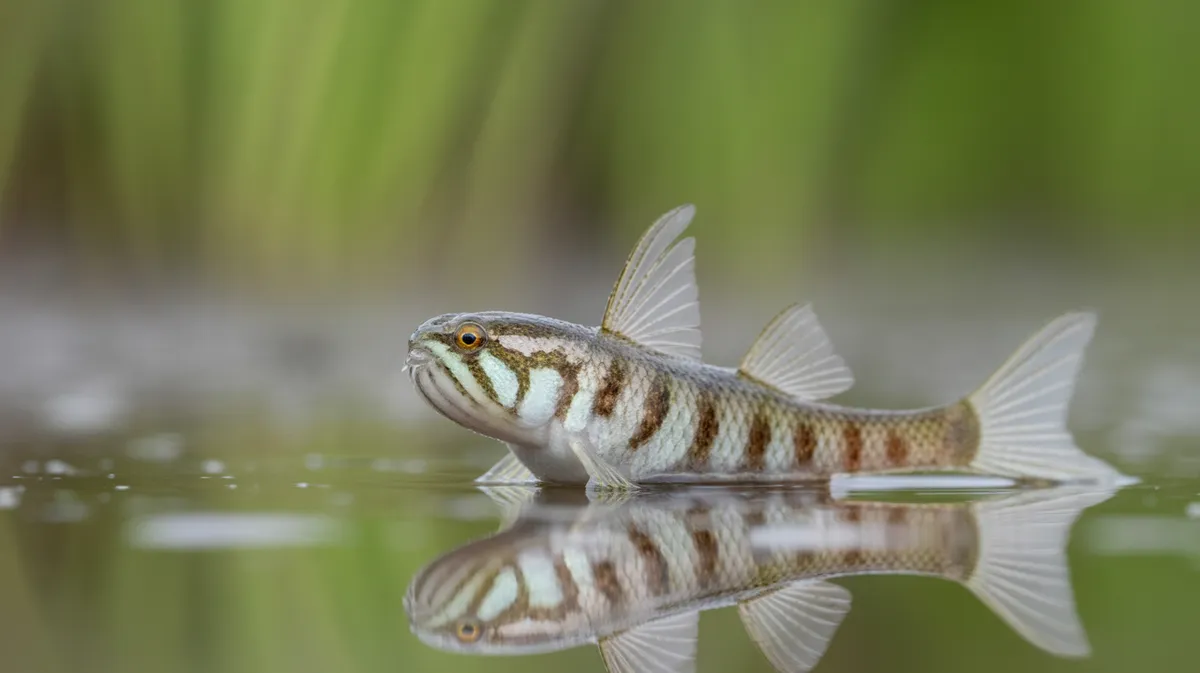
About the Dwarf Siren
The Dwarf Siren is a small, aquatic salamander native to the southeastern United States. It is easily recognized by its elongated, eel-like body, external feathery gills, and the absence of hind limbs, possessing only tiny, three-toed forelimbs. Dwarf Sirens are fully aquatic and spend their entire lives in shallow, vegetated freshwater habitats such as swamps, marshes, and ditches. They are secretive, often hiding among aquatic vegetation and debris, and are most active at night. Their cryptic lifestyle and small size make them a rarely seen amphibian.
Fascinating facts
Neotenic Amphibian
Dwarf Sirens remain in their larval form for their entire lives and never develop lungs, relying solely on their external gills for respiration.
Three-Toed Limbs
They possess only tiny, three-toed forelimbs and lack hind limbs completely, a rare adaptation among salamanders.
Drought Survival
During dry periods, Dwarf Sirens can bury themselves in mud and become dormant until water returns.
Detailed description
The Dwarf Siren (Pseudobranchus striatus) is a small, slender, fully aquatic salamander distinguished by its elongated, eel-like body, which typically measures 10–18 cm (4–7 in) in length. Unlike most salamanders, it lacks hind limbs entirely and possesses only diminutive forelimbs, each with three toes—a key diagnostic feature separating it from related sirenids. The skin is smooth and often exhibits a pattern of pale longitudinal stripes or spots against a darker background, providing camouflage among aquatic vegetation. Prominent, bushy external gills are retained throughout life (a condition known as neoteny), facilitating efficient underwater respiration. The head is small and somewhat flattened, with reduced eyes adapted for low-light environments. Dwarf Sirens are nocturnal and secretive, spending daylight hours concealed in dense aquatic plants or organic debris. They are capable of surviving periods of drought by burrowing into mud and entering a state of metabolic torpor (aestivation). Their diet consists primarily of small aquatic invertebrates, such as insect larvae, crustaceans, and worms. The species is known for its ability to regenerate lost body parts, including limbs and tail, a trait shared with other salamanders.
Did you know?
Dwarf Sirens have only three toes on each front limb, a unique trait among North American salamanders.
Research & sources
Wikipedia summary
Dwarf sirens are eel-like salamanders of the genus Pseudobranchus. Dwarf sirens possess external gills throughout adulthood and lack hind legs, and can be distinguished from members of the genus Siren in that dwarf sirens have three toes on each foot rather than four. Whereas sirens have three gill slits, dwarf sirens keep just a single slit. Like sirens, dwarf sirens are restricted to the Southeastern United States.
Behaviour & social structure
Dwarf Sirens are solitary and predominantly nocturnal, emerging at night to forage among submerged vegetation and detritus. They employ a sit-and-wait hunting strategy, remaining motionless until prey comes within striking distance, then capturing it with a rapid lateral movement of the head. Their feeding is opportunistic, targeting a variety of small aquatic invertebrates, including chironomid larvae, amphipods, copepods, and small snails. Social interactions are minimal outside of the breeding season, and individuals are generally intolerant of conspecifics in confined spaces. During periods of environmental stress, such as drought, they exhibit burrowing behavior, using their snouts and bodies to penetrate soft mud where they can survive for weeks to months in a dormant state. Activity levels are closely tied to water temperature and availability, with peak activity observed during warmer, wetter months.
Reproduction & life cycle
Breeding in Pseudobranchus striatus typically occurs from late winter to early spring, though timing can vary with local climate and water conditions. Courtship is subtle and not well documented, but involves tactile and chemical cues. Females lay small, adhesive eggs singly or in small clusters, attaching them to submerged vegetation or detritus. Clutch size ranges from 50 to 100 eggs per season, with each egg measuring about 2 mm in diameter. There is no parental care; eggs are left to develop independently. Embryonic development is rapid, with hatching occurring in approximately 2–3 weeks, depending on water temperature. Hatchlings are miniature versions of adults, already possessing external gills and lacking hind limbs. Sexual maturity is typically reached within 1–2 years.
Adaptations & survival
Dwarf Sirens exhibit several unique adaptations for an aquatic lifestyle. The retention of external gills into adulthood (neoteny) allows for efficient gas exchange in oxygen-poor, stagnant waters. The absence of hind limbs and the presence of a laterally compressed tail enhance swimming efficiency and maneuverability in dense vegetation. Their cryptic coloration and secretive habits reduce predation risk. The ability to aestivate in mud during droughts is a critical survival strategy in ephemeral wetlands. They also possess remarkable regenerative abilities, capable of regrowing lost limbs, tail, and even parts of internal organs. Sensory adaptations include a lateral line system for detecting water vibrations, compensating for their reduced vision.
Cultural significance
Dwarf Sirens have limited direct cultural significance due to their secretive nature and restricted range. However, they are of scientific interest as model organisms for studies of neoteny, limb regeneration, and wetland ecology. In some southeastern U.S. folklore, sirens (including Pseudobranchus and Siren species) have been associated with mysterious aquatic creatures, though the Dwarf Siren itself is rarely featured in myth or legend. Their presence is considered an indicator of healthy wetland ecosystems.
Recent research
Recent research has focused on the genetic basis of neoteny and regenerative capacity in Pseudobranchus striatus, with implications for developmental biology and regenerative medicine. Molecular studies have clarified the phylogenetic relationships within Sirenidae, supporting the distinctiveness of the genus Pseudobranchus. Ecological studies have examined their responses to habitat alteration and the effects of environmental contaminants on reproductive success. Ongoing monitoring projects are assessing population trends in response to climate change and habitat fragmentation.
Videos
Habitat
Shallow, vegetated freshwater wetlands


Conservation
The Dwarf Siren is currently classified as Least Concern on the IUCN Red List.
Threats & challenges
While currently listed as Least Concern by the IUCN, Dwarf Sirens face several localized threats. Habitat loss and degradation due to wetland drainage, agricultural expansion, and urban development are primary concerns. Pollution from pesticides and fertilizers can reduce water quality and prey availability. Prolonged droughts, exacerbated by climate change, may increase the frequency and severity of population bottlenecks. Introduced predatory fish and amphibians can also pose risks to eggs and juveniles. Despite these challenges, populations remain stable in many protected or undisturbed habitats, but ongoing monitoring is recommended.
Taxonomy
Scientific name
Pseudobranchus striatus
- Kingdom
- Animalia
- Phylum
- Chordata
- Class
- Amphibia
- Order
- Urodela
- Family
- Sirenidae
- Genus
- Pseudobranchus
- Species
- striatus
Community notes
Share your observations about the Dwarf Siren.
No community notes yet. Be the first!
Discover more wildlife
More fascinating animals from the encyclopedia.